Phoenix summers throw one lightning storm after another at your house, and every storm carries a surge that can fry your AC control board, your refrigerator, or the electronics plugged in throughout your home. If you’ve started searching for whole house surge protector installation near me, you’re probably already dealing with flickering lights, a fried appliance, or just a nagging feeling that your home isn’t protected. That search usually means you’re ready to stop patching problems and start preventing them.
This guide gives you a straightforward answer: what a whole house surge protector actually does, where it gets installed in your electrical panel, and how to vet a licensed electrician in the Greater Phoenix area before you let anyone touch your panel. You’ll also learn what separates a five minute install from a job that takes half a day.
We’ll walk through the installation process step by step, cover realistic pricing expectations, and explain why upfront quotes and workmanship guarantees matter more in Arizona’s harsh electrical environment than almost anywhere else in the country. By the end, you’ll know exactly what to ask for and who to call.
Why your home needs whole-house surge protection
Arizona’s monsoon season isn’t just dramatic to watch from your patio. Between June and September, the Phoenix area sees some of the highest lightning strike density in the Southwest, and every strike within miles of your home can send a voltage spike racing through the utility lines and into your electrical panel. Most homeowners assume a lightning strike has to hit their house directly to cause damage. It doesn’t. A strike a mile away, a utility transformer fault, or even the sudden cycling of your own AC compressor can push a surge through your wiring strong enough to damage sensitive electronics.
Power strip protectors only guard whatever is plugged into them at that moment. Your HVAC system, water heater, pool pump, and the control boards buried inside your refrigerator and washing machine never get that protection because they’re hardwired or plugged into outlets nowhere near a surge strip. A whole-house surge protector installs directly at your electrical panel or meter, so every circuit in your home gets covered the instant a spike hits, not just the outlet where your laptop charger happens to be plugged in.
A whole-house surge protector guards every circuit in your home at once, not just the one outlet where you remembered to plug in a power strip.
The real cost of an unprotected panel
Homeowners who skip surge protection usually don’t realize the damage until months later, when a control board quietly fails or a smart thermostat stops responding. The costs add up fast once you start pricing replacements:
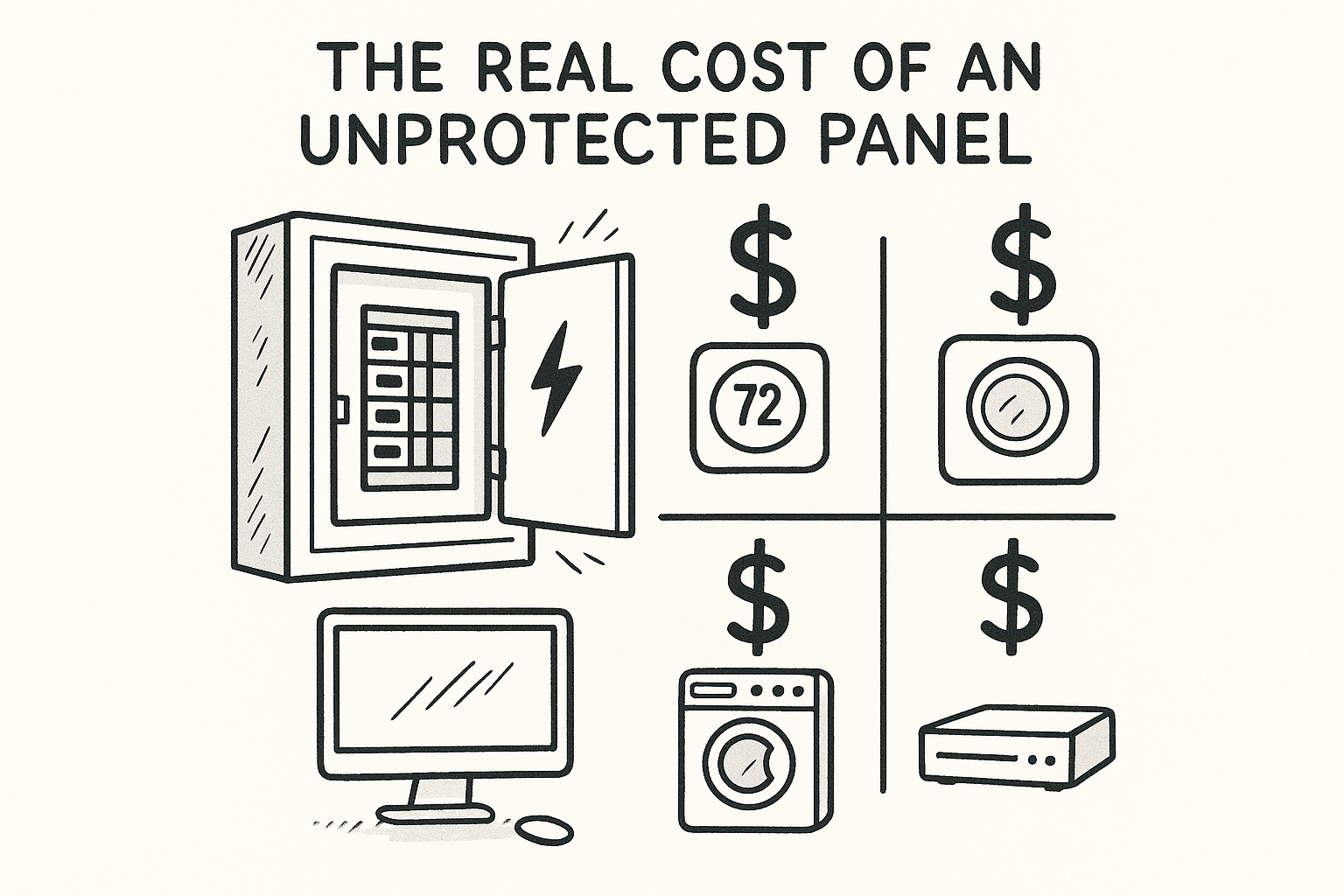
| Damaged component | Typical replacement cost |
|---|---|
| HVAC control board | $400 to $1,200 |
| Refrigerator control board | $200 to $600 |
| Washer/dryer electronics | $150 to $500 |
| Smart thermostat or security panel | $150 to $400 |
| Whole-house surge protector install | $300 to $600 |
Once you line those numbers up, the math is obvious. A single AC control board failure can cost more than the surge protector that would have prevented it.
Why Arizona homes face extra risk
Desert wiring conditions make Phoenix homes more vulnerable than the national average. Extreme summer heat stresses insulation and connections inside your panel, and the region’s older housing stock, especially homes built before the 2000s in Scottsdale, Tempe, and Mesa, often carries panels that were never designed with today’s load of smart devices, EV chargers, and home electronics in mind. Add in frequent lightning activity tracked by NOAA during monsoon months, and you’ve got a combination that puts more strain on a typical Phoenix panel than you’d see in a milder climate.
Utility-side surges are another factor homeowners overlook. Grid switching, downed lines during dust storms, and transformer issues on APS or SRP equipment can all send irregular voltage into your home, even on a clear day. A whole-house unit reacts in nanoseconds, diverting that excess voltage to the ground before it reaches your outlets and appliances.
What’s actually at stake beyond appliances
Beyond appliance repair bills, think about what’s connected to your electrical system that you can’t easily replace. Home security systems, medical equipment, server backups, and irreplaceable data on desktop computers all sit exposed without panel-level protection. If you’re already invested in smart home tech, an EV charger, or a home office setup, a single bad surge can wipe out thousands of dollars in equipment in one storm. That’s the real argument for installation: it’s cheaper to prevent the damage than to keep replacing what the desert electrical grid keeps breaking.
Step 1. Assess your home’s surge protection needs
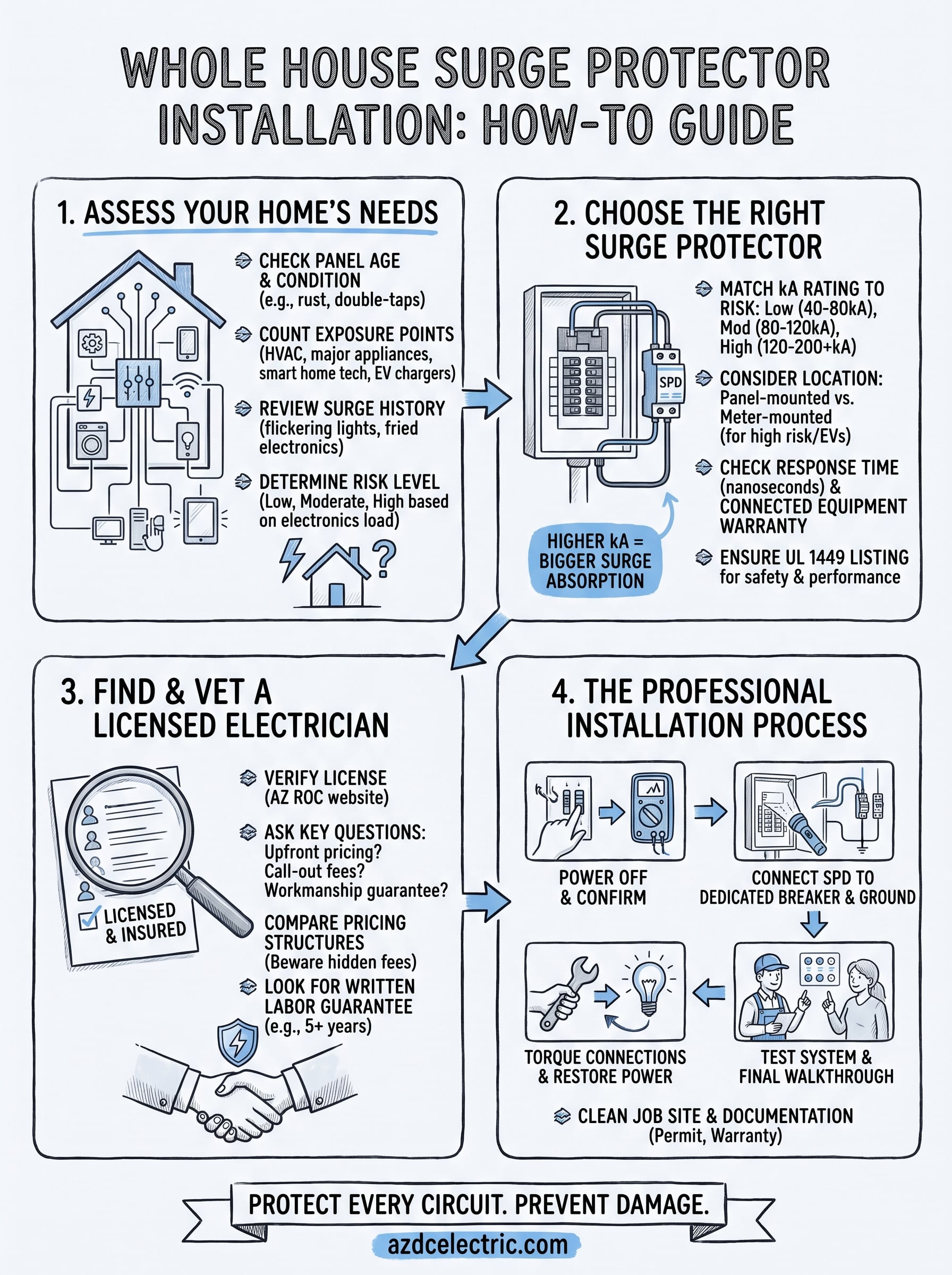
Before you call anyone for whole house surge protector installation near me, take a walk through your own house first. Check your electrical panel’s age, count how many high-value electronics you’re running, and think back on any flickering lights or tripped breakers you’ve brushed off in the last year. Every one of those details changes what kind of protection your home actually needs and helps you avoid paying for more, or less, than you should.
Look at your panel’s age and condition
Open your panel cover (or have your electrician do it if you’re not comfortable) and check the manufacturer’s label for an install date. Panels older than 20 years, especially Federal Pacific or Zinsco brands common in older Scottsdale and Tempe homes, often lack the busbar space or grounding setup needed for a clean surge protector install. If your panel already looks rusted, scorched, or overloaded with double-tapped breakers, you’re looking at a panel upgrade conversation alongside the surge protector, not instead of it.
Count your exposure points
Walk through your house room by room and tally what’s actually at risk. Your list probably includes more than you think:
- HVAC system and any smart thermostats
- Refrigerator, washer, dryer, and other major appliances
- Home security system and cameras
- EV charger or planned EV charger installation
- Pool or spa equipment
- Home office electronics, servers, or medical devices
The more connected devices your home runs, the more a single surge can cost you, and the more sense a whole-house unit makes.
Review your surge history
Think back on the last few years. Have you lost a garage door opener, a microwave, or a modem after a storm? Those small failures are often early warning signs that your panel has already absorbed surges it couldn’t fully block. Homeowners in Mesa, Chandler, and Gilbert frequently report a pattern of "random" electronics dying every monsoon season, which is a strong signal that surge exposure, not bad luck, is the real cause.
Match your risk level to your next move
Once you’ve gathered these details, you’ll fall into one of three categories: low-risk homes with newer panels and few electronics, moderate-risk homes with some smart devices and an aging panel, or high-risk homes with EV chargers, pools, and older wiring all in the mix. That assessment sets up everything in the next step, because the surge protector you need depends entirely on how much load and exposure your home actually carries.
Step 2. Choose the right whole-house surge protector
Once you know your risk level, you’re ready to compare actual products instead of guessing. Whole-house surge protectors aren’t one-size-fits-all, and the specs on the box tell you almost everything you need to know before an electrician even shows up. Two numbers matter more than the rest: surge current rating, measured in kiloamps (kA), and response time, measured in nanoseconds. A higher kA rating means the device can absorb a bigger surge before it fails, and a faster response time means less voltage reaches your outlets before the unit kicks in.
Match the rating to your risk category
Low-risk homes with newer panels and fewer electronics can usually get by with a mid-range unit. Moderate and high-risk homes, especially anything with an EV charger, pool equipment, or a home office full of gear, need a unit built for repeated surges over years of monsoon seasons.
| Home risk level | Recommended kA rating | Typical install location |
|---|---|---|
| Low (newer panel, few electronics) | 40 to 80 kA | Panel-mounted |
| Moderate (some smart devices, aging panel) | 80 to 120 kA | Panel-mounted |
| High (EV charger, pool, home office, older wiring) | 120 to 200+ kA | Panel-mounted or meter-mounted |
Buy for your worst monsoon season, not your average one, because that’s the surge your protector actually has to survive.
Panel-mounted versus meter-mounted units
Most Phoenix homes end up with a panel-mounted surge protector, which wires directly into your breaker panel and sits close to the circuits it protects. Meter-mounted or meter-collar units install at the utility meter itself, catching surges before they even reach your panel. Meter-mounted units cost more upfront but make sense for high-risk homes or anyone running an EV charger and pool equipment off the same service. Either option needs a dedicated breaker space, so factor that into your panel assessment from Step 1.
Check the warranty terms, not just the price
Cheap surge protectors without a real manufacturer warranty aren’t worth installing. Look for a device backed by a connected equipment warranty, sometimes covering $25,000 to $50,000 in damage if the unit fails to stop a surge. Compare that warranty language across brands before you decide, because a low sticker price on the device itself often means a weaker warranty and a shorter service life once Arizona heat starts stressing the internal components.
Don’t skip the UL listing
Any unit you consider should carry a UL 1449 listing, which confirms it’s been tested against the voltage protection ratings the industry actually relies on. Skip anything that doesn’t list this certification clearly on the packaging or spec sheet, no matter how good the price looks.
Step 3. Find and vet a licensed local electrician
Once you know what device fits your home, the next job is finding someone qualified to install it safely at your panel. This isn’t a DIY project. Working inside a live panel means handling the main service conductors, and a mistake here can cause a fire or void your homeowner’s insurance. Searching whole house surge protector installation near me gets you a list of names, but the real work starts once you begin narrowing that list down.
Confirm the license before you confirm the quote
Every electrician working in Arizona needs a license through the Arizona Registrar of Contractors, and you can verify that license number on the ROC website in under a minute. Don’t take a company’s word for it. Pull up their license status yourself and check for any complaint history or disciplinary action tied to that number.
A five-minute license check on the ROC website tells you more about a contractor than any five-star review ever will.
Ask the right questions before you book
A quick phone call should tell you most of what you need to know. Run through this checklist with any electrician you’re considering:
- Are you licensed, bonded, and insured in Arizona?
- Do you carry the surge protector brand and kA rating I need?
- Is the quote a flat, upfront price, or will I get a final bill after the work is done?
- Do you charge a call-out or dispatch fee just to show up?
- What’s the warranty on your workmanship, separate from the manufacturer’s warranty on the device?
- Can you show me a recent panel install you’ve completed in my area?
Compare pricing structures, not just totals
Some companies quote a low number upfront, then tack on fees for permits, disposal, or "panel access" once they’re on site. Others give you a single number that covers everything. AZ DC Electric works on an upfront pricing model, so the number you get before the job starts is the number you pay, with no dispatch fee tacked on across most of the Phoenix valley.
Weigh the warranty as heavily as the price
A cheap install with no workmanship guarantee isn’t actually cheap if the connection fails in two years and you’re paying for a second visit. Look for a company backing its labor with a real guarantee, ideally five years or longer, and confirm in writing what that guarantee covers before anyone opens your panel.
Step 4. What happens during professional installation
Once you’ve picked a device and hired a licensed electrician, the actual install moves faster than most homeowners expect. A panel-mounted surge protector typically takes 30 to 60 minutes once your electrician is on site, though a meter-mounted unit or a job that uncovers panel issues can stretch into a few hours. Knowing the sequence ahead of time helps you spot a rushed job versus a thorough one.
The step-by-step process
A proper installation follows a consistent pattern no matter which brand of surge protector you’ve chosen:
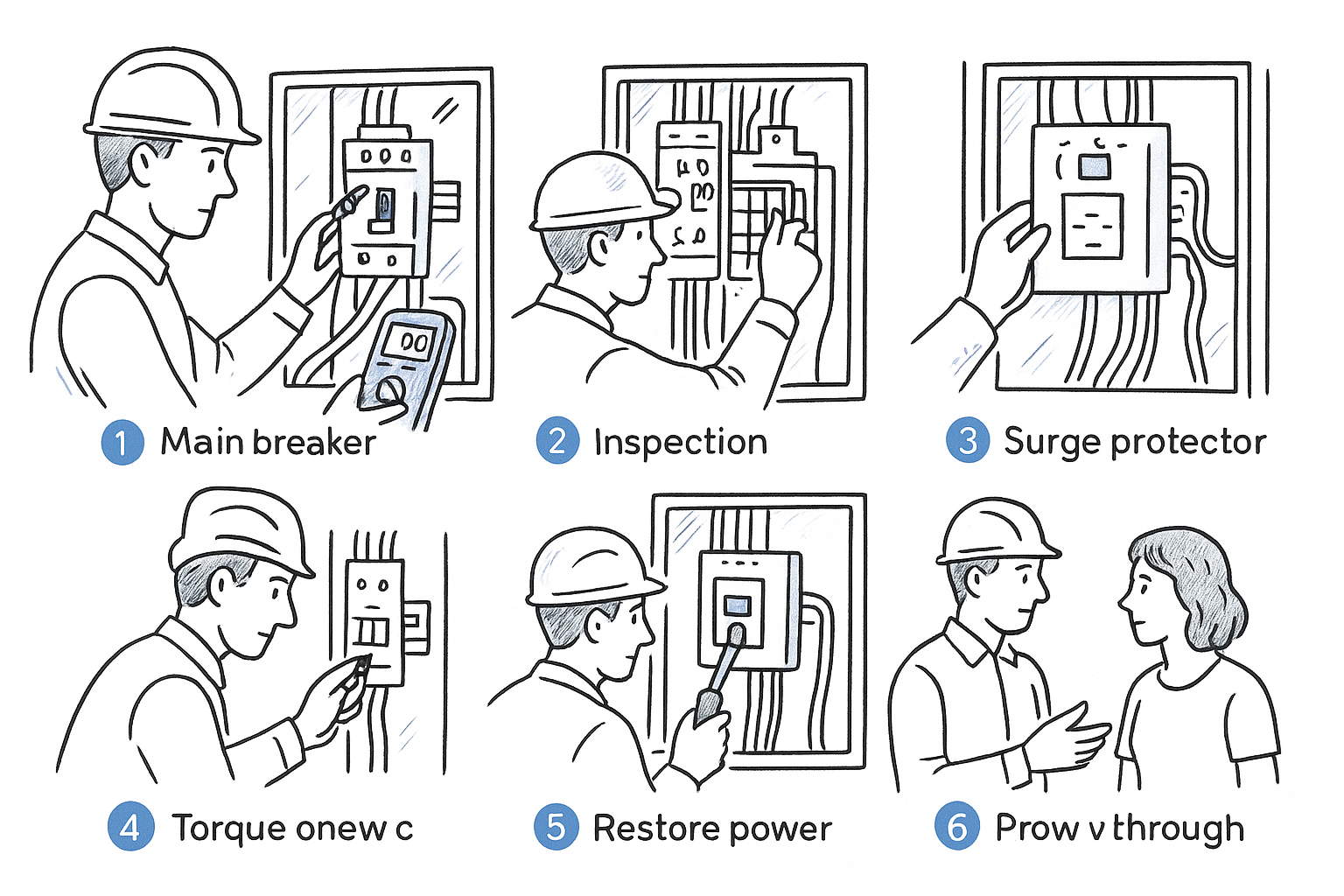
- Your electrician shuts off the main breaker and confirms zero voltage with a meter before touching anything inside the panel.
- They inspect the busbar and existing breakers for corrosion, double-tapping, or outdated wiring that could complicate the install.
- The surge protector connects to a dedicated breaker slot, with leads run to the panel’s bus and a solid ground connection.
- They torque every connection to the manufacturer’s spec, since a loose lead is the most common cause of early surge protector failure.
- Power gets restored, and the electrician tests the unit’s status light or indicator to confirm it’s actively monitoring your circuits.
- They walk you through what the indicator lights mean and how to tell if the unit has absorbed a major surge and needs replacement.
A rushed installer skips the torque check and the ground connection test, and that’s exactly where most surge protector failures start.
What a thorough electrician checks before leaving
A good electrician doesn’t just wire in the device and pack up. They’ll check for open breaker slots with enough room for the unit, confirm your panel’s grounding rod and connections meet current code, and test that the main breaker still trips correctly after the work is done. If your panel shows signs of overloading or outdated wiring during this process, expect them to flag it rather than just install around the problem.
Cleanup and paperwork you should expect
Before your electrician leaves, you should get a few things beyond a working surge protector. Ask for a copy of the permit if one was pulled, a written warranty document covering the labor, and a walkthrough of what the device does when it takes a hit. AZ DC Electric backs its installs with a five-year workmanship guarantee and guarantees a clean job site when the work wraps up, so you’re not left sweeping up wire scraps or wondering what was actually done inside your panel.
Keeping your home protected for years to come
A whole-house surge protector isn’t a luxury upgrade in Phoenix, it’s basic insurance against a grid that throws lightning strikes and utility spikes at your panel every monsoon season. You’ve now got the full picture: assess your risk, pick a unit with the right kA rating, vet a licensed electrician, and confirm the installation follows every safety step before power gets restored. Skip any of those steps and you’re gambling with equipment that costs far more to replace than the protector does to install.
Don’t wait for a fried AC board or a dead refrigerator to force the issue. If you’re ready to stop searching and start protecting every circuit in your home, schedule your surge protector installation with AZ DC Electric and get an upfront quote, a licensed electrician, and a five-year workmanship guarantee behind the work.