Figuring out what size electrical panel do I need is one of the most common questions we hear from homeowners across the Phoenix Metro Area. It makes sense, your electrical panel is the backbone of your home’s entire electrical system, and choosing the wrong size means either paying for capacity you’ll never use or, worse, running out of power when you need it most. With today’s homes pulling more electricity than ever through EV chargers, smart appliances, pool equipment, and HVAC systems working overtime in Arizona heat, the answer isn’t always straightforward.
At AZ DC Electric, we’ve installed and upgraded hundreds of electrical panels across Scottsdale, Mesa, Chandler, and the surrounding valley. That hands-on experience has shown us that the right panel size depends on a few specific factors, not guesswork. In this guide, we’ll walk you through the differences between 100, 200, and 400 amp panels, help you calculate your home’s actual electrical load, and explain when it’s time to upgrade.
What panel size means and why it matters
Your electrical panel controls how much electricity flows into your home at any given time. The size, measured in amps (A), represents the maximum current your panel can safely handle before breakers trip. Think of it like a water main: a wider pipe delivers more flow, and a narrower one limits what can run at once. When you’re figuring out what size electrical panel do I need, you’re essentially asking how much total electrical capacity your home requires now and in the near future.
How amps, watts, and your home connect
Amps and watts work together to measure power. Voltage in a standard US home runs at 120V or 240V, and the relationship is straightforward: Watts = Volts x Amps. A 200A panel at 240V can supply up to 48,000 watts of total capacity, though you never draw all of it at once. Here’s how common household loads compare:
| Appliance | Typical Draw |
|---|---|
| Central AC (3-ton) | 3,500W |
| Electric range | 8,000-12,000W |
| Level 2 EV charger | 7,200W |
| Electric water heater | 4,500W |
| Electric washer + dryer | 5,000W |
Size your panel so peak load never exceeds 80% of total capacity, which keeps breakers stable and leaves room for future circuits.
What happens when your panel is undersized
An undersized panel creates problems you’ll notice quickly. Breakers trip under normal use, lights flicker when large appliances start up, and you have no capacity to add new circuits for upgrades. In older Phoenix-area homes still running 60A or 100A panels, these symptoms become common once residents add pool equipment, heat pumps, or EV chargers.
Warning signs your panel may be too small:
- Frequent breaker trips during normal household activity
- Lights flickering when the AC or dryer starts
- No open breaker slots for new circuits
- Panel feels warm to the touch
Step 1. Find your current panel and service size
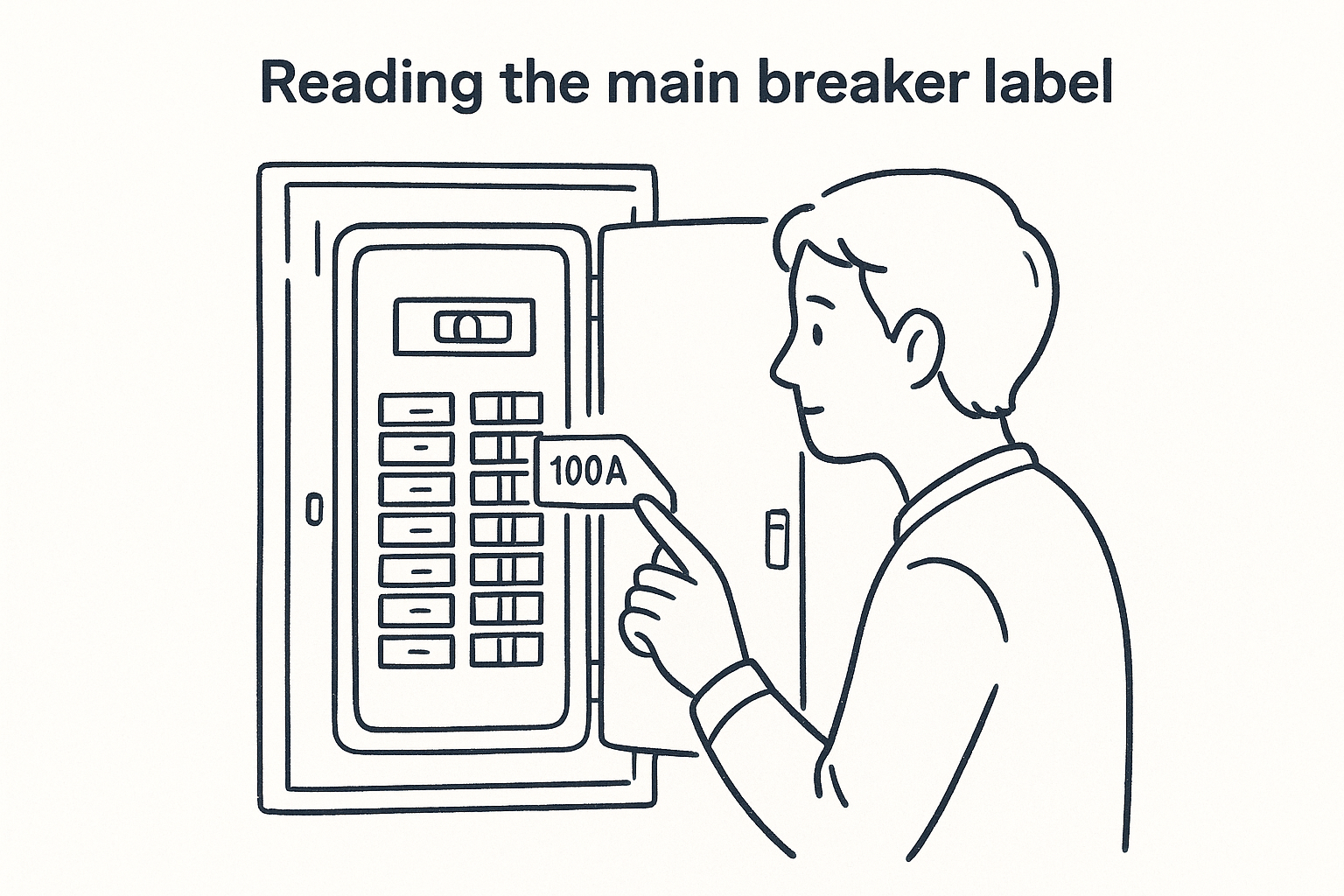
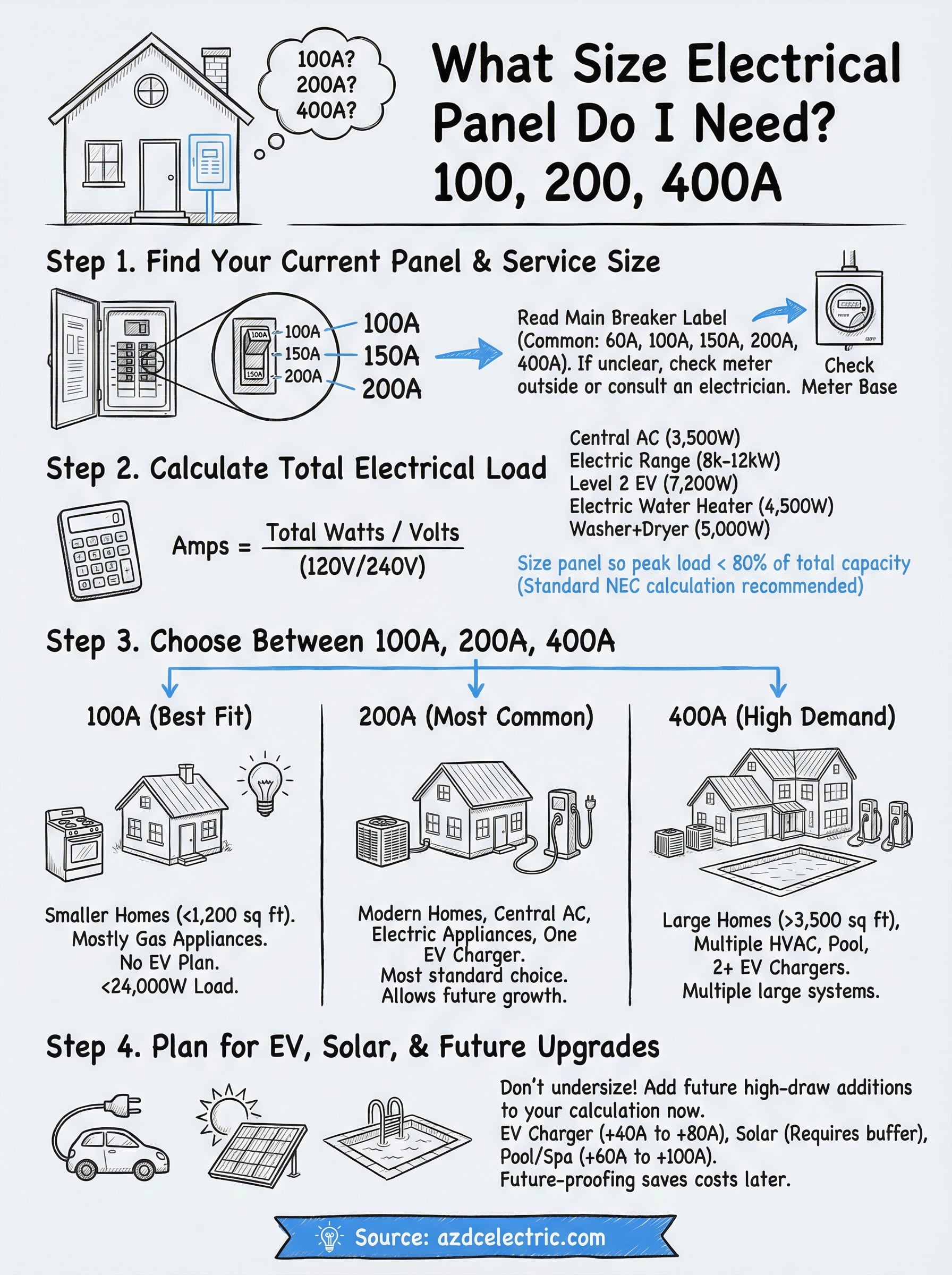
Your first task is locating your electrical panel, also called a breaker box or load center. In most Phoenix-area homes, you’ll find it in the garage, a utility closet, or mounted on an exterior wall. Open the door and look at the main breaker at the top. That single large breaker controls the total amperage flowing into your home and is the fastest way to determine your current service size.
Reading the main breaker label
The number stamped on your main breaker handle tells you your current service size. Common values are 60, 100, 150, 200, or 400 amps. If the label is worn or missing, check the inside door of the panel for a printed specification sheet. You can also check your meter base outside, where a utility sticker often lists the service rating.
If you cannot identify your service size from the panel or meter, contact a licensed electrician before making any upgrade decisions.
What to note before moving forward
Before going to the next step, write down these details so you have them ready. Having accurate data now prevents guesswork later and helps any electrician give you a precise recommendation faster.
- Main breaker amperage (for example, 100A or 200A)
- Number of open breaker slots available
- Any double-tapped breakers or visible damage
This baseline is what you’ll build on when determining what size electrical panel do I need for your specific home.
Step 2. Add up your electrical loads the right way
After identifying your current panel, you need to calculate your home’s total electrical load before deciding on a new panel size. This calculation tells you the actual demand your home places on the system, which is the most reliable way to answer what size electrical panel do I need for your specific situation.
Use the standard load calculation method
The National Electrical Code (NEC) provides a standard load calculation method that licensed electricians use on every panel job. You work through each load category, convert everything to watts, then divide your total by your voltage to get the required amperage. Here’s a simplified version you can run at home:
| Load Category | How to Calculate |
|---|---|
| General lighting | Square footage x 3 watts |
| Small appliance circuits | 2 circuits x 1,500W each |
| Laundry circuit | 1 circuit x 1,500W |
| Fixed appliances | Nameplate wattage for each |
| HVAC | Largest unit’s nameplate rating |
Add all wattage totals together, then apply a demand factor of 40% to everything over 10,000 watts. Divide the adjusted total by 240V to get your minimum required amperage.
Running this calculation before calling an electrician saves time and gives you a concrete starting point for your upgrade conversation.
Step 3. Choose between 100A, 200A, and 400A
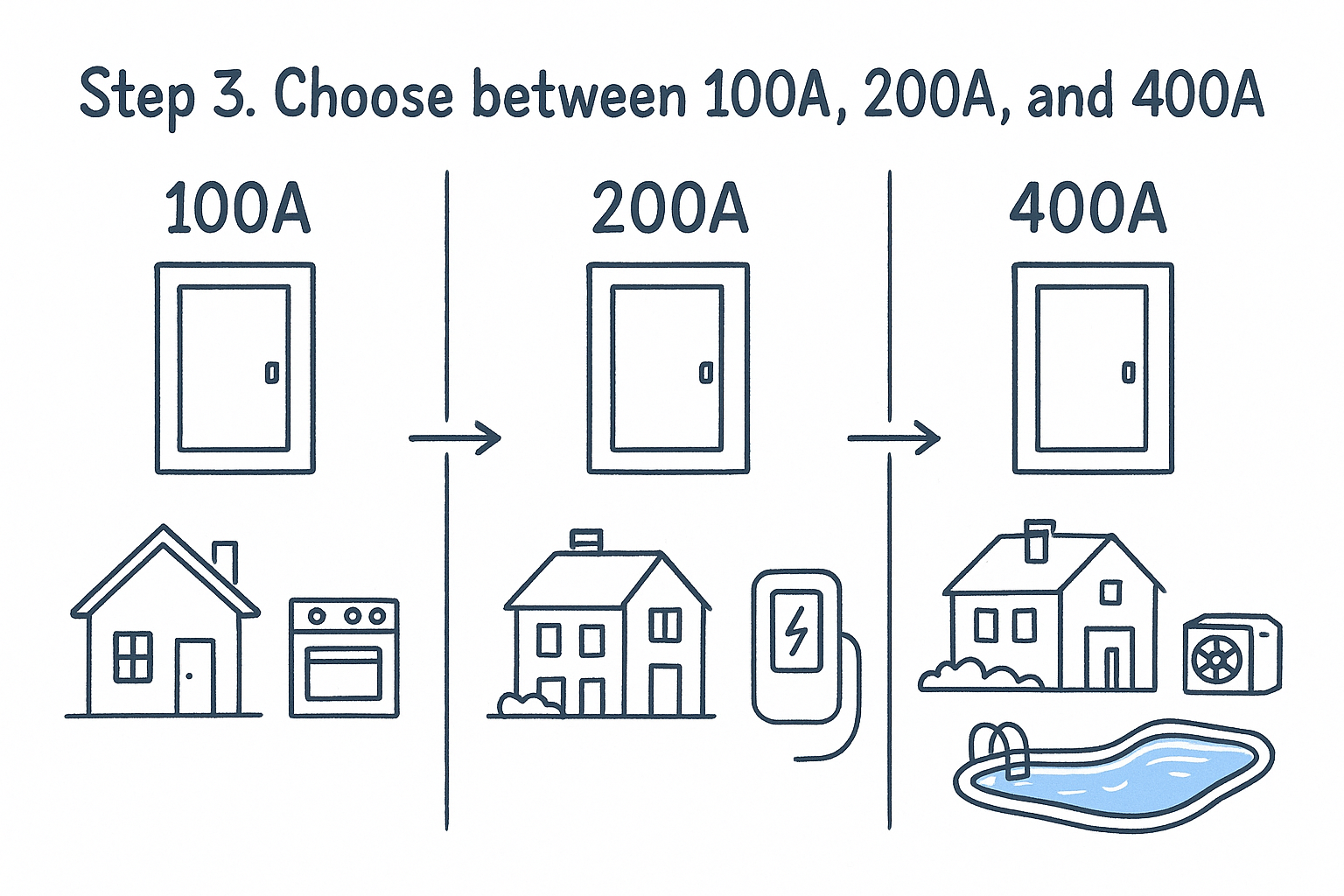
Once you have your load calculation in hand, matching that number to the right panel size is straightforward. Use the table below as a starting point, then confirm your choice with the specific guidance under each option.
| Panel Size | Best Fit |
|---|---|
| 100A | Homes under 1,200 sq ft, mostly gas appliances |
| 200A | Most modern homes, EV charger, full electric kitchen |
| 400A | Large homes over 3,500 sq ft, multiple high-draw systems |
When a 100A panel works
A 100-amp panel fits smaller homes under 1,200 square feet that rely on gas appliances for heating, cooking, and water heating. If your load calculation stays below 24,000 watts and you have no plans for an EV charger or major electric upgrades, 100A covers your current needs without overspending on capacity.
When 200A is the right choice
200 amps is the standard answer for most people asking what size electrical panel do I need. Your load calculation will land here if you run central AC, electric appliances, and at least one EV charger. A 200A panel also gives you enough open slots to add circuits without replacing the panel again in five years.
If your load calculation falls between 100A and 200A, always choose 200A to build in room for future upgrades.
When 400A is necessary
A 400-amp service makes sense for homes over 3,500 square feet running multiple large systems simultaneously, such as two HVAC units, a pool, and two EV chargers. Two 200A sub-panels fed from a single 400A service is a standard setup in larger new Phoenix-area builds and covers virtually any future load you add.
Step 4. Plan for EV chargers, solar, and big upgrades
Future upgrades are the most common reason homeowners undersize their panel and end up paying for a second upgrade just a few years later. Before you finalize what size electrical panel do I need for your home, account for every high-draw addition you plan to add in the next five to ten years.
EV chargers and solar panels change your load math
A Level 2 EV charger draws around 7,200 watts on a dedicated 240V, 40A circuit. Adding two chargers to a fully loaded 200A panel can push you into 400A territory faster than most homeowners expect. Solar inverters also add complexity because they feed power back through your panel, and most solar installations require a separate interconnection breaker that takes up panel slots.
Use this checklist before finalizing your panel size:
- One Level 2 EV charger: add 40A to your load calculation
- Two EV chargers: add 80A to your load calculation
- Solar with battery backup: verify inverter amperage and add a 20 to 30% buffer on top
- Future pool or spa: budget 60 to 100A depending on equipment
If you plan to add solar or two EV chargers within five years, jump to 200A or 400A now rather than upgrading twice.
Future-proofing your panel decision
Upgrading your panel once is far cheaper than scheduling a second replacement in three years. Choosing one size larger than your current calculation requires costs a fraction of the full labor and permitting fees you would pay on a repeat job.
Next steps
You now have a clear framework for answering what size electrical panel do I need for your home. Start by reading your main breaker, run the NEC load calculation from Step 2, and match your number against the 100A, 200A, and 400A guidelines in Step 3. If you plan to add an EV charger or solar within the next few years, build that load into your decision now rather than paying for a second upgrade later.
Most Phoenix-area homeowners land on 200A as the right choice, but your specific load calculation and future plans are what actually drive the answer. Once you have those numbers, the next move is getting a licensed electrician to confirm the calculation, pull the proper permits, and complete the installation to code. AZ DC Electric serves the entire Greater Phoenix Metro Area with upfront pricing and a 5-year workmanship guarantee. Schedule your panel upgrade consultation and get a firm quote before any work begins.