Every light switch you flip, every appliance you plug in, and every outlet in your home connects back to one critical piece of equipment: your electrical panel. So what is an electrical panel, exactly? It’s the metal box, usually mounted in a garage, utility room, or basement, that receives power from your utility company and distributes it through individual circuits to every room in your building. Think of it as the control center for your entire electrical system.
Most homeowners don’t give their panel a second thought until something goes wrong, a breaker keeps tripping, lights flicker without explanation, or a home inspector flags the panel during a sale. That’s when understanding how your panel works, what’s inside it, and when it needs attention becomes more than just trivia. It becomes a matter of safety and function. Outdated or overloaded panels are one of the leading causes of residential electrical fires, and knowing the basics can help you spot warning signs early.
At AZ DC Electric, we handle electrical panel upgrades, replacements, and troubleshooting across the Greater Phoenix Metro Area every day. We’ve written this guide to give you a clear, practical understanding of your panel, its parts, its purpose, and the safety considerations that come with it. Whether you’re a homeowner curious about that gray box on the wall or you’re weighing a panel upgrade, this article covers what you need to know before making any decisions.
Why electrical panels matter for safety and power
Your electrical panel does more than just hold breakers. It serves as the central safety mechanism between the raw power coming from your utility line and the wiring that runs through your walls. When you understand what is an electrical panel and what it actually does, you start to see it less as a passive junction box and more as an active protection system that keeps your home from overloading, arcing, or catching fire. Without it functioning correctly, every circuit in your home is at risk.
Your panel protects your home from overcurrent
The most critical job your panel performs is cutting off power when something goes wrong. Each circuit breaker inside the panel is designed to trip automatically when the electrical current on a circuit exceeds a safe threshold for that wire. That trip is intentional. It stops the wire from carrying more current than it was built to handle, which prevents the wire from overheating inside your wall. A wire that overheats doesn’t always produce visible flames right away. It can smolder inside insulation for hours before igniting surrounding material.
An overloaded circuit that doesn’t trip is far more dangerous than one that trips frequently, because it means the protection mechanism itself has failed.
Older homes with outdated fuse-based panels face this risk more directly. Fuses work on the same overcurrent principle as breakers, but once a fuse blows, it must be replaced rather than simply reset. Homeowners in older homes sometimes swap blown fuses for ones rated higher than the wiring can support, thinking it stops the nuisance. It does stop the tripping. But it also eliminates the safety protection the fuse was providing, leaving the wire exposed to sustained overcurrent with no shutoff.
Your panel controls how power reaches every room
Every circuit in your home originates at the panel. The panel takes the large incoming feed from your utility provider and splits it into individual circuits, each protected by its own breaker. This is how your kitchen can run a refrigerator, microwave, and dishwasher without those appliances sharing a single wire throughout the entire house. Dedicated circuits, like those required for electric dryers, HVAC systems, and EV chargers, carry their own breaker specifically sized for the load that device draws.
When your electrical needs grow, whether from a home addition, a new high-draw appliance, or adding a home EV charging station, the panel has to have enough capacity to support that additional load. A panel rated for 100 amps may have been sufficient for a home built in the 1970s, but modern households routinely pull more than that through daily use alone. Panels that can’t keep up don’t just trip breakers repeatedly. They can run hot, degrade over time, and create fire risks that aren’t obvious until the damage is already done.
Why panel age and condition matter
Not all panels age equally. Some brands and models have documented histories of failure. The Federal Pacific Electric Stab-Lok panel, common in homes built between the 1950s and 1980s, has been widely associated with breakers that fail to trip under overload conditions. Zinsco panels, another common mid-century brand, carry similar documented concerns. If your home has one of these panels, it doesn’t automatically mean immediate danger. But it does mean you should schedule an inspection with a licensed electrician to evaluate the actual condition and risk level before assuming your protection is intact.
What’s inside an electrical panel: parts and types
To fully grasp what is an electrical panel, you need to know what’s physically inside it. Opening the door reveals a structured layout of electrical components, each serving a specific role in routing and protecting power through your home. Understanding these parts helps you communicate clearly with an electrician and recognize when something looks out of place.
The main components of your panel
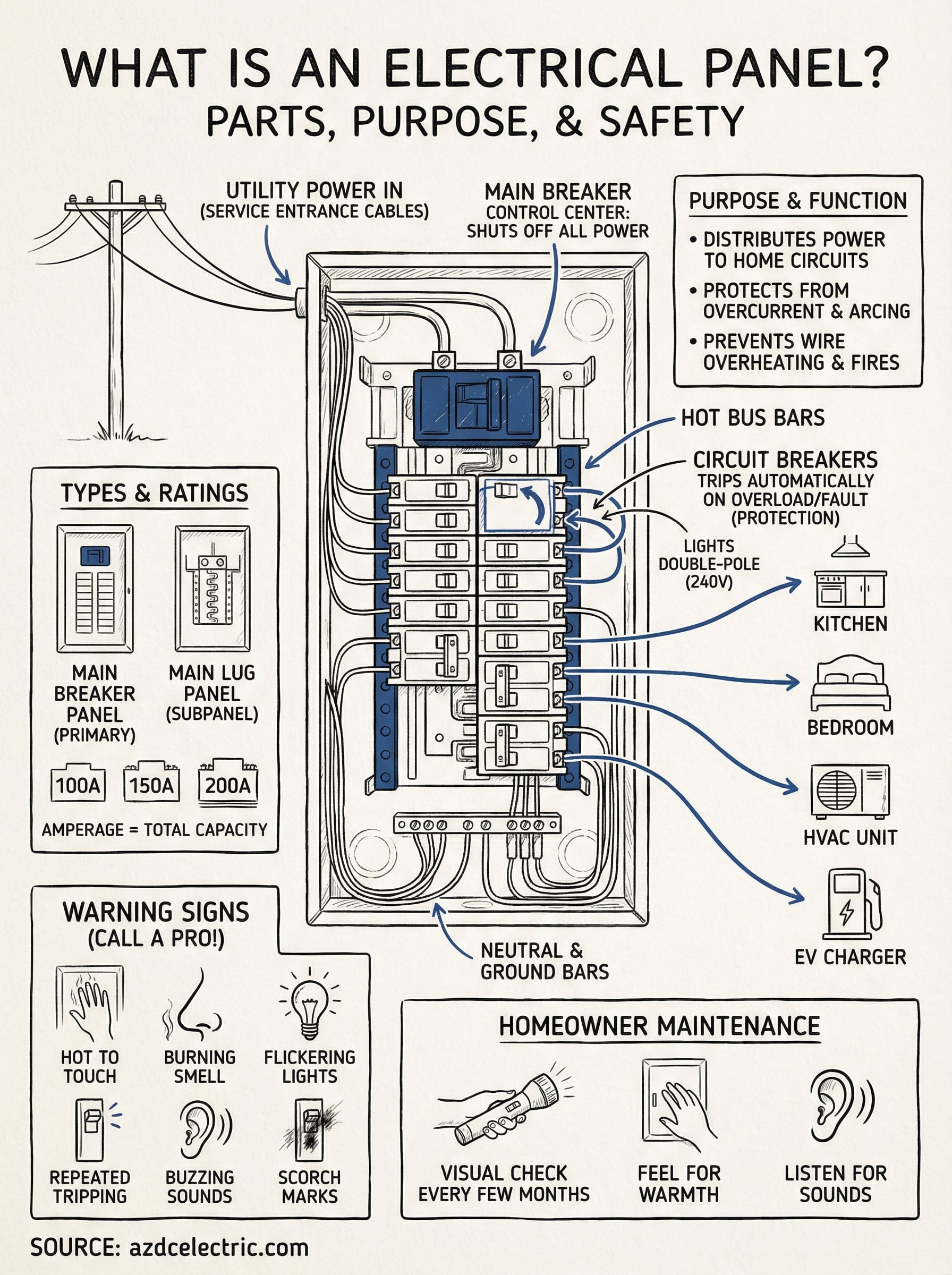
The main breaker sits at the top of most panels and controls the flow of power to every circuit below it. It connects directly to the service entrance wires coming in from your utility provider and lets you shut off all power to the panel in a single switch. Below it, the hot bus bars run down both sides of the panel, carrying voltage from the main breaker to each individual circuit breaker. Neutral and ground wires terminate on separate bars at the bottom or sides of the panel, completing each circuit safely.

Circuit breakers are the components most homeowners interact with most often. Each breaker clips onto a bus bar and supplies power to a single circuit, whether that’s a bedroom, a bathroom, or a dedicated appliance. Double-pole breakers take up two slots and serve higher-voltage circuits like dryers, water heaters, and EV chargers, while single-pole breakers cover standard 120-volt circuits throughout the rest of the home.
Arc fault circuit interrupter (AFCI) and ground fault circuit interrupter (GFCI) breakers are specialized types that add another layer of protection beyond basic overcurrent interruption.
Panel types and what they mean for your home
Residential panels fall into two main categories: main breaker panels and main lug panels. A main breaker panel includes its own shutoff breaker, making it the primary service panel for most homes. A main lug panel does not have a built-in main breaker, so it relies on an upstream disconnect, which typically means it functions as a subpanel fed from a larger main panel elsewhere in the building.
Panels also come in different amperage ratings, most commonly 100-amp, 150-amp, and 200-amp configurations. Your panel’s amp rating determines the total load your home’s electrical system can safely handle at one time, which is why upgrading from a 100-amp to a 200-amp panel often becomes necessary when you add significant electrical loads like EV chargers or solar systems.
How an electrical panel works in a home
Understanding what is an electrical panel requires looking at the process from start to finish. Power enters your home from the utility company through service entrance cables that connect directly to your panel’s main breaker. From there, the panel takes that single large feed and divides it into individual circuits, each one routed through its own breaker to a specific area or device in your home. The panel doesn’t generate power. It receives, divides, and controls it.
Power flows from the utility to your circuits
Your utility provider sends electricity to your home at a specific voltage and amperage, typically 240 volts delivered as two 120-volt legs. Both legs enter the panel and connect to the hot bus bars running down each side. Single-pole breakers tap into one leg and supply 120-volt circuits for standard outlets, lights, and small appliances. Double-pole breakers bridge both legs to supply 240-volt circuits for large appliances like your dryer, HVAC unit, or EV charger.
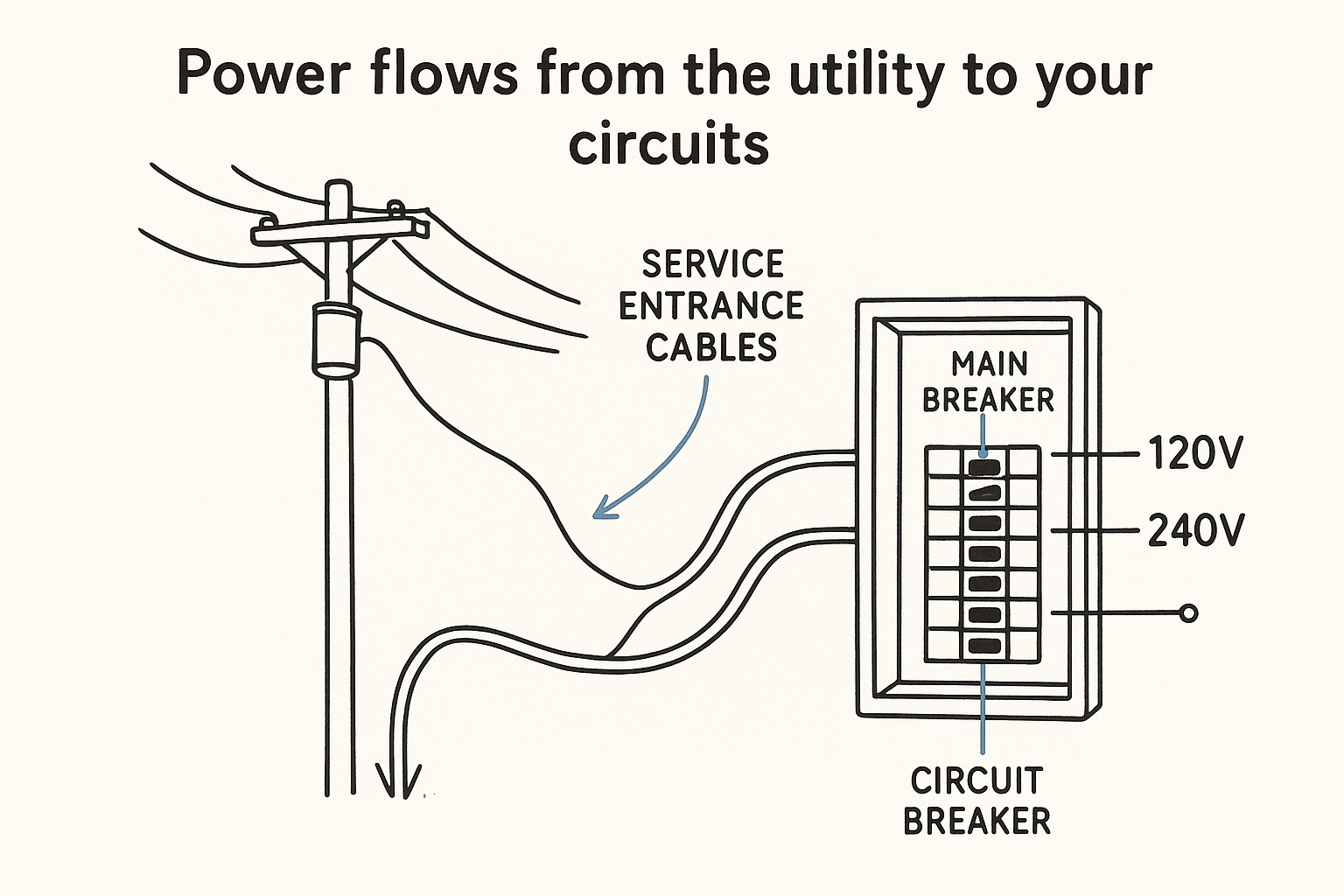
When you turn on a light switch or plug in a device, you’re completing a circuit that runs from the panel, through the hot wire, through the device, and back to the panel through the neutral wire. That return path keeps current flowing in a controlled loop. The ground wire runs alongside these conductors as a safety path for fault current, directing stray electricity away from metal surfaces and back to the panel where a breaker can trip if needed.
How your panel responds when something goes wrong
Each breaker monitors the current flowing through its circuit in real time. When that current exceeds the breaker’s rated capacity, the internal mechanism heats up and triggers a trip, opening the circuit and stopping the flow of electricity. This response is designed to happen faster than the wiring can sustain heat damage. Modern panels use thermally activated mechanisms in each breaker, which means the protection scales with actual electrical conditions rather than relying on an external device or fixed timer.
A breaker that trips and won’t reset after cooling down is telling you that an underlying problem still exists on that circuit, not that the breaker itself is defective.
If a wire develops a fault or makes unintended contact with a ground, a correctly functioning panel isolates that circuit immediately, preventing the fault from spreading to other circuits or causing deeper damage in your wiring. Your panel is, in that sense, the last line of defense between a minor wiring issue and a serious electrical hazard inside your walls.
Breaker box vs electrical panel: terms and differences
If you’ve heard both "breaker box" and "electrical panel" and wondered whether they refer to different things, the short answer is: they don’t. Both terms describe the same piece of equipment, the metal enclosure that receives power from your utility and distributes it through breakers to circuits throughout your home. The terms are used interchangeably in everyday conversation, by homeowners, contractors, and even some electricians. Understanding what is an electrical panel means recognizing that the name on the label doesn’t change how the device actually functions.
Why two names exist for the same equipment
The terminology split comes down to what part of the equipment people focus on. "Electrical panel" or "service panel" tends to describe the whole system, including the enclosure, the bus bars, the wiring, and the breakers together as a unit. "Breaker box" puts attention on the most visible and interactive component inside that enclosure: the row of circuit breakers you flip when a circuit trips. Both names stuck over decades of common use, and neither one is technically wrong.
The term "load center" is another name you’ll see on manufacturer labels for the same equipment, used frequently in product documentation and electrical specifications.
Homeowners and real estate listings sometimes also use "fuse box" when referring to older panels, though this term is more specific. A fuse box uses fuses rather than circuit breakers and represents an older generation of technology that most licensed electricians recommend replacing in modern homes for both safety and capacity reasons.
When the terms actually differ
There is one context where the terms start to carry distinct meanings. A "panel" in professional electrical work can refer to either a main service panel or a subpanel, while "breaker box" almost always describes any enclosure containing breakers regardless of its role in the system. A subpanel is a secondary distribution point fed from your main panel, often installed in a garage, workshop, or home addition to serve a localized area without running individual circuits all the way back to the main panel.
Knowing this distinction helps you communicate more precisely with your electrician, especially if your home has multiple panels or you’re planning to add a subpanel as part of a renovation or EV charger installation.
Common panel problems and warning signs
Knowing what is an electrical panel helps you recognize when yours is starting to fail. Panels don’t usually stop working all at once; they tend to show warning signs over weeks or months before a larger problem develops. Catching those signs early means you can schedule a repair or upgrade on your own timeline rather than dealing with an emergency after something trips permanently or creates a hazard inside your home.
Signs your breakers are failing
A breaker that trips repeatedly on the same circuit is the most common indicator that something needs attention. That said, frequent tripping doesn’t always mean the breaker itself is the problem; it can mean the circuit is overloaded, or that a device on that circuit is drawing more current than expected. A breaker that trips but won’t reset after you’ve removed the load is a clearer sign that the breaker has worn out and needs replacement.
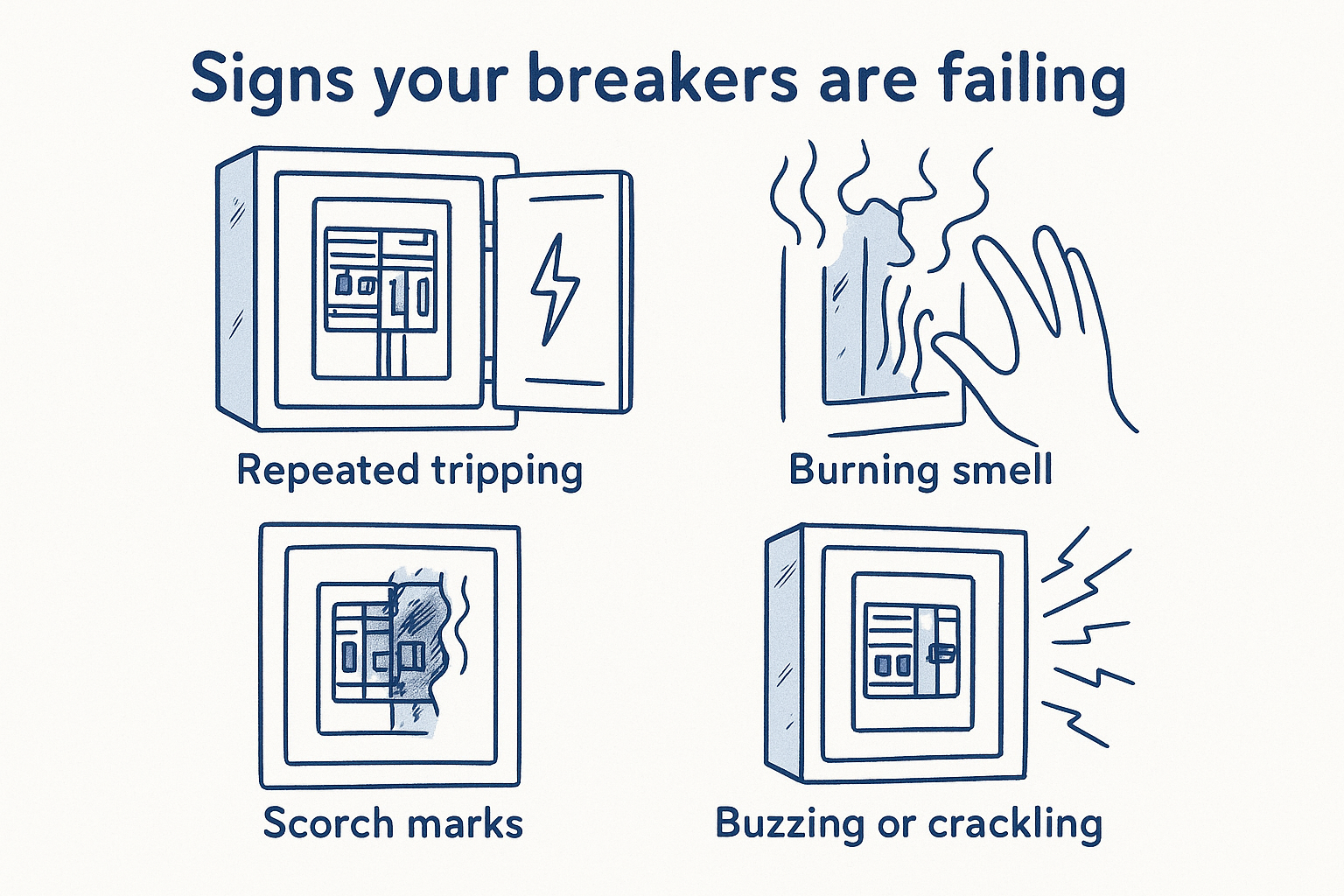
Here are the most common warning signs homeowners notice before a panel fails:
- Breakers that trip repeatedly without an obvious cause
- A burning or hot plastic smell coming from the panel enclosure
- Scorch marks or discoloration around any breaker slot or wiring
- Lights that flicker or dim when you switch on a large appliance
- Buzzing or crackling sounds from inside the panel
- A panel door or enclosure that feels warm to the touch
If you notice a burning smell or visible scorch marks anywhere in or around your panel, treat it as an urgent safety issue and contact a licensed electrician the same day.
Signs your panel is undersized or outdated
Your panel’s amperage rating determines how much total load your home can pull at once. If you’ve added major appliances, a home addition, or an EV charger since the panel was installed, the existing capacity may no longer match your actual demand. Running consistently close to or at that limit causes heat buildup inside the panel over time, which accelerates wear on breakers, bus bars, and wiring connections.
Older panels present a different category of concern. If your panel still uses fuses instead of circuit breakers, or if a home inspection has flagged it as a known problematic brand, those factors alone are strong reasons to have a licensed electrician evaluate whether a full replacement is the right move before a problem forces the decision for you.
Maintenance and safety: what homeowners can do
Once you understand what is an electrical panel and how it protects your home, the next step is knowing what you can realistically do yourself versus what requires a licensed electrician. Most panel maintenance is not a DIY task, but there are straightforward steps you can take as a homeowner to monitor your panel’s condition and prevent small issues from becoming costly repairs.
What you can safely inspect yourself
Start with a visual check of your panel every few months. Open the panel door and look for any scorch marks, discoloration around breaker slots, or corrosion on the inside of the enclosure. You should also check that each breaker sits firmly in its ON position, since a breaker that sits halfway between ON and OFF may not be providing reliable protection to that circuit.
Pay attention to how your panel feels. Run your hand near (but not on) the outside of the enclosure to detect unusual warmth. A panel that feels hot to the touch is a sign that something inside is running under stress, whether from an overloaded circuit, a failing breaker, or loose wiring connections. You can also listen for buzzing or crackling sounds with the door open, which signal arcing or a failing component that needs professional evaluation.
Routine visual checks take less than five minutes and can flag problems before they turn into emergency repairs.
When to call a licensed electrician
Some situations require a professional and should not wait. If you find any of the warning signs described above, or if your panel is more than 25 years old, schedule an inspection with a licensed electrician rather than waiting for a failure. An electrician can test individual breakers under load, check the torque on wire connections, and verify that your panel’s amperage rating still matches your home’s current electrical demand.
Homeowners sometimes delay professional inspections because the panel appears to be working fine. However, many panel failures develop silently over years of gradual wear. If you have recently added an EV charger, a new appliance, or a room addition, that added load is a strong reason to have your panel evaluated sooner rather than later. A licensed electrician can determine whether your existing panel has enough capacity or whether an upgrade is the right move for your home.
Wrap-up and next steps
Understanding what is an electrical panel gives you a clear advantage as a homeowner. Your panel is the core of your home’s electrical system, and knowing its parts, how it works, and what warning signs to watch for puts you in a better position to catch problems early and make informed decisions about repairs or upgrades. A panel that’s outdated, undersized, or showing signs of wear is a safety risk, not just an inconvenience, and acting on those signs before a failure occurs is always the smarter path.
If your panel is aging, struggling to keep up with your current electrical load, or flagged by a recent home inspection, the right next step is a professional evaluation. AZ DC Electric serves homeowners across the Greater Phoenix Metro Area with panel inspections, upgrades, and replacements backed by a 5-year workmanship guarantee. Schedule your electrical panel service today and get answers from a licensed electrician before a small issue becomes a serious one.