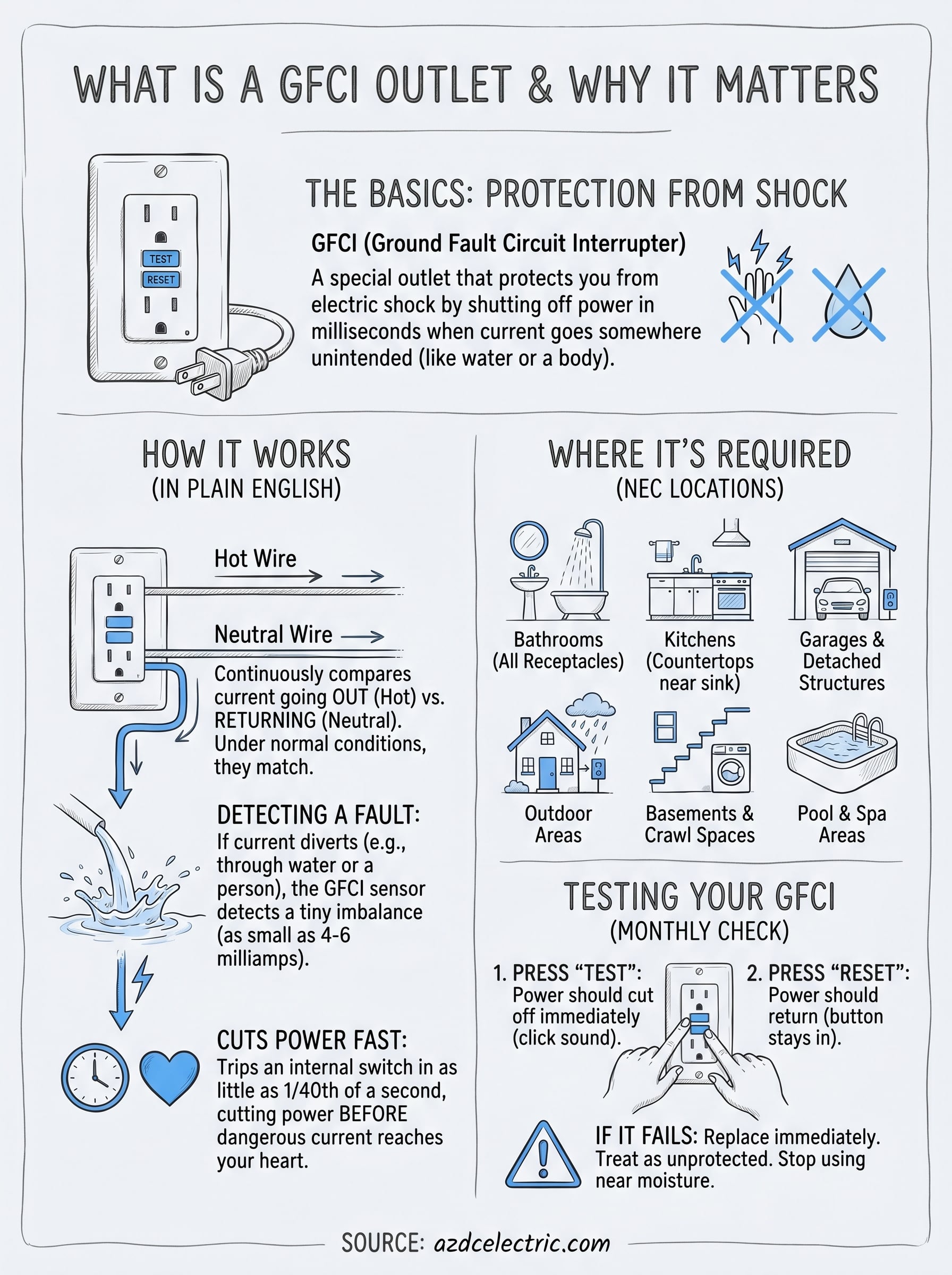
A GFCI outlet, short for Ground Fault Circuit Interrupter, is a special type of electrical outlet designed to protect you from electric shock. It monitors the flow of electricity through a circuit and shuts off power in milliseconds if it detects current traveling along an unintended path, like through water or a person’s body. You’ve probably seen one before: it’s the outlet with the small "Test" and "Reset" buttons, commonly found in kitchens, bathrooms, and garages.
Understanding how GFCI outlets work, where they’re required by code, and why they matter isn’t just useful knowledge, it can prevent serious injuries and house fires. At AZ DC Electric, we install and inspect GFCI outlets across the Greater Phoenix Metro Area daily, and we see firsthand how often homes are missing them in critical locations where water and electricity meet.
This article breaks down exactly what a GFCI outlet does, how it differs from a standard outlet, where current electrical codes require them, and how to tell if yours are working properly.
Why GFCI outlets matter for safety
Electricity and water are a dangerous combination, and homes have plenty of places where the two exist close together. When you ask what is a GFCI outlet and why it appears in specific rooms, the short answer is protection from a real, common hazard. Ground faults occur when electricity finds an unintended path to the ground, and that path is often through a person’s body. Without a GFCI outlet in the right location, a simple mistake like using a plugged-in appliance near standing water can result in a fatal shock.
The real numbers behind electrical accidents
Standard outlets offer no protection against ground faults. They keep delivering power even if you’re completing the circuit with your hand. The U.S. Consumer Product Safety Commission (CPSC) credits widespread GFCI adoption with dramatically reducing electrocution deaths in the home since their code requirements began in the 1970s. Before GFCIs became standard, household electrocutions were far more frequent and often involved completely ordinary situations like shaving or washing dishes.
According to the CPSC, GFCIs could prevent more than two-thirds of the approximately 400 electrocutions that still occur in and around the home each year.
How fast danger can strike
Speed is what makes GFCI outlets genuinely life-saving, and it’s worth understanding why. A standard circuit breaker is designed to protect wiring and property from overloads, not to protect people from shock. It trips only when there’s a large surge of current, far more than your body can tolerate safely. A GFCI outlet reacts in as little as 1/40th of a second, cutting power before a dangerous level of current reaches your heart or lungs. That fraction of a second is the difference between a scare and a life-threatening injury.
How a GFCI outlet works in plain English
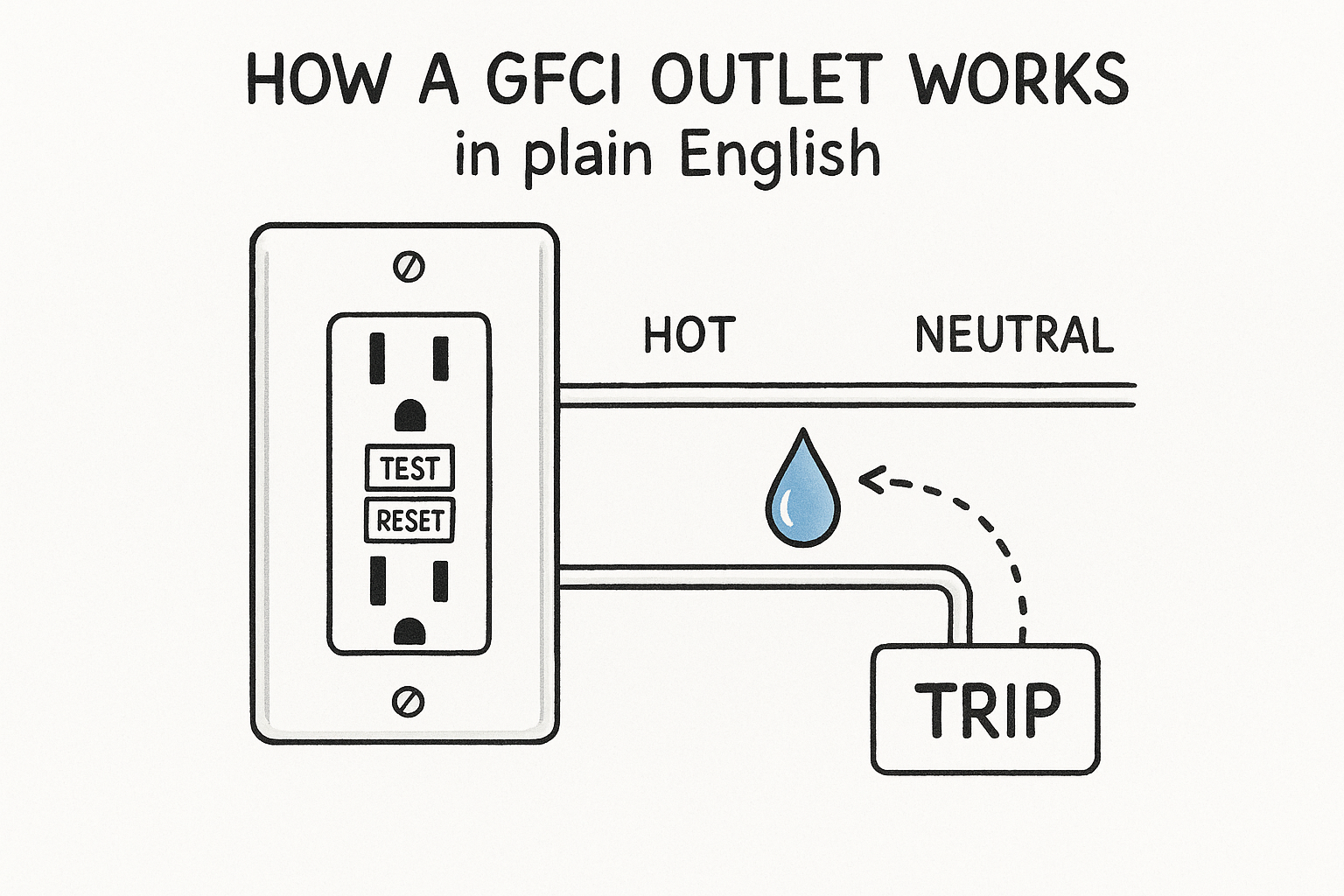
When you ask what is a GFCI outlet, the mechanism behind it is simpler than most people expect. A GFCI outlet continuously compares the amount of current flowing out through the hot wire against the current returning through the neutral wire. Under normal conditions, those two values match perfectly.
Detecting the fault
If something goes wrong, like water bridging a connection or a frayed wire touching a metal surface, some of that current diverts away from the neutral path. The GFCI sensor picks up even a tiny imbalance, as small as 4 to 6 milliamps, which is barely enough to feel but enough to cause serious injury.
The human heart can go into fibrillation at currents as low as 10 milliamps, which is exactly why the GFCI’s sensitivity threshold is set well below that level.
Cutting power before you feel it
Once the outlet detects that imbalance, it trips an internal switch instantly, cutting power to the circuit before a dangerous shock can fully develop. Your standard wall outlet cannot do this because it has no monitoring circuitry at all. That single difference is what makes GFCI outlets a non-negotiable safety feature in any area where moisture is present.
Where GFCI protection is required in homes
When you’re learning what is a GFCI outlet and where it belongs in your home, the answer comes directly from the National Electrical Code (NEC), which sets the minimum installation requirements. These rules have expanded significantly over the decades, so older homes often lack protection in locations that modern code now mandates. Knowing the required locations helps you identify gaps in your current setup before they become a real hazard.
The NEC updates its requirements every three years, which means homes built before the 1990s may be missing GFCI protection in several areas that current code now covers.
Rooms and locations that require GFCI outlets
Bathrooms, kitchens, garages, and outdoor areas are the most commonly required locations under current NEC guidelines. Your kitchen needs GFCI protection on all countertop receptacles within six feet of a sink. Unfinished basements, crawl spaces, and any outlet near a pool or spa also fall under the requirement. Here’s a quick reference for where your home needs GFCI protection:
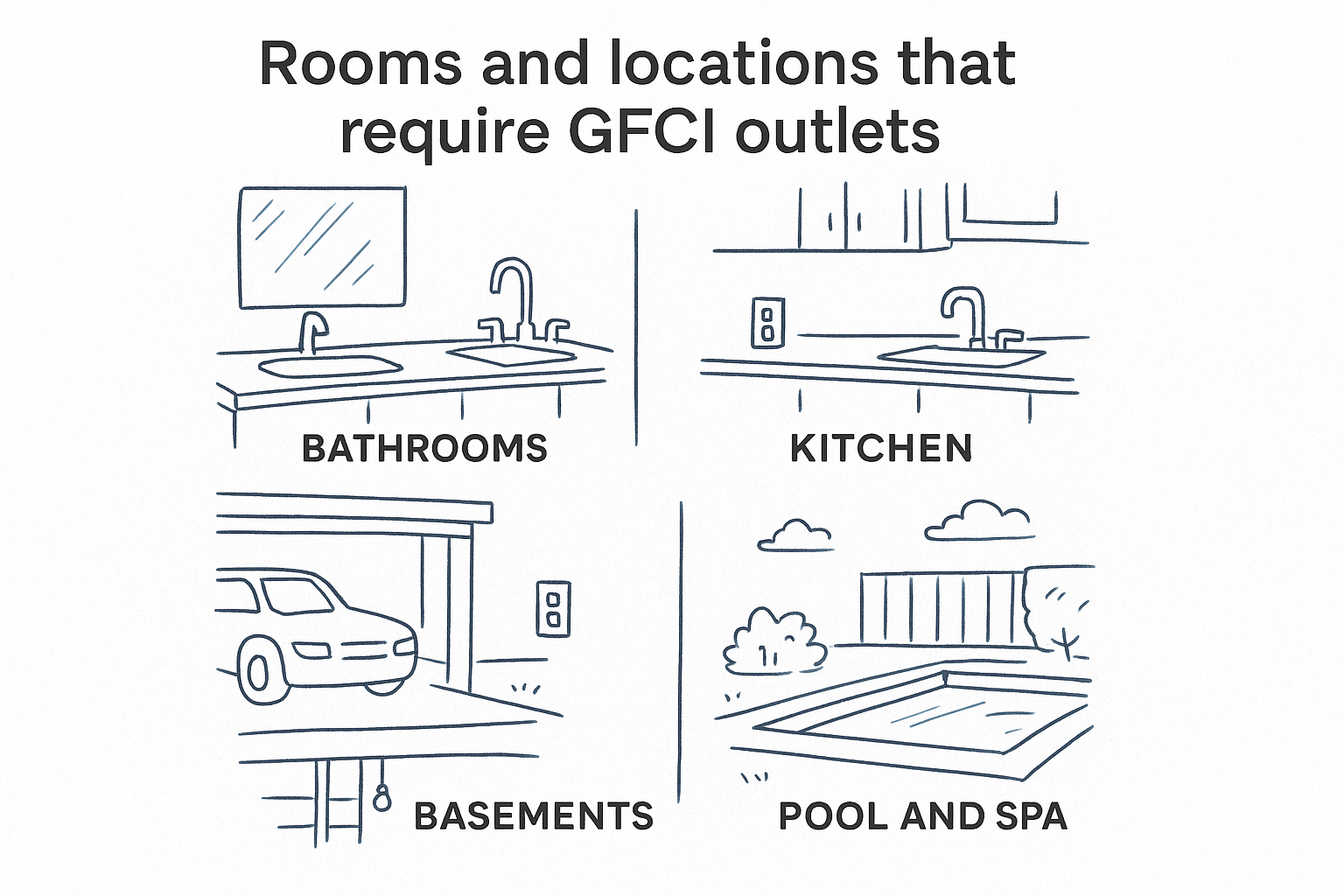
- Bathrooms (all receptacles)
- Kitchen countertops
- Garages and detached structures
- Outdoor receptacles
- Basements and crawl spaces
- Pool and spa areas
How to test and reset a GFCI outlet
Testing your GFCI outlets takes less than a minute, and you should do it monthly to confirm they’re still working correctly. A GFCI outlet that has failed internally can look completely normal but offer zero protection in a real ground fault situation.
Running the test
Locate the "Test" button on the face of the outlet and press it firmly. You should hear a click, and any device plugged into that outlet should immediately lose power. If the outlet keeps delivering power after you press "Test," the GFCI mechanism has failed and the outlet needs to be replaced right away.
Treat a failed outlet as completely unprotected until a licensed electrician swaps it out. Never continue using a faulty GFCI outlet near any source of moisture, even for a short time.
Resetting after a trip
After a test or a real fault trips the outlet, press the "Reset" button firmly until you feel it click into place. Power should return to the outlet immediately.
If the Reset button pops back out repeatedly, the outlet is detecting an ongoing fault somewhere in the circuit, and you should stop using it until an electrician inspects the wiring.
If resetting keeps failing, unplug every device connected to that circuit first, then try again. One specific appliance may be the source of the ground fault causing the repeated trip.
Common GFCI questions and troubleshooting
Understanding what is a GFCI outlet leads to a few practical follow-up questions. The two most common involve repeated tripping and whether one GFCI outlet can protect multiple receptacles on the same circuit.
Why does my GFCI outlet keep tripping?
Frequent tripping usually means one of three things: a failing outlet, a faulty appliance on the circuit, or moisture in the wiring. Start by unplugging everything on that circuit and pressing Reset. If it holds, plug your devices back in one at a time to find the specific appliance causing the fault.
If the outlet trips with nothing plugged in at all, the wiring itself has a problem and needs a licensed electrician before you use that circuit again.
Can one GFCI outlet protect multiple outlets?
Yes, a single GFCI outlet can protect additional standard outlets wired downstream from it on the same circuit. This is called a daisy-chain setup, and it’s a standard way to extend ground fault protection without replacing every outlet in the room.
To confirm which outlets are covered, press the Test button and check which nearby outlets lose power. Any outlet that goes dead is downstream and protected by that one GFCI device.
Next steps for a safer home
Now that you understand what is a GFCI outlet and how it protects you, the next move is straightforward: check every room in your home where water and electricity share space. Walk through your bathrooms, kitchen, garage, and any outdoor outlet locations. Press the Test button on each GFCI outlet you find and confirm it trips correctly. If any outlet fails the test, or if you discover locations that are missing GFCI protection entirely, those gaps need to be corrected by a licensed electrician.
Older homes in the Greater Phoenix Metro Area often have outdated wiring that doesn’t meet current NEC requirements, and many homeowners don’t realize it until an incident occurs. Catching those gaps now costs far less than dealing with the aftermath later. If you want a professional to inspect your outlets and install GFCI protection where your home needs it, contact AZ DC Electric to schedule a safety assessment today.