You flip a breaker back on and it trips again within minutes, or you’re staring at your electrical panel wondering why some circuits have a test button and others don’t. If you’ve searched what is a gfci circuit breaker, you’re probably trying to figure out whether that unfamiliar switch in your panel is protecting you, malfunctioning, or missing entirely from a circuit that needs one.
A GFCI circuit breaker is a breaker that monitors the electrical current flowing through a circuit and shuts off power within milliseconds if it detects current leaking somewhere it shouldn’t, like through water or a person. That’s different from a standard breaker, which only trips on overloads or short circuits, and it works at the panel level rather than at a single outlet like a GFCI outlet does.
In this article, we’ll break down exactly how a GFCI breaker detects a fault, where Arizona code requires one, and how it compares to GFCI outlets so you know which protection your home’s wiring actually needs before your next inspection or upgrade.
Why a GFCI circuit breaker matters for your home
Ground faults kill people every year, and most victims never see it coming. Ground fault electrocution happens when electricity finds an unintended path to the ground, often through a person’s body, and a current as small as 5 milliamps can cause a painful shock while 100 milliamps can stop your heart. A standard breaker won’t trip at those levels because it’s designed to catch overloads and short circuits, not the tiny current leaks that make ground faults so dangerous. That gap is exactly why the National Fire Protection Association and electrical codes across the country require GFCI protection in specific areas of the home, and why understanding what a GFCI circuit breaker does isn’t just technical trivia, it’s a safety decision that affects everyone under your roof.
A GFCI breaker reacts in the time it takes to blink, long before a ground fault turns into a fatal shock.
The Arizona factor: pools, spas, and outdoor living
Scottsdale and the surrounding Phoenix Metro Area come with a specific electrical risk profile that homeowners in drier, cooler climates don’t deal with as often. Backyard pools and spas, outdoor kitchens, misting systems, and irrigation controllers all combine water and electricity in ways that dramatically raise the odds of a ground fault. Add in the fact that so many Arizona homes run major appliances and pumps year-round because of the heat, and you’ve got more circuits working harder in conditions where a wiring fault is more likely to find a path through moisture or a person standing on wet concrete near a pool deck.
Whole-circuit protection versus a single point of failure
A GFCI breaker protects every outlet and fixture wired downstream of it on that circuit, not just one receptacle. That matters if your garage, exterior lighting, and pool equipment all share a circuit, because one breaker upgrade can cover the entire run instead of leaving gaps between individually protected outlets. It’s also why many electricians recommend breaker-level protection for circuits feeding hot tubs, well pumps, or detached structures where running a dedicated GFCI outlet to every device isn’t practical or code-compliant.
How a GFCI circuit breaker works to prevent shocks
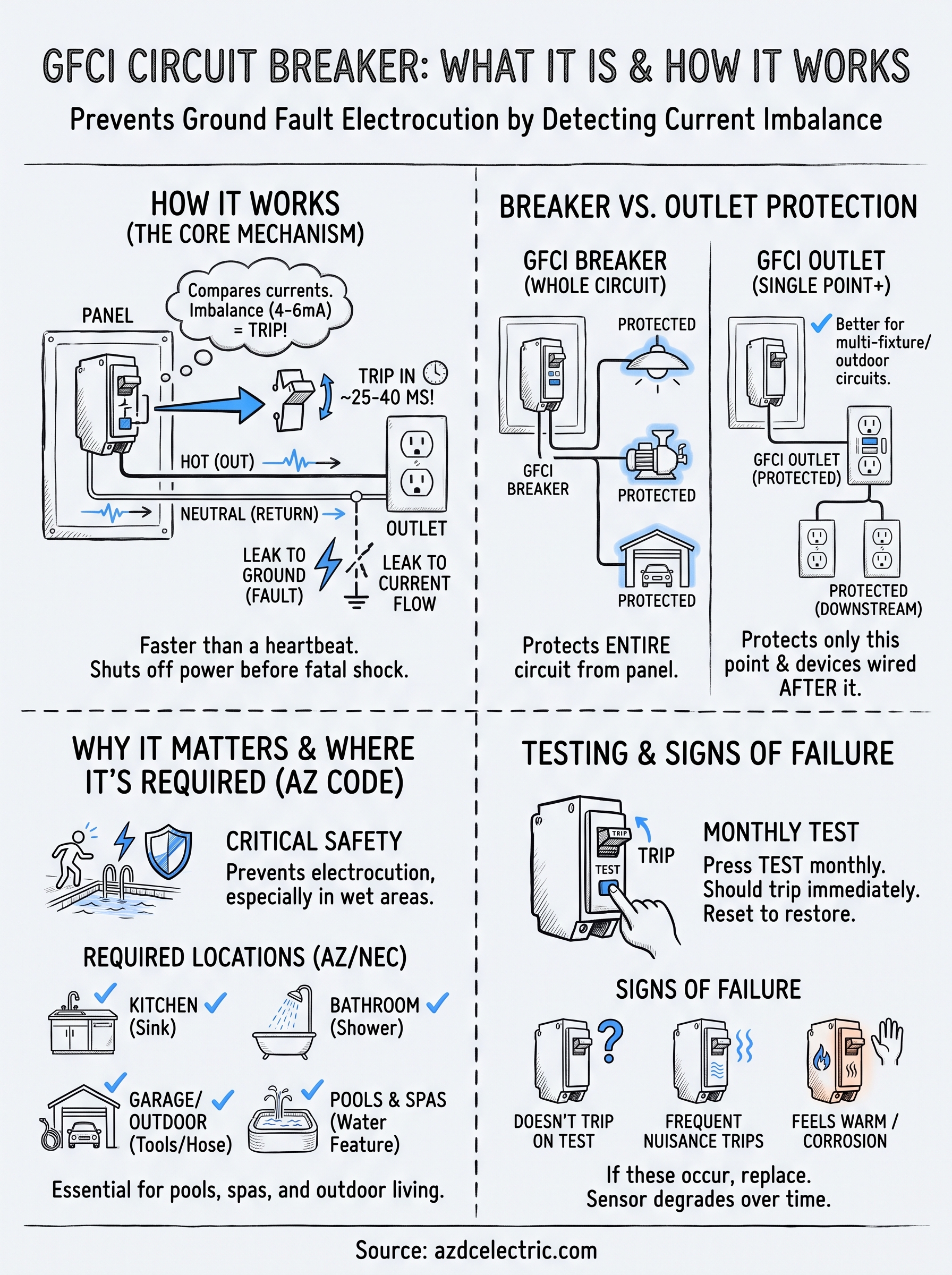
Inside every GFCI breaker sits a small sensor that continuously compares the current flowing out on the hot wire to the current returning on the neutral wire. Under normal conditions, those two numbers match exactly, because electricity is a closed loop. Current imbalance of as little as 4 to 6 milliamps tells the breaker that some electricity is escaping the circuit, likely through water, damaged insulation, or a person, and the internal mechanism trips the breaker before that leak becomes a fatal shock.
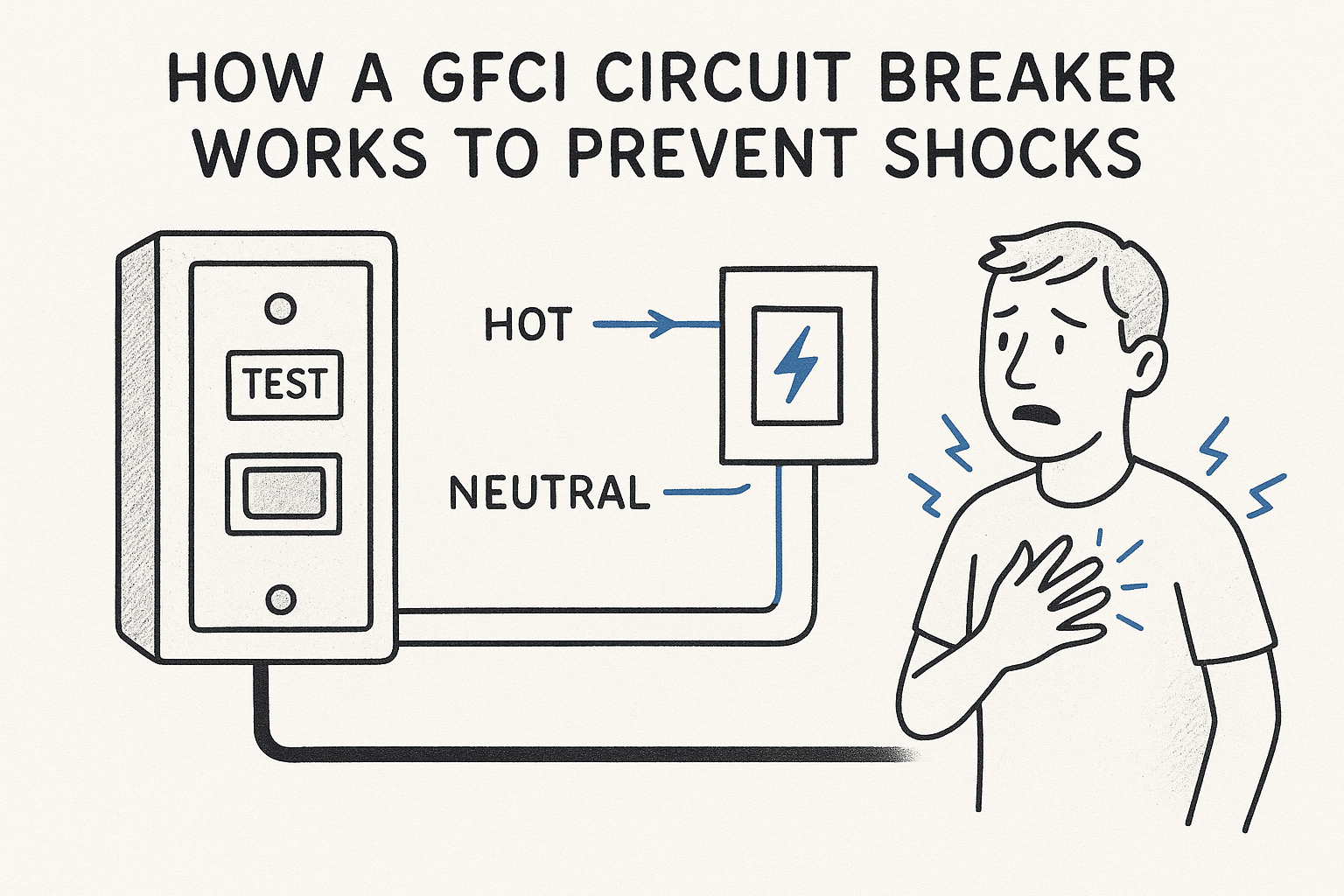
A GFCI breaker doesn’t care how much power you’re using, it cares whether all of it comes back.
Why speed matters
That detection and shutoff happens in roughly 25 to 40 milliseconds, faster than a human nerve can register pain. Compare that to a standard breaker, which needs a sustained overload or dead short before it reacts, often taking seconds rather than milliseconds. The speed of response is the entire point of a GFCI breaker, since a ground fault that lingers even briefly can drive current through your heart’s rhythm and cause cardiac arrest.
Resetting after a trip
Once a GFCI breaker trips, it fully cuts power to the circuit rather than just reducing it, and you’ll need to physically reset it at the panel. If it trips repeatedly, that’s the breaker doing its job by flagging a real fault somewhere downstream, not a nuisance to override by resetting it again and again.
GFCI breaker vs. GFCI outlet vs. standard breaker
Homeowners often lump these three devices together, but each one protects a different scope of your home’s wiring. A standard breaker only watches for overloads and short circuits on a whole circuit. A GFCI outlet watches for ground faults, but only at that one receptacle and anything wired downstream of it on the same run. A GFCI circuit breaker watches for ground faults across the entire circuit from the panel outward, which is why it’s often the better fit for circuits feeding multiple fixtures, pool equipment, or detached structures.
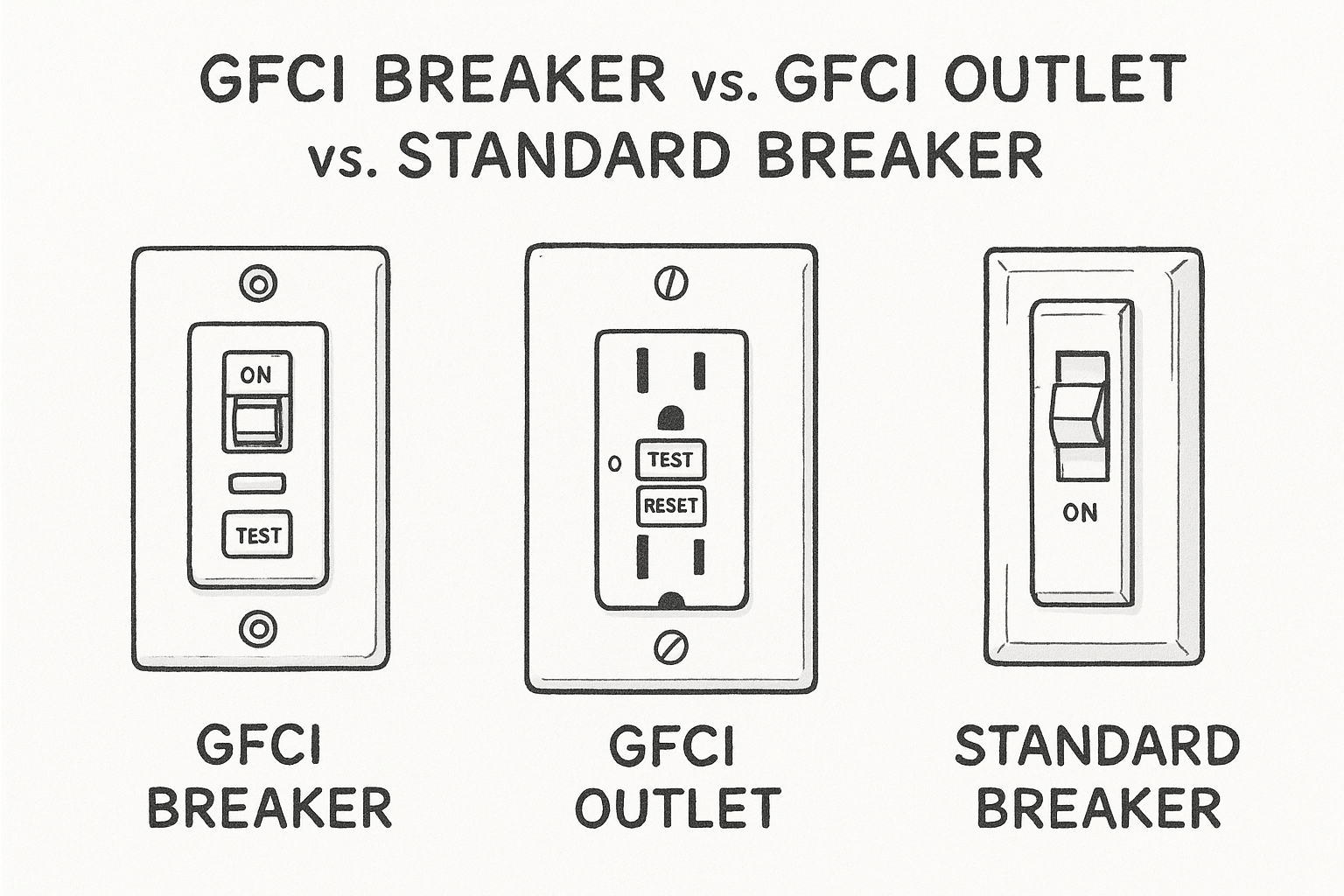
Where the protection lives
The biggest practical difference comes down to location and coverage, which this table breaks down:
| Device | Detects | Coverage | Typical use |
|---|---|---|---|
| Standard breaker | Overloads, short circuits | Whole circuit | General lighting, standard outlets |
| GFCI outlet | Ground faults | Single outlet plus downstream devices on that run | Kitchens, bathrooms, single-outlet retrofits |
| GFCI breaker | Ground faults | Entire circuit from the panel | Pools, spas, garages, outdoor circuits, whole-circuit protection |
A GFCI outlet protects one point on a circuit, a GFCI breaker protects every point on it.
Which one actually belongs in your panel
Electricians typically reach for a GFCI breaker when a circuit serves several outlets or hardwired equipment, like a pool pump or a detached garage, since replacing every downstream outlet individually gets expensive and leaves room for gaps. A GFCI outlet still makes sense for a single retrofit, like an older bathroom that only needs one point protected. Either device satisfies code requirements when installed correctly, but the breaker option simplifies protection when multiple devices share a run.
Where GFCI protection is required in Arizona homes
Arizona follows the National Electrical Code (NEC), which spells out exactly which rooms and outdoor areas need GFCI protection, and Scottsdale, Mesa, Chandler, and most Valley cities enforce those requirements through local permitting. Kitchens, bathrooms, garages, unfinished basements, laundry areas, and any outlet within six feet of a sink all fall under this rule, along with every exterior receptacle on the house. Homeowners who skip this step on a remodel or panel upgrade often fail inspection, so it pays to know the list before you call an electrician.
If water can reach the outlet, code assumes a ground fault can too, and requires protection accordingly.
Outdoor and wet-location circuits get extra scrutiny
Given how many Arizona properties include a pool, spa, or irrigation system, code treats these circuits with added weight. Pool pumps, spa equipment, outdoor kitchens, and any receptacle near a water feature need GFCI coverage, and inspectors in the Phoenix Metro Area pay close attention to these details because the consequences of a missed ground fault near a pool deck are severe.
New construction and major renovations trigger updates
Building a new home or pulling permits for a kitchen or bathroom remodel in the Valley means your entire project has to meet current GFCI requirements, even if the rest of the house was wired decades ago under older code. That’s often the moment homeowners discover just how many circuits in an older Scottsdale or Chandler home never had protection to begin with.
Signs your GFCI breaker is failing or needs testing
GFCI breakers wear out like any other electrical component, and the internal sensor that detects ground faults can degrade years before the breaker stops working entirely. Testing your GFCI circuit breaker monthly catches that decline early, since a breaker that no longer trips on command has quietly stopped protecting the circuit even though power still flows through it normally.
What monthly testing looks like
Most panels label the breaker’s test button right on the switch. Press it, and the breaker should trip immediately, cutting power to everything downstream.
- Press the test button and confirm the breaker flips to the off position
- Reset it manually and check that power returns to the circuit
- Note the date somewhere you’ll remember, like a calendar reminder
- Call an electrician if the breaker doesn’t trip or won’t reset
A GFCI breaker that won’t trip during a test has already failed at the one job it exists to do.
Warning signs beyond the test button
Several other clues point to a failing breaker even between scheduled tests. Frequent nuisance trips with no obvious cause, a breaker that feels warm to the touch, visible corrosion inside the panel, or outlets on that circuit that flicker under normal use all suggest the breaker or the wiring behind it needs attention. Repeated tripping near pool equipment or outdoor fixtures deserves particular urgency, since that’s often where moisture is finding a path it shouldn’t. If your breaker is more than ten years old, replacement makes more sense than continued troubleshooting, since sensor components degrade with age regardless of how the breaker looks from the outside.
Getting your GFCI protection right
A GFCI circuit breaker isn’t a nice-to-have add-on, it’s the difference between a circuit that just powers your pool equipment and one that actually protects the people standing near it. You now know how it detects a current imbalance, how fast it reacts, and why breaker-level protection beats a single outlet on circuits feeding multiple fixtures or wet locations. You also know where Arizona code requires it and what a failing breaker looks like before it puts your family at risk.
If you’re unsure whether your panel has the right GFCI protection in place, or you’re planning a remodel that will trigger a code update, don’t guess. A licensed electrician can test every breaker in your panel, flag any gaps, and install what’s actually required for your home’s layout. Schedule an inspection with AZ DC Electric and get your panel checked before a ground fault finds the gap first.