A single power surge can damage electronics, appliances, and HVAC systems in seconds, and most homeowners in the Phoenix Metro Area don’t realize how often surges actually happen. Lightning, utility grid switching, and even your own AC compressor cycling on and off can send voltage spikes through your wiring. A Square D surge protection device installed at the panel is one of the most effective ways to protect everything connected to your electrical system at once.
But Square D offers several models, the HEPD80, the HEPD50, the SurgeBreaker Plus, and each one has different specs, ratings, and panel compatibility requirements. Choosing the right unit means understanding surge current ratings, modes of protection, and whether the device actually fits your specific Square D panel or load center. That’s where this guide comes in.
Below, we break down the full Square D surge protection lineup, compare specifications side by side, and explain which panels each model is designed for. At AZ DC Electric, we install whole-home surge protectors across Scottsdale and the Greater Phoenix area every week. We’ve seen what works, what doesn’t, and which models give homeowners the best protection for their setup. This article pulls from that hands-on experience to help you make a confident, informed decision, whether you’re buying one yourself or hiring a licensed electrician to handle the install.
What a Square D surge protection device is
A Square D surge protection device is a piece of electrical equipment that connects directly to your main panel or load center and diverts excess voltage away from your circuits before it can reach your appliances, electronics, or wiring. Square D, a brand under Schneider Electric, has manufactured electrical equipment for over a century. Their surge protection devices are purpose-built to work with their own QO and Homeline panel systems, which makes them a popular choice for homeowners who already have a Square D panel installed. These devices are not the same as the power strip surge protectors you plug into a wall outlet. They operate at the system level, giving your entire home coverage from a single install point.
How surge protection devices work
Every surge protection device (SPD) works on the same core principle: it monitors the voltage coming into your panel and, when that voltage spikes above a safe threshold, it routes the excess energy to ground rather than letting it travel through your branch circuits. The component that does this inside most SPDs is a metal oxide varistor (MOV). MOVs are fast-acting; they respond to surges in nanoseconds. Square D units typically use multiple MOVs arranged across different paths in your electrical system, including line-to-neutral, line-to-ground, and neutral-to-ground connections, so no surge pathway goes unprotected. When an MOV absorbs enough surge energy over its service life, it degrades and eventually fails, which is why Square D devices include status indicators that tell you when protection is compromised.
A surge protection device does not limit how much current flows through your circuits. It only clamps voltage spikes, so it works alongside your breakers rather than replacing them.
Type 1 vs. Type 2: the distinction that matters
Square D sells both Type 1 and Type 2 surge protection devices, and the difference affects where each one installs and what it protects against. A Type 1 device installs on the line side of your main breaker, meaning it sits between the utility meter and the panel itself. Type 1 units are rated to handle direct lightning strike energy, which can reach tens of thousands of amps. They typically require a licensed electrician because the install point is always energized, even when your main breaker is off. A Type 2 device installs on the load side of the main breaker, inside the panel. It handles surges that originate within the utility distribution network or surges generated inside your own home by motors, HVAC compressors, and other inductive loads. Most whole-home residential installs use a Type 2 device, and that includes the majority of Square D’s residential lineup.
What Square D builds into their SPDs
Square D devices stand out because they are engineered specifically for integration with their own breaker panels. Most residential models use a two-slot breaker space inside the panel, connecting through a dedicated double-pole breaker that Square D includes with the unit. This design keeps the install clean and avoids field-wired connections that could introduce errors. Square D also builds visual status indicators directly into the device housing, typically a green LED that confirms active protection and an indicator that alerts you when the MOV components need replacement. Some models include an audible alarm as well. The HEPD80, for example, carries an 80kA surge current rating per phase, which exceeds the minimum 36kA that the National Electrical Code recommends for service entrance protection in most residential applications. That rating reflects how much surge energy the device can absorb before its internal components begin to degrade.
Why whole-home surge protection matters
Most homeowners think surge protection is only necessary during a lightning storm. In reality, the majority of damaging surges originate inside your own home, not from outside. Every time a large motor starts or stops, like your HVAC compressor, refrigerator, pool pump, or washing machine, it creates a small voltage spike that travels backward through your wiring. These internal surges happen dozens of times every day, and over months and years they degrade sensitive electronics, shorten appliance lifespans, and stress the circuit boards inside devices you rely on constantly. A Square D surge protection device installed at the panel intercepts these spikes before they reach your circuits.
The surges you can’t see coming
Phoenix sits in one of the most lightning-active regions in the country, and the summer monsoon season brings repeated high-voltage strikes near residential neighborhoods. When lightning hits a utility line within miles of your home, the surge travels directly into your service entrance, often reaching thousands of amps before it ever enters your panel. Beyond lightning, utility companies regularly switch loads on the grid during peak demand periods, and each switching event sends a brief but powerful transient through the distribution network. Your home has no natural barrier against these transients unless a device is installed to absorb them at the panel level. Point-of-use surge strips at individual outlets only protect what’s plugged into them directly, leaving your hardwired appliances, HVAC system, water heater, and in-wall wiring completely exposed.
Whole-home surge protection and point-of-use strips work best together. The panel device handles large surges at the source, while outlet strips catch any residual energy that reaches branch circuits.
What’s at stake without protection
The cost of replacing damaged equipment adds up fast. A single surge event can destroy a smart appliance, an HVAC control board, or a home theater system, and most homeowner insurance policies require you to prove the surge caused the damage before covering any repair costs. Beyond the dollar amount, repeated low-level surges shorten the useful life of everything on your circuits, meaning you replace appliances and electronics sooner than you should. A whole-home SPD typically costs a few hundred dollars installed, while the appliances and systems it protects often represent tens of thousands of dollars in combined value.
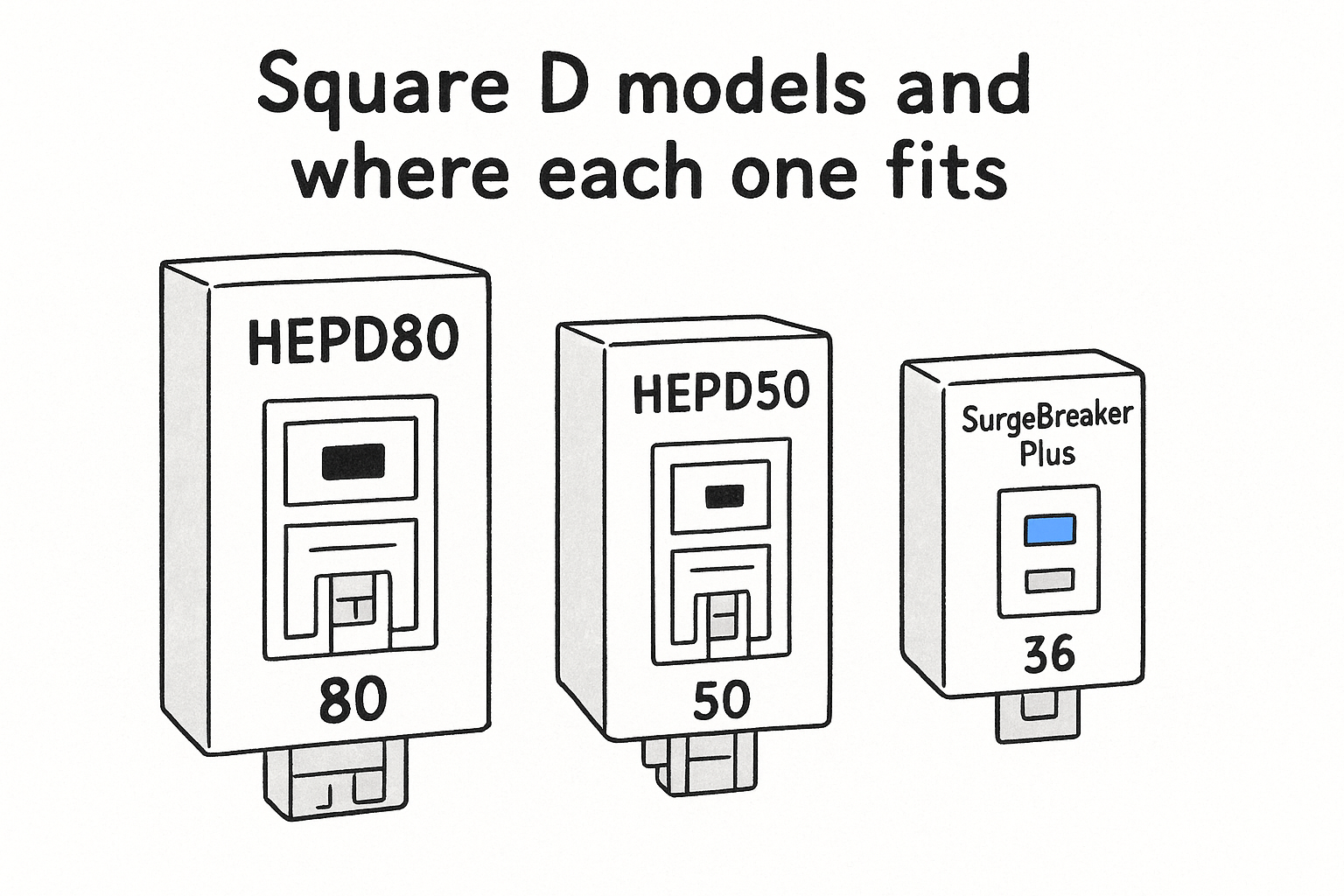
Square D models and where each one fits
Square D makes several residential surge protection devices, and each model targets a specific level of protection and panel configuration. Picking the wrong unit means either overpaying for capacity you don’t need or landing on a device that physically won’t fit your load center. Understanding where each model sits in the lineup helps you narrow the choice before you call an electrician or head to a supply house.
HEPD80
The HEPD80 is Square D’s highest-rated residential Type 2 device, rated at 80kA per phase. It connects to your panel through a dedicated double-pole breaker that ships with the unit, occupying two breaker slots in your load center. This model works with both QO and Homeline panels, which covers the large majority of Square D equipment installed in Phoenix-area homes. The HEPD80 includes a green status LED and an audible alarm, so you get an immediate alert if the device absorbs a significant event and its MOV components begin to wear down.
HEPD50
The HEPD50 shares the same form factor and install method as the HEPD80 but carries a 50kA surge current rating instead of 80kA. It still uses a two-slot breaker connection and works with both QO and Homeline load centers. This model suits smaller homes or secondary distribution panels where the full 80kA capacity exceeds what the installation actually requires. Like the HEPD80, the HEPD50 includes a status indicator to confirm active protection.
If your property has a detached garage, workshop, or pool equipment subpanel, installing a second HEPD50 at that location covers circuits that don’t route back through your main panel.
SurgeBreaker Plus
The SurgeBreaker Plus is a Type 2 device that mounts directly inside your QO or Homeline panel as a tandem unit, taking up two breaker spaces. It carries a 36kA rating per mode, which meets the NEC minimum threshold for residential service entrance surge protection. The SurgeBreaker Plus works well when panel space is tight and you need a code-compliant Square D surge protection device without sacrificing extra slots to a larger unit. It includes a visual status indicator, though it does not include the audible alarm found in the HEPD series. For most standard Phoenix-area homes with available panel space, the HEPD80 is the stronger long-term investment.
Key specs to compare before you buy
Three numbers appear on every Square D surge protection device spec sheet: surge current rating, number of modes protected, and clamping voltage. Understanding what each one means before you buy keeps you from overspending on capacity your home doesn’t need or choosing a unit that leaves part of your electrical system exposed.
Surge current rating
The surge current rating, measured in kiloamps (kA), tells you how much peak surge energy the device can handle per event before its internal MOV components start to degrade. The National Electrical Code sets 36kA as the minimum for residential service entrance protection, but Square D’s HEPD80 reaches 80kA per phase. A higher kA rating doesn’t mean the device activates more often; it means the MOVs wear down more slowly over repeated surge events, directly extending the useful service life of the unit. When you compare models side by side, the kA number is the single most important figure to check first.
In Phoenix, where monsoon storms can send multiple surges through the utility lines in a single afternoon, choosing the highest kA rating available for your panel is worth the small price difference.
Modes of protection
Modes of protection describe the electrical paths the device monitors for incoming surges. A full-coverage unit protects line-to-neutral, line-to-ground, and neutral-to-ground simultaneously. Devices that only cover two modes leave gaps where a surge traveling on the unmonitored path passes straight through to your circuits unchecked.
When you review any Square D model’s spec sheet, confirm it lists all three modes under the protection configuration section. The table below shows what each mode covers:
| Mode | Path protected |
|---|---|
| L-N | Line to Neutral |
| L-G | Line to Ground |
| N-G | Neutral to Ground |
Clamping voltage and response time
Clamping voltage is the level at which the device activates and diverts excess energy to ground. A lower clamping voltage means the unit responds sooner and lets less spike energy reach your circuits. Square D’s residential units typically clamp at 700V or below on a standard 120/240V system, which meets UL 1449 requirements for listed devices. Response time, measured in nanoseconds, tells you how quickly the MOVs engage once a surge is detected, and faster response directly reduces how much transient energy passes through before the device clamps. Both numbers appear on the product spec sheet, and both matter when you’re comparing models for a high-value installation.
Panel compatibility: QO, Homeline, and others
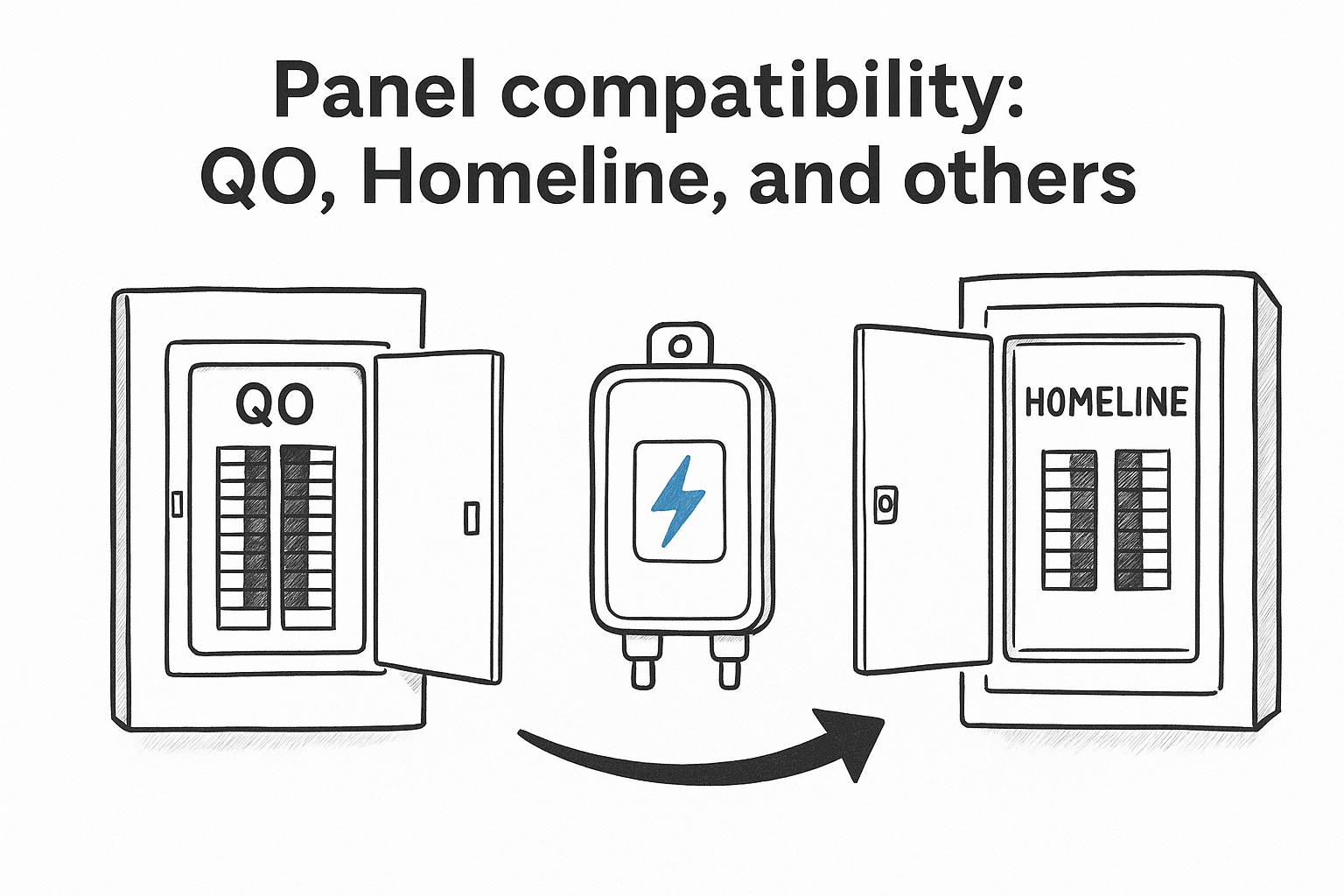
Before you order any Square D surge protection device, confirm which panel series is installed in your home. Square D sells two main residential load center lines, QO and Homeline, and while both accept the same HEPD and SurgeBreaker Plus models, the internal breaker slots and mounting rails differ between them. Buying the wrong breaker kit creates a frustrating return trip to the supply house, so checking your panel label first saves time and money.
QO panels
QO panels use Square D’s plug-on breaker design, where each breaker snaps directly onto a stab rail inside the panel without additional hardware. The HEPD80 and HEPD50 each ship with a compatible QO double-pole breaker that fits this design exactly. QO load centers are common in homes built or renovated after the mid-1990s and are identifiable by the square breaker shape and the "QO" label on the inside door of the panel.
If your panel label is worn or missing, photograph the existing breakers and share that photo with your electrician before purchasing any device.
Homeline panels
Homeline panels use a different plug-on design that accepts Homeline-series breakers rather than QO breakers. The two breaker types are not interchangeable, even though they look similar at a glance. Square D’s HEPD80 and SurgeBreaker Plus both list Homeline compatibility, and each ships with the correct breaker for that series. Homeline load centers tend to appear in builder-grade new construction and are one of the most common panels across Phoenix-area subdivisions built in the 2000s and 2010s.
What to do if your panel isn’t Square D
Your home may have a panel from another manufacturer, such as Eaton, Siemens, or Leviton. Square D surge protection devices are designed for Square D panels, and dropping an HEPD80 into a non-Square D load center creates a compatibility problem at the breaker slot level. In this situation, you have two options. You can replace the panel or subpanel with a Square D unit at the same time as the SPD installation, which many Phoenix homeowners do when their original panel is already aging. Alternatively, you can select a Type 2 SPD from the manufacturer that matches your existing panel and treat the Square D line as outside your scope. A licensed electrician can confirm compatibility during a quick site visit before any material is ordered, which prevents wasted cost on incompatible hardware.
What installation looks like in a real home
Understanding the installation process helps you prepare your home and set realistic expectations for the job. A Square D surge protection device typically installs in one to two hours for most Phoenix-area homes, assuming the panel has available breaker slots and is accessible. Your electrician will need clear access to your main panel, so move any stored items or furniture away from the panel door before the appointment to avoid delays.
What the electrician does before the panel opens
Before touching the panel, your electrician will assess the available space inside your load center. They confirm which breaker slots are free and check that the existing wiring condition is safe to work around. This step also includes verifying your panel model, QO or Homeline, to confirm that the breaker shipped with the HEPD80 or SurgeBreaker Plus matches your system. If your panel is already full, the electrician may combine two single-pole breakers using a tandem breaker to free up the two slots the device requires. Skipping this assessment step is how jobs run long, so a thorough electrician always starts here.
How the device connects inside the panel
The electrician shuts off the main breaker, which de-energizes the load side of your panel. They then mount the surge protection device housing to an available knockout or a dedicated mounting location on the panel enclosure, depending on the model. Two leads from the device connect to the included double-pole breaker, which snaps into the freed slots on the bus bar. A ground wire runs from the device to the grounding bus inside the panel, completing the path the device needs to divert surge energy safely. Once all connections are torqued to specification, the main breaker goes back on.
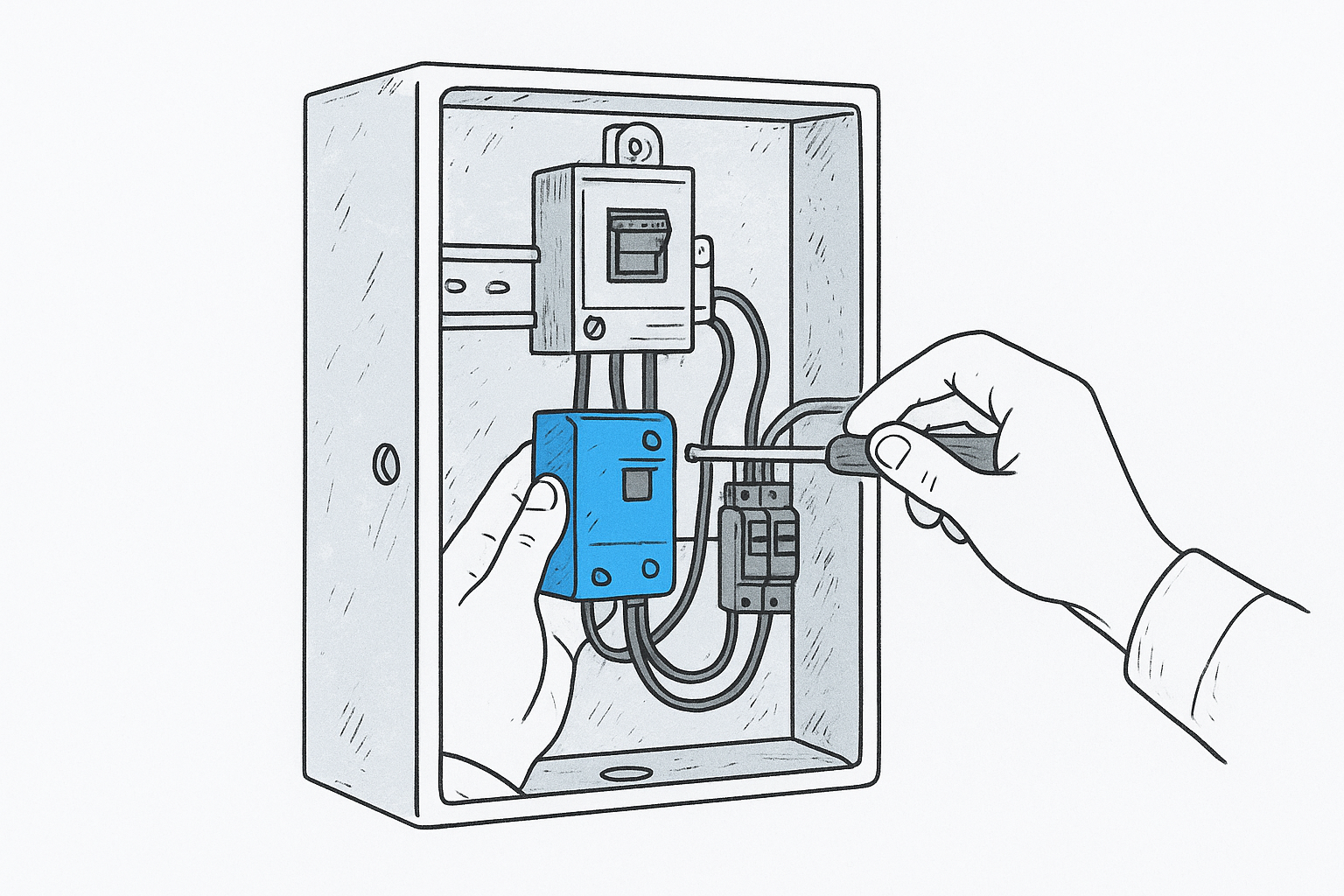
The line side of a residential panel, above the main breaker, stays energized even when the main breaker is off, so only a licensed electrician should work in that zone.
Testing and confirming protection after installation
Once power is restored, the status LED on your device should show solid green immediately, confirming that active protection is in place. Your electrician will verify the indicator, check for any tripped breakers resulting from the connection process, and confirm that all circuits on both phases are reading normal voltage. They will also walk you through where the device is located and what each indicator means so you can check it yourself after monsoon storms or any major surge event.
Troubleshooting, indicators, and lifespan
After your Square D surge protection device is installed, the status indicator becomes your primary tool for confirming the unit is working correctly. Most Square D residential models use a two-state LED system that tells you instantly whether active protection is in place. Checking this indicator after every major storm or utility event takes less than 30 seconds and keeps you ahead of any failure before it creates a gap in your home’s protection.
Reading the status indicators
The green LED on your HEPD80 or SurgeBreaker Plus confirms that the internal MOV components are intact and the device is actively monitoring your circuits. If that light goes out or turns red, the MOVs have absorbed enough cumulative surge energy to compromise protection, and you need to replace the unit. On the HEPD series, an audible alarm also activates when the device reaches end-of-life status, giving you both a visual and an audio alert at the same time.
| Indicator | Meaning |
|---|---|
| Green LED on | Full protection active |
| Green LED off | MOVs degraded, replace unit |
| Audible alarm | End-of-life alert (HEPD series only) |
When to replace your device
Most Square D surge protection devices do not follow a fixed calendar-based replacement schedule. The MOVs inside the unit degrade based on how many surges the device absorbs and how significant those surges are, not simply how old the device is. A unit installed in Phoenix that handles repeated monsoon surges across multiple seasons may wear down faster than the same model installed in a low-lightning region, so local conditions directly affect the useful service life of your unit.
Check your status indicator at least once per season and immediately after any storm event that you know was severe in your area.
If your green indicator light goes out, replace the device promptly rather than assuming protection continues. Running your home without active surge protection is exactly the situation the original install was designed to prevent. Replacement stays straightforward because the same breaker slots and wiring connections your electrician used the first time remain in place. A licensed electrician can swap a failed unit in under an hour, and the new device starts protecting your circuits as soon as the breaker closes and the green LED confirms active status.
Next steps
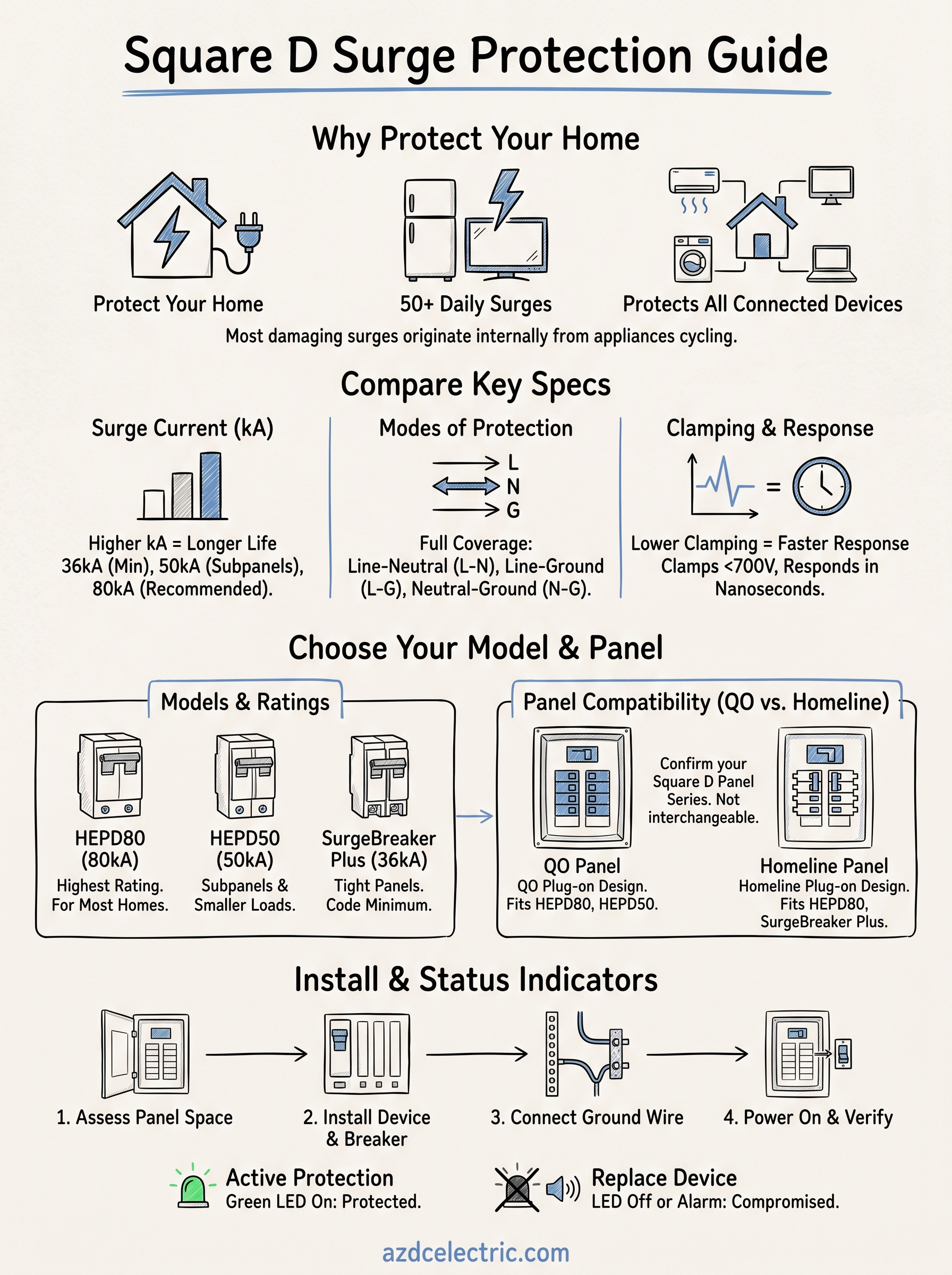
You now have the information you need to choose the right Square D surge protection device for your home. The HEPD80 is the strongest option for most Phoenix-area homes with available panel space, the HEPD50 works well for subpanels and smaller installations, and the SurgeBreaker Plus handles tight panels where slot count is the limiting factor. Confirm your panel series first, either QO or Homeline, before ordering any unit to avoid a compatibility mismatch at the breaker level.
Buying the right device is only half the job. Proper installation requires a licensed electrician who can confirm panel compatibility, free up the correct breaker slots, and verify the status indicator shows active protection once the work is complete. If you are in Scottsdale or anywhere in the Greater Phoenix Metro Area, the team at AZ DC Electric installs whole-home surge protectors regularly and can get your home protected quickly.