A generator isn’t much use during a power outage if you’re running extension cords through your house to keep things running. A manual transfer switch solves that problem by giving you a safe, code-compliant connection point between your portable generator and your home’s electrical panel. But before you commit, you need to understand what manual transfer switch installation cost actually looks like, and why quotes can vary so much from one project to the next.
The short answer: most homeowners in 2026 spend between $400 and $1,500 total, depending on the switch itself, the complexity of the install, and local labor rates. That’s a wide range, and the final number depends on factors like your panel’s condition, how many circuits you want to transfer, and whether any permit work is required.
At AZ DC Electric, we install manual transfer switches across the Greater Phoenix Metro Area for homeowners who want reliable backup power without the price tag of a whole-home automatic system. This guide breaks down every cost component, equipment, labor, permits, and the variables that push a project toward the higher or lower end, so you can budget with real numbers before picking up the phone.
Why a manual transfer switch matters
Running a portable generator without a transfer switch isn’t just inconvenient, it’s genuinely dangerous. When you plug a generator directly into your home’s wiring through a dryer outlet or any other wall receptacle, the power it produces can feed back through your meter and onto the utility lines outside. Utility workers repairing the outage have no idea power is flowing through those lines, and that makes backfeed a life-threatening hazard for anyone working on the grid in your neighborhood.
The backfeed problem that puts lives at risk
Backfeed happens when generator power travels through your panel and out to the utility lines instead of staying inside your home. The voltage that comes back out can reach thousands of volts by the time it hits the transformer, and a lineworker touching what they assume is a dead wire can be killed instantly. This is why the National Electrical Code requires an isolation device, like a transfer switch or an interlock, between any generator and the utility connection.
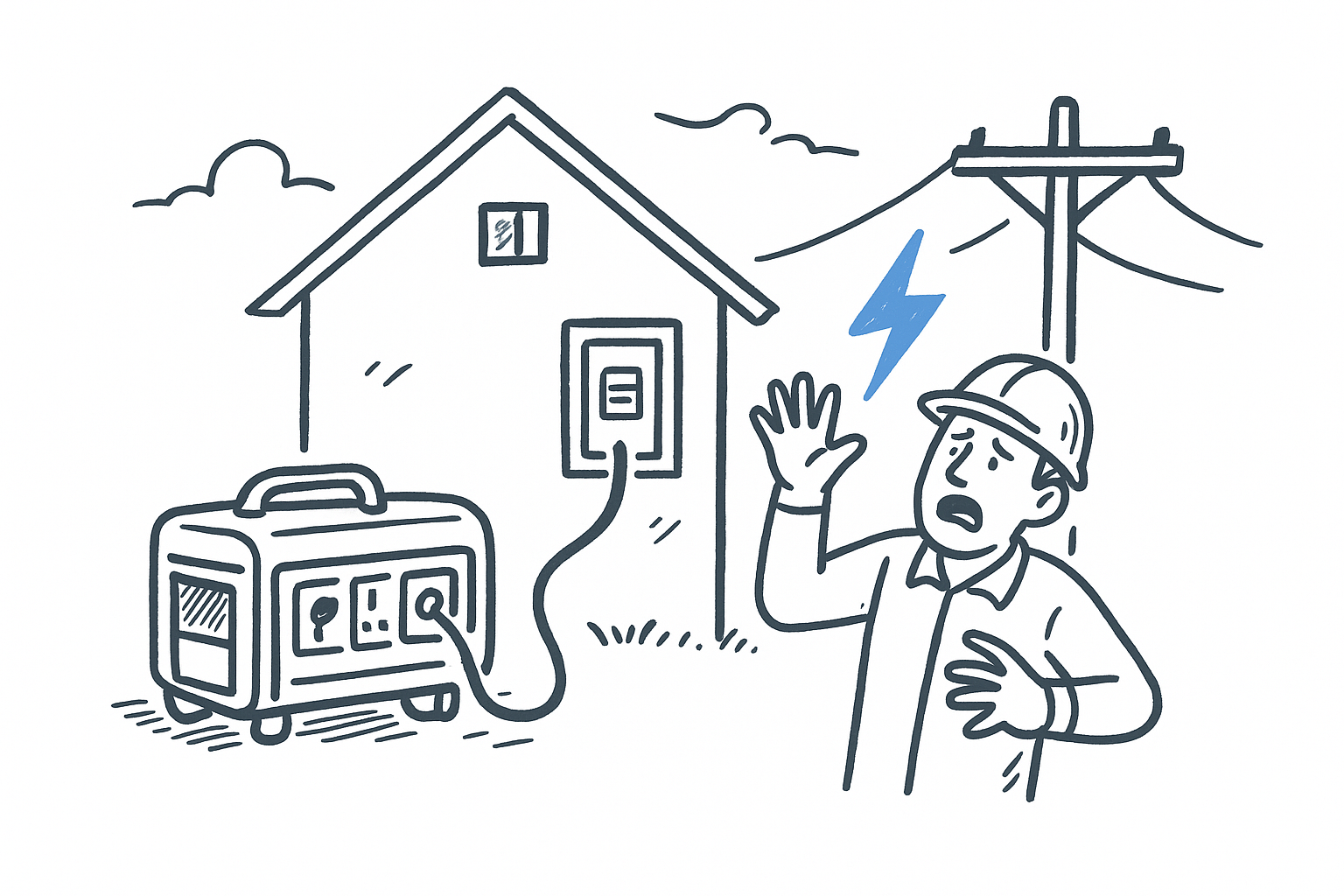
Connecting a generator directly to your home’s wiring without a transfer switch is a code violation in every U.S. jurisdiction and creates a real risk of electrocution for utility workers.
Beyond the safety issue, running a generator without proper isolation means your generator is also fighting the utility if power comes back on during the outage. That collision of two power sources can destroy the generator, damage appliances, and blow circuits inside your panel all at once.
What circuits actually matter during an outage
A manual transfer switch typically connects to a dedicated subpanel that feeds only the circuits you choose ahead of time. That selective approach is part of what keeps the manual transfer switch installation cost lower than a whole-home automatic system, since you’re not routing power to every outlet in the house.
Choosing the right circuits is more practical than it sounds. Most homeowners in the Phoenix area prioritize:
- Refrigerator and freezer to protect food during multi-day outages
- HVAC or window units to manage extreme summer heat
- Lighting in key rooms like the kitchen and main hallway
- Medical equipment if anyone in the household depends on it
- Well pump or sump pump where applicable
Your electrician helps you identify which circuits carry the highest priority loads and sizes the subpanel to match your generator’s rated output. Trying to power too many high-draw appliances simultaneously will trip the generator’s breaker, so mapping this out before the install saves real frustration when an outage actually hits.
How a transfer switch protects your equipment
Beyond keeping people safe, a properly installed transfer switch also protects your appliances and electronics. When grid power returns after an outage, it doesn’t always come back clean. Voltage spikes and surges are common in the first few seconds after restoration, and a transfer switch gives you a deliberate switchover point where you physically move from generator power back to utility power rather than having both sources merge unpredictably.
Modern appliances, especially HVAC systems, smart home devices, and anything with a circuit board inside, are sensitive to voltage irregularities. Damage from a power event often isn’t visible until something stops working weeks later, and most manufacturer warranties don’t cover surge-related failures. Treating the installation as a one-time investment makes far more financial sense than replacing a refrigerator, a smart thermostat, or a variable-speed pool pump because you skipped the proper connection equipment.
Manual transfer switch installation cost in 2026
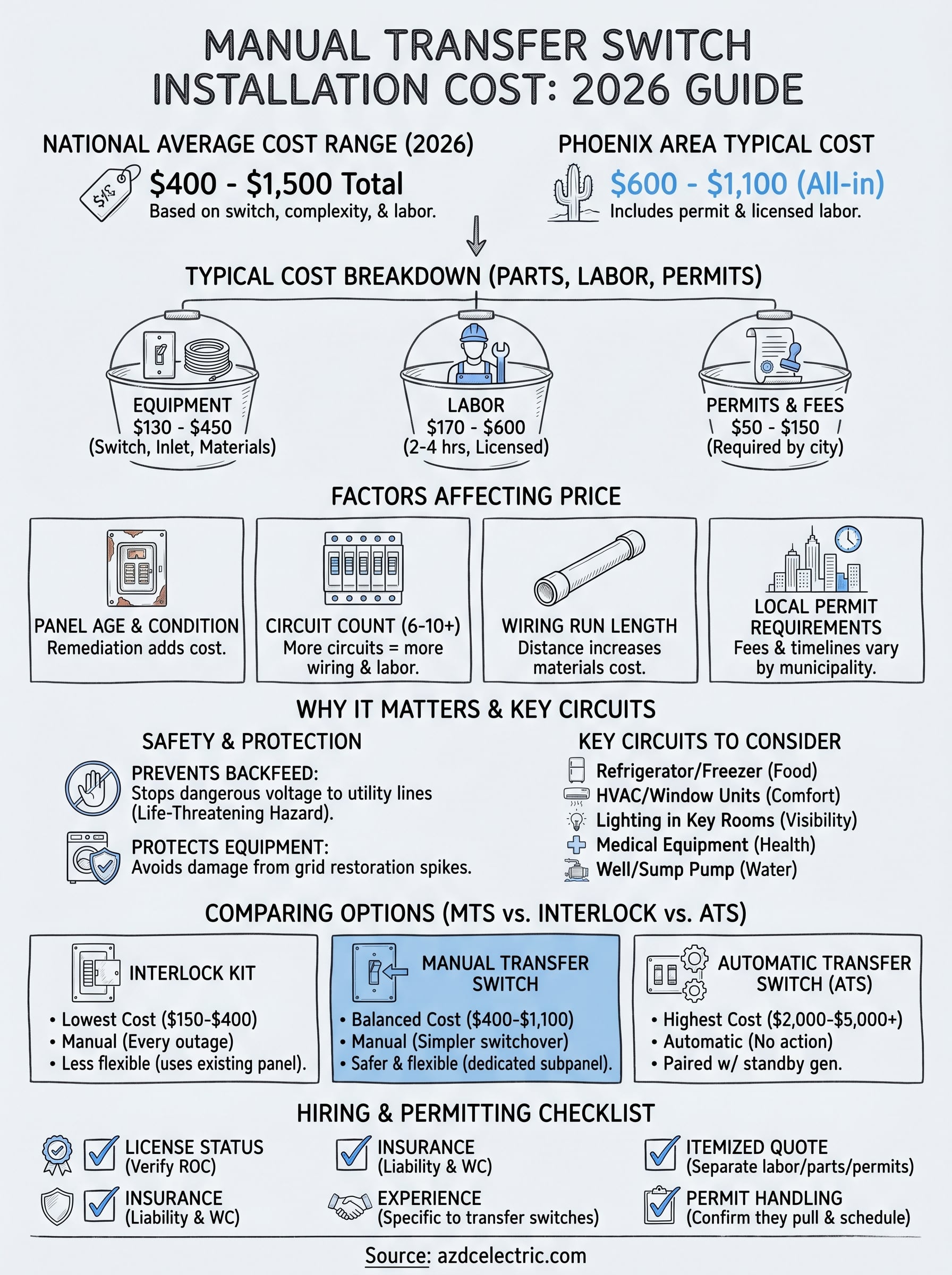
The national average for a complete manual transfer switch installation sits between $400 and $1,500 in 2026, with most residential projects landing somewhere in the $500 to $900 range when you factor in a mid-tier switch, standard labor, and a straightforward panel setup. That number shifts based on your location, the age of your electrical panel, and how many circuits you want the switch to cover. Understanding where your project falls within that range starts with knowing what drives costs at each end of the spectrum.
What the national average actually looks like
At the lower end, you’re typically looking at a basic 6-circuit switch installed on a newer panel in an accessible location, with minimal labor complications and no permit delays. At the higher end, projects usually involve older panels that need minor remediation, additional wiring runs, or larger transfer switches covering 10 or more circuits. The table below gives you a clear picture of where most projects fall by switch size.
| Switch size | Equipment cost | Labor cost | Typical total |
|---|---|---|---|
| 6-circuit manual switch | $80 to $150 | $200 to $400 | $280 to $550 |
| 8-circuit manual switch | $120 to $200 | $250 to $450 | $370 to $650 |
| 10-circuit manual switch | $175 to $300 | $300 to $500 | $475 to $800 |
| Whole-panel manual switch | $250 to $500 | $400 to $700 | $650 to $1,200 |
The manual transfer switch installation cost you see advertised often reflects equipment only. Always confirm whether a quote includes labor, materials, and permit fees before comparing numbers.
Where Phoenix-area projects land
Phoenix-area homeowners generally pay in the middle to upper portion of the national range, largely because Arizona requires permits for this type of work and licensed electrician labor rates in the metro area reflect the local cost of living. Most projects in Scottsdale, Mesa, Chandler, and surrounding suburbs run $600 to $1,100 all-in, including the switch, wiring materials, and permit fees. Summer scheduling demand can also push labor costs slightly higher if you’re booking after an outage event when every electrician in the valley is busy.
Your specific generator size also plays a role here. A larger portable generator producing 7,500 watts or more may require heavier gauge wiring between the inlet and the subpanel, which adds a modest amount to the materials cost but keeps your installation code-compliant and safe under load.
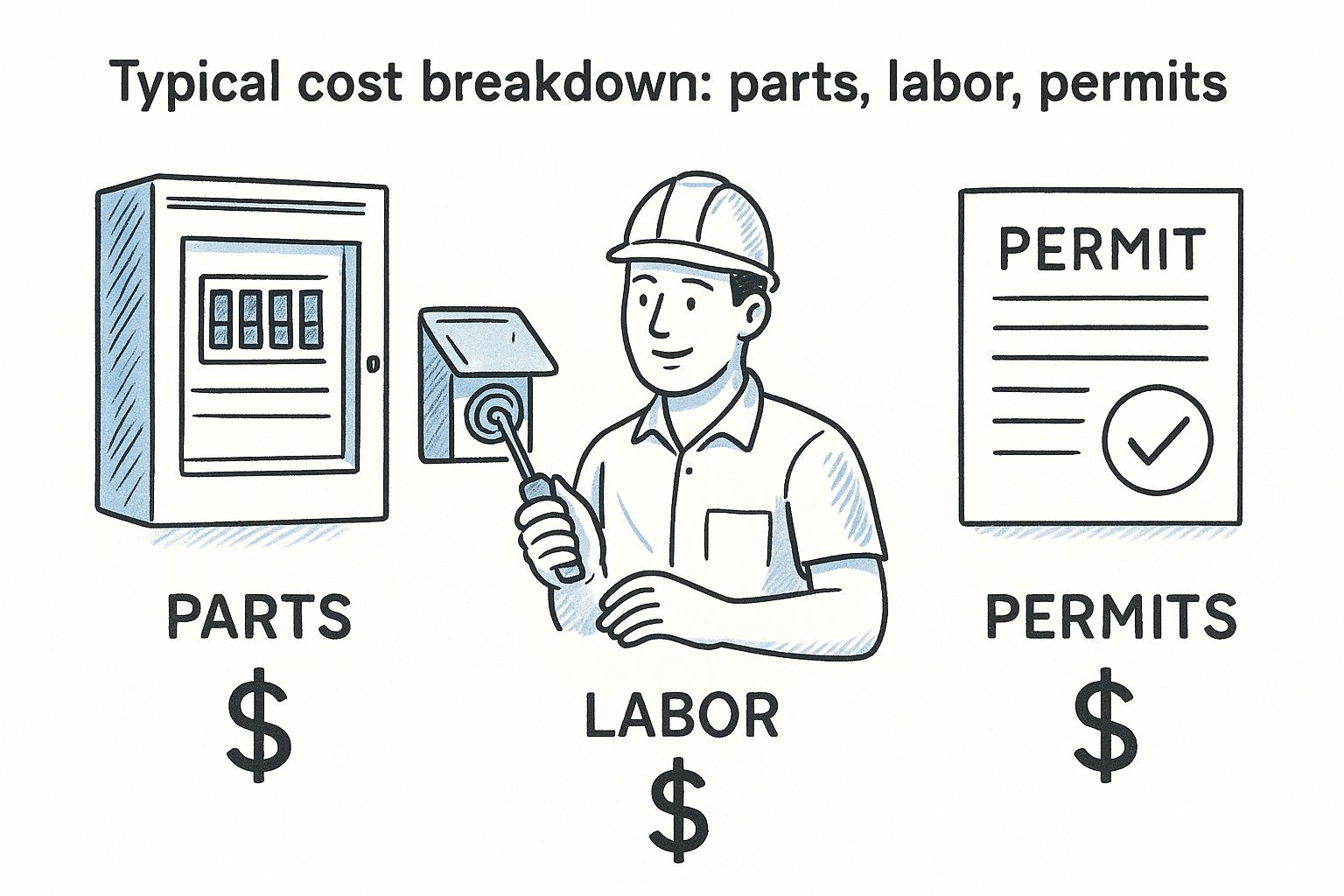
Typical cost breakdown: parts, labor, permits
Understanding the manual transfer switch installation cost means separating it into three distinct buckets: the physical equipment, the electrician’s labor, and the permit fees your local jurisdiction requires. Each one contributes to your final invoice in a predictable way, and knowing what each piece costs on its own helps you spot a quote that’s missing something important.
Equipment: the switch and the materials
The switch itself is the most straightforward part of the budget. Name-brand manual transfer switches from manufacturers like Reliance Controls or Generac typically run $80 to $300 depending on the number of circuits. Beyond the switch, your electrician needs wiring, conduit, a weatherproof inlet box for the generator cord, breakers, and connection hardware. These supplemental materials usually add $50 to $150 to the equipment side of the project, so figure $130 to $450 total for parts before anyone touches a screwdriver.
The inlet box deserves specific attention. Most installations use a 30-amp or 50-amp weatherproof inlet mounted on an exterior wall so you can connect your generator’s power cord safely from outside. The inlet’s amperage rating needs to match your generator’s output, and your electrician sizes it during the planning phase.
Labor: what electricians charge
Electrician labor in the Phoenix metro area runs $85 to $150 per hour for licensed work, and a standard manual transfer switch installation takes two to four hours for most residential projects. That puts labor costs between $170 and $600 for a typical job, with the lower end reflecting a simple install on a newer panel and the upper end covering older panels or longer wiring runs between the panel and the generator inlet location.
Ask for an itemized quote that separates labor hours from equipment costs so you can compare electricians on an equal footing.
Permits and inspection fees
Most Arizona jurisdictions require an electrical permit for transfer switch work, and you should expect the permit itself to cost $50 to $150 depending on the city. Scottsdale, Mesa, and Chandler each have their own fee schedules, but most fall within that range for a standard residential project. The permit triggers an inspection, which a licensed electrician handles as part of the job.
Skipping the permit saves nothing in the long run. If a home inspector or insurance adjuster discovers unpermitted electrical work, you may face mandatory remediation costs that dwarf the original permit fee.
What factors change the final price
The manual transfer switch installation cost you see in a general range only tells part of the story. Several specific variables can move your quote significantly in either direction, and knowing them in advance helps you understand why two neighbors with the same generator might receive estimates that differ by several hundred dollars.
Your electrical panel’s age and condition
Older electrical panels create the most common source of cost variation on any transfer switch project. If your home still has a Federal Pacific or Zinsco panel, or a panel that’s already at capacity with no open breaker slots, your electrician may need to perform remediation work before the transfer switch install can even begin. Addressing these conditions adds labor time and materials that weren’t part of the original scope.
A panel inspection before requesting transfer switch quotes is a smart move, since it eliminates surprises on installation day.
Panels in good shape with available breaker space allow electricians to work efficiently and stay within the lower portion of the labor estimate. Panels that need work first add both time and parts to your bill.
Circuit count and wiring run length
The number of circuits you want the transfer switch to cover directly affects which switch model you need and how long the installation takes. A 6-circuit switch installed on a panel in an accessible garage moves quickly. A 10-circuit switch on a panel at the opposite end of the house from the generator inlet location means more wire, more conduit, and more hours of labor.
The physical distance between your electrical panel and the exterior wall where the generator inlet mounts matters more than most homeowners expect. Every additional foot of wiring run adds materials cost and time, particularly when the route passes through finished walls, attic space, or requires conduit for code compliance.
Local permit requirements and inspection scheduling
Permit fees vary by city across the Phoenix metro area, and some municipalities take longer to schedule inspections than others, which can affect project timelines. Cities like Scottsdale and Chandler have clear online permit processes, but the fee schedules differ, and some projects require a same-day rough-in inspection before your electrician can close up any walls.
Scheduling delays in peak summer months, when demand for electrical work spikes across the valley, can also affect labor availability and push costs up modestly if you need the work done quickly after an outage event.
How to estimate your manual transfer switch cost
Estimating your manual transfer switch installation cost before calling an electrician puts you in a much stronger position during the quoting process. You don’t need to know every technical detail, but you do need a few pieces of information about your home and your generator to arrive at a number that reflects your actual project rather than a generic average. Gathering these details in advance also speeds up the quoting conversation and reduces the chance that an electrician revises their number once they arrive on-site.
Start with your circuit count
The number of circuits you want the transfer switch to cover is the single biggest variable you control going into this project. Walk through your home and identify the appliances and systems that matter most during a Phoenix-area summer outage. Refrigerators, HVAC equipment, and key lighting typically top the list, but add medical devices or a well pump if those apply to your household.
Here is a straightforward way to map this out before your first call:
- List every circuit you consider essential during an outage
- Check your main panel’s breaker labels and note the amperage for each circuit
- Add those amperage numbers together and compare the total draw to your generator’s rated output
- That comparison shows how many circuits your generator can realistically support at once, which determines the switch size you need
Factor in your panel and site conditions
Your panel’s age and its physical location relative to where you plan to mount the generator inlet box both directly affect how long the installation takes and what it costs. Check whether your panel has open breaker slots available, and measure roughly how far the panel sits from the exterior wall where the generator power cord will connect. Longer wiring runs and panels without open slots both push labor time higher, so providing these details upfront helps your electrician quote accurately rather than revise the number partway through the job.
Sharing photos of your panel and the planned inlet location with an electrician before scheduling the appointment reduces the chance of a revised quote on installation day.
Get itemized quotes and compare them
Request written quotes from at least two licensed electricians that separate equipment, labor, and permit fees as distinct line items. A quote that bundles everything into one number makes it impossible to understand what you are actually paying for. Comparing itemized quotes also reveals whether one contractor is using a higher-grade switch, billing more for labor hours, or leaving permit fees out of the total, which is common and can add $50 to $150 to your final bill if you do not ask directly before work begins.
Manual transfer switch vs interlock kit vs ATS
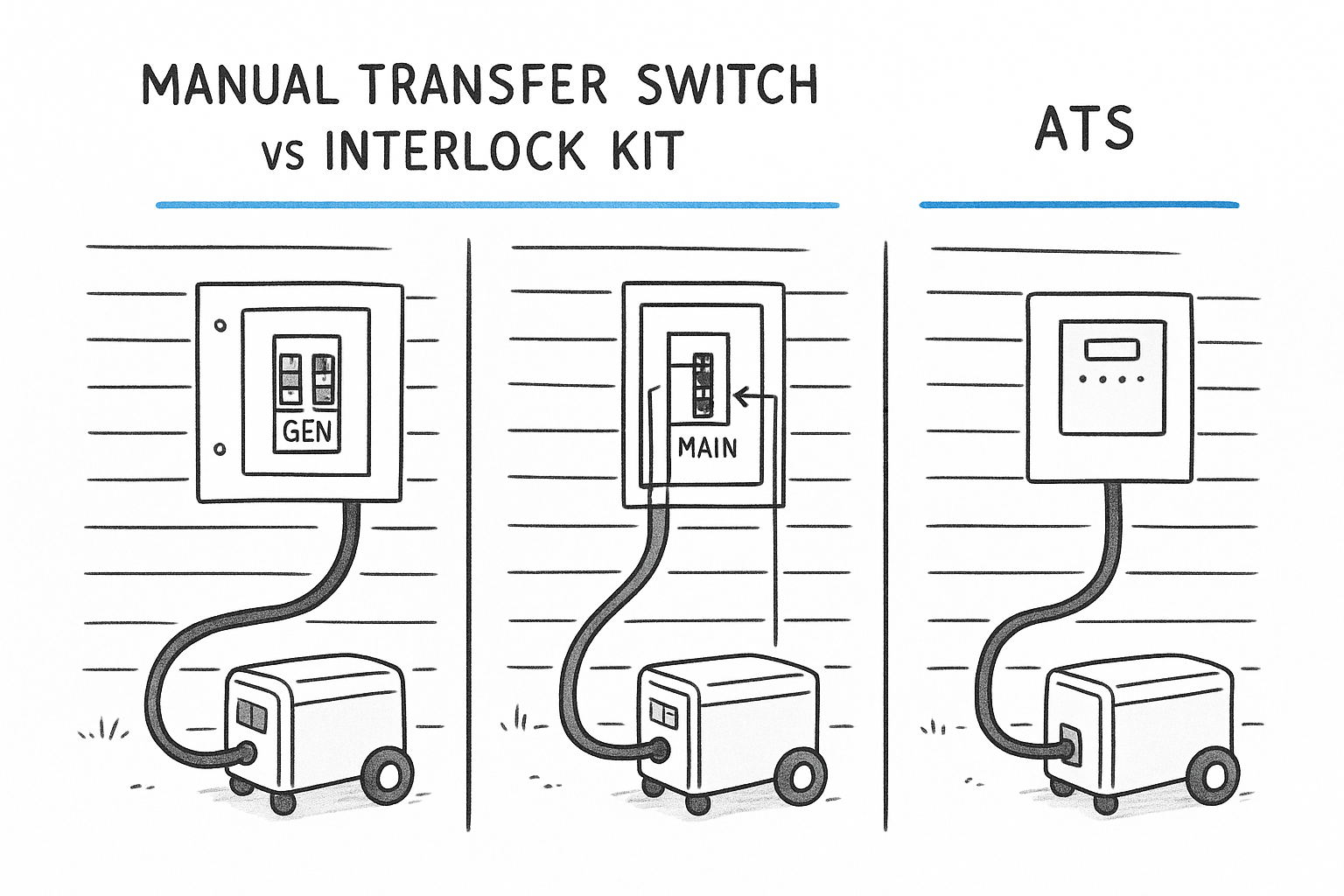
When you start researching backup power options, you will quickly find three main ways to connect a generator to your home: a manual transfer switch, an interlock kit, and an automatic transfer switch (ATS). Each one solves the same fundamental safety problem, isolating your generator from the utility line, but they do it at different price points and with different levels of convenience. Understanding the tradeoffs helps you decide which option actually fits your situation rather than simply picking the cheapest number.
Interlock kit: the lowest-cost option
An interlock kit is a metal plate that mounts directly on your existing main panel and physically prevents the main breaker and the generator breaker from being on at the same time. Because it uses your existing panel rather than adding a separate subpanel, the equipment cost runs $50 to $150, and labor is minimal since the installation is simpler than a full transfer switch setup. The tradeoff is flexibility: you manage the load manually by switching individual breakers on and off, and the approach requires more attention during an outage to avoid overloading your generator.
An interlock kit is code-compliant in most jurisdictions, but check with your local building department before purchasing one, since some municipalities have specific requirements about approved installation methods.
Automatic transfer switch: the highest-cost option
An automatic transfer switch detects a utility outage and switches your home to generator power without any action from you. That convenience comes at a significant cost: ATS installations typically run $2,000 to $5,000 or more for a residential project, and most are paired with a standby generator rather than a portable unit. If you travel frequently or have medical equipment that cannot tolerate an interruption, the ATS makes strong financial sense despite the higher price.
Which option fits your situation
Comparing the manual transfer switch installation cost against the alternatives makes the decision straightforward for most Phoenix-area homeowners who already own a portable generator.
| Option | Equipment cost | Total installed cost | Manual action required |
|---|---|---|---|
| Interlock kit | $50 to $150 | $150 to $400 | Yes, every outage |
| Manual transfer switch | $80 to $300 | $400 to $1,100 | Yes, but simpler |
| Automatic transfer switch | $300 to $1,000+ | $2,000 to $5,000+ | No |
Most homeowners with a portable generator find the manual transfer switch hits the right balance: safer and cleaner than an interlock kit, far more affordable than an ATS, and straightforward enough to operate without any technical background once the install is done.
Hiring and permitting checklist for Phoenix homes
Hiring the right electrician and pulling the correct permits are the two steps that most homeowners underestimate when budgeting a manual transfer switch installation cost. Getting both right the first time protects your investment, keeps your homeowner’s insurance valid, and ensures the work passes inspection without delays. The checklist below covers what to confirm before signing any contract and how to move through the permit process without surprises.
What to verify before hiring an electrician
Not every electrician who offers generator work has done transfer switch installations regularly, and the difference in quality between an experienced installer and someone doing their second one is significant. Verifying credentials and asking the right questions upfront saves you from costly callbacks after the job is done.
Before you hire, confirm each of the following:
- License status: Verify the electrician holds a current Arizona Registrar of Contractors license. You can check license status directly at the Arizona Registrar of Contractors website.
- Insurance: Confirm they carry both general liability insurance and workers’ compensation coverage before anyone enters your home.
- Experience with transfer switches: Ask specifically how many manual transfer switch installations they have completed, not just general electrical work.
- Itemized written quote: Request a quote that separates equipment, labor, and permit fees as distinct line items so you can compare contractors accurately.
- Timeline and permit handling: Confirm they pull the permit on your behalf and schedule the inspection, since some contractors leave that step to the homeowner.
Hiring an unlicensed electrician to cut costs often voids your homeowner’s insurance coverage for any damage related to that work.
How to handle the permit process
Phoenix-area municipalities each run their own permit process, but the basic steps are consistent across Scottsdale, Mesa, Chandler, and surrounding cities. Your electrician submits the permit application, typically online, before any work begins. The permit fee, usually $50 to $150 depending on the city, gets added to your total project cost and is non-negotiable. Once the work is complete, an inspector visits to verify the installation meets local code requirements.
Your role during this process is straightforward. Confirm with your electrician that the permit has been issued before the installation day, and make sure you receive a copy of the final inspection approval for your records. Store that document with your home’s other important paperwork, since future buyers, insurers, and lenders may ask for it.
What to do next
You now have a complete picture of manual transfer switch installation cost, from the equipment and labor breakdown to the permit process and how the options compare. Most Phoenix-area homeowners land somewhere between $600 and $1,100 for a complete installation, and the variables that push that number up or down are all things you can assess before making a single call.
Your next move is straightforward. Pull your panel’s breaker list, identify the circuits that matter most to your household during an outage, and note the distance from your panel to your planned generator inlet location. Having those details ready makes your first conversation with an electrician faster and gives you a stronger foundation for comparing quotes.
When you are ready to schedule, the team at AZ DC Electric installs manual transfer switches across Scottsdale, Mesa, Chandler, and the Greater Phoenix Metro Area with upfront pricing and a 5-year workmanship guarantee.