Choosing between LED lighting vs fluorescent lighting isn’t just about picking a bulb off the shelf. It’s a decision that directly affects your electricity bill, maintenance schedule, and even how comfortable a room feels. Both technologies have been used in homes and businesses across the Phoenix metro for decades, but they perform very differently when you look at the numbers, and the gap has only widened in recent years.
Fluorescent fixtures were once the go-to for anyone who wanted something more efficient than incandescent bulbs. They got the job done. But LED technology has matured fast, and the cost to buy in has dropped significantly. That shift has left a lot of homeowners and business owners wondering whether it’s time to replace what they already have or stick with what’s working. The answer depends on factors like energy consumption, lifespan, upfront cost, and even potential health effects like eye strain and flicker sensitivity.
At AZ DC Electric, we handle lighting upgrades and installations throughout the Greater Phoenix area every week, from retrofitting fluorescent panels in commercial spaces to installing new LED systems in residential remodels. We put this guide together based on what we see in the field and the questions our customers actually ask. Below, you’ll find a straight comparison of cost, efficiency, lifespan, and practical trade-offs so you can make the right call for your space.
Why the LED vs fluorescent choice matters
Most people don’t give their lighting a second thought until a tube burns out or a fixture starts flickering. But the choice between LED and fluorescent lighting affects what you pay every month, how often you deal with replacements, and whether the light in your home or workspace is comfortable to spend hours in. For homeowners and businesses across the Phoenix metro, where power bills already climb in summer, those factors show up directly in your budget.
The real cost of running older fluorescent fixtures
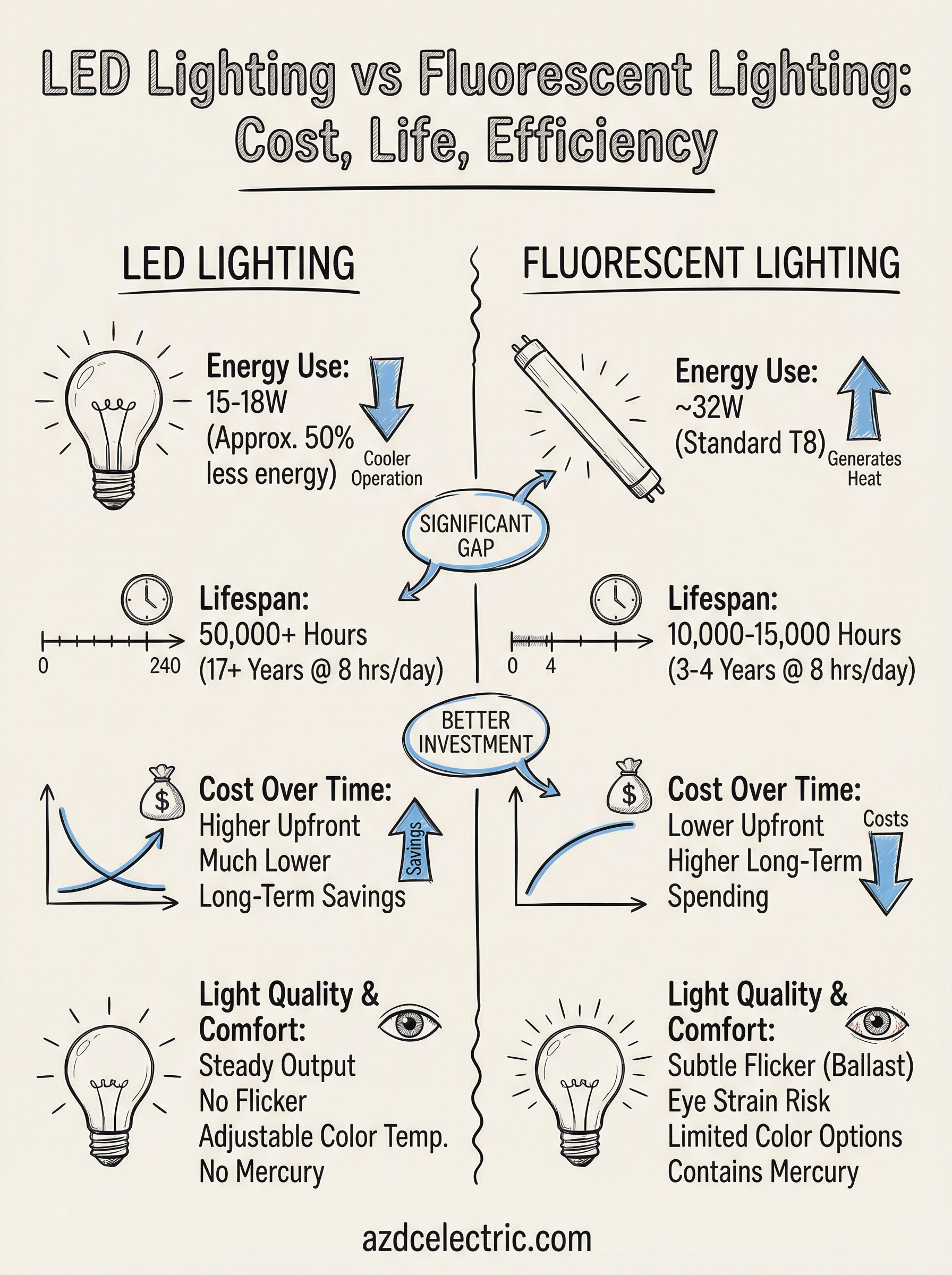
Fluorescent lighting was a real step up from incandescent, but LED technology has moved well beyond what fluorescent can offer in terms of energy consumption. A standard T8 fluorescent tube draws around 32 watts. A comparable LED tube draws roughly 15 to 18 watts while producing the same usable light output. If you have a commercial space or a home with multiple fixtures running several hours each day, that wattage gap turns into measurable monthly savings on your utility bill.
In a space with 20 fluorescent fixtures running eight hours a day, switching to LED equivalents can cut lighting-related electricity use by 40 to 50 percent.
Beyond wattage, tubes also generate more heat than LED alternatives. That extra heat raises the ambient temperature in the room, which puts more pressure on your air conditioning system. In an Arizona summer, reducing heat load from your lighting is a practical way to lower cooling costs, not just an environmental preference.
Beyond the bill: comfort, maintenance, and long-term planning
When you compare led lighting vs fluorescent lighting on comfort, the differences are easy to overlook until you experience them side by side. Fluorescent tubes use a ballast to regulate current, and that ballast causes a low-level flicker, especially as the fixture ages. Some people develop eye strain or headaches from that flicker without ever connecting it back to their lighting source.
LED fixtures don’t use a ballast, so they deliver steady, consistent light output without the subtle cycling that fluorescent tubes exhibit. They also come in a wide range of color temperatures, from warm amber tones to crisp daylight whites, so you can match the light to each room’s specific purpose.
Maintenance rounds out the comparison. Fluorescent tubes typically last 10,000 to 15,000 hours. Quality LED products are rated for 50,000 hours or more, which means far fewer replacements and less time coordinating service calls over the full life of your fixtures. That reliability matters whether you’re managing a single-family home or a commercial property with dozens of fixtures overhead.
LED vs fluorescent basics: how each light works
Understanding how each technology works gives you a clearer picture of why they perform so differently. Fluorescent and LED fixtures both convert electrical energy into visible light, but the process each one uses is completely different, and those differences explain the gap in efficiency, lifespan, and light quality.
How fluorescent tubes produce light
A fluorescent tube works by running an electrical current through a sealed glass tube filled with mercury vapor and inert gas. That current excites the mercury vapor, which releases ultraviolet radiation. The UV radiation then strikes a phosphor coating on the inside of the tube, and that coating converts the UV energy into visible light. The process requires a ballast to regulate the current and prevent the tube from drawing too much power and burning out instantly.
Because fluorescent tubes rely on mercury vapor, they require special disposal to avoid releasing toxic material into the environment.
How LEDs produce light
LED stands for light-emitting diode, and the process is far more direct. When electricity passes through a semiconductor material, it excites electrons that release energy in the form of photons, which are visible light. There’s no gas, no mercury, and no ballast involved. The result is a light source that converts a much higher percentage of input energy into light rather than heat.
When you compare led lighting vs fluorescent lighting at the mechanical level, the simpler design of an LED is a big part of why it lasts longer and runs cooler. Fewer moving parts and no reactive components mean less that can wear out or fail over time. That simplicity also makes LED fixtures easier to dim, easier to control with smart home systems, and less sensitive to temperature changes, which matters in a Phoenix climate where attic and garage temperatures swing dramatically by season.
Energy use, lifespan, and total cost over time
Numbers make the led lighting vs fluorescent lighting debate concrete. When you put the actual figures side by side, the gap between these two technologies becomes hard to ignore, especially if you’re trying to control operating costs in a home or commercial space over several years.

Wattage and energy consumption
A standard T8 fluorescent tube draws around 32 watts to produce roughly 2,600 lumens. A direct LED replacement for that same tube draws between 15 and 18 watts for comparable output. That’s a reduction of nearly 50 percent in energy consumption per fixture. Multiply that across a home with 10 fixtures running six hours a day, and you’re looking at a real difference on your monthly utility bill.
Lighting can account for 10 to 15 percent of a home’s total electricity use, so cutting that load in half adds up fast.
Lifespan and replacement frequency
Fluorescent tubes typically carry a rated lifespan of 10,000 to 15,000 hours. Quality LED tubes and fixtures are rated for 50,000 hours or more, which means you replace them far less often. Run a fixture for eight hours a day, and a fluorescent tube lasts roughly three to four years. An LED in the same fixture can last over 17 years.
Fewer replacements mean lower material costs and less time coordinating maintenance visits. For a commercial property with dozens of overhead fixtures, that difference alone can justify the switch before you factor in any energy savings.
How the total cost compares
LED fixtures cost more upfront than fluorescent tubes. However, lower energy bills and fewer replacements close that gap within one to two years for most applications. After that payback period, every additional year of LED operation is net savings.
For a home in the Phoenix metro running central AC most of the year, reduced heat output from LED fixtures also puts less strain on your cooling system. That secondary benefit adds to your total annual savings beyond what the lights directly consume.
Light quality, comfort, and safety differences
When you compare led lighting vs fluorescent lighting, energy costs tend to dominate the conversation, but how the light actually feels in a room matters just as much. The way a fixture delivers light affects focus, eye comfort, and even how safe your space is day to day.
Flicker, color temperature, and eye comfort
Fluorescent fixtures rely on a ballast to regulate current, and that ballast causes a subtle flicker that cycles with the electrical frequency, typically 60 times per second in the US. Most people don’t consciously notice it, but over hours of exposure it can contribute to eye strain, headaches, and fatigue. Sensitive individuals, including people with migraines or certain visual conditions, often feel the effects before they identify the source.
Switching to LED fixtures eliminates ballast-related flicker entirely, which is one of the most immediate comfort improvements people report after an upgrade.
LED fixtures produce steady, consistent light output because they run on direct current with no cycling component. They also give you control over color temperature. You can choose warm whites around 2700K for living spaces or cooler daylight tones around 5000K for task areas like kitchens or workspaces. Fluorescent tubes offer limited flexibility in this area and tend to shift color over time as they age.
Safety considerations
Fluorescent tubes contain mercury vapor, which makes safe disposal a real concern. A broken tube releases that mercury into the air and surfaces around it, requiring careful cleanup. LEDs contain no mercury or other hazardous gases, so a broken fixture doesn’t create a chemical exposure risk in your home or commercial space.
For households with children or pets, that difference is worth factoring in alongside the efficiency and comfort benefits you gain from making the switch.
How to switch from fluorescent to LED
Switching from fluorescent to LED is simpler than most people expect, but the right approach depends on what fixtures you currently have and how your electrical system is wired. Before you buy anything, spend a few minutes understanding what you’re working with so you don’t end up with incompatible parts.
Check your existing fixtures first
Your first step is identifying whether your fluorescent fixtures use a magnetic or electronic ballast. Some LED tubes work with an existing ballast, which makes installation straightforward. Others require you to bypass the ballast entirely, which takes more electrical work but removes a component that can fail and reduce efficiency over time. Check the tube packaging carefully, as it will specify ballast compatibility.
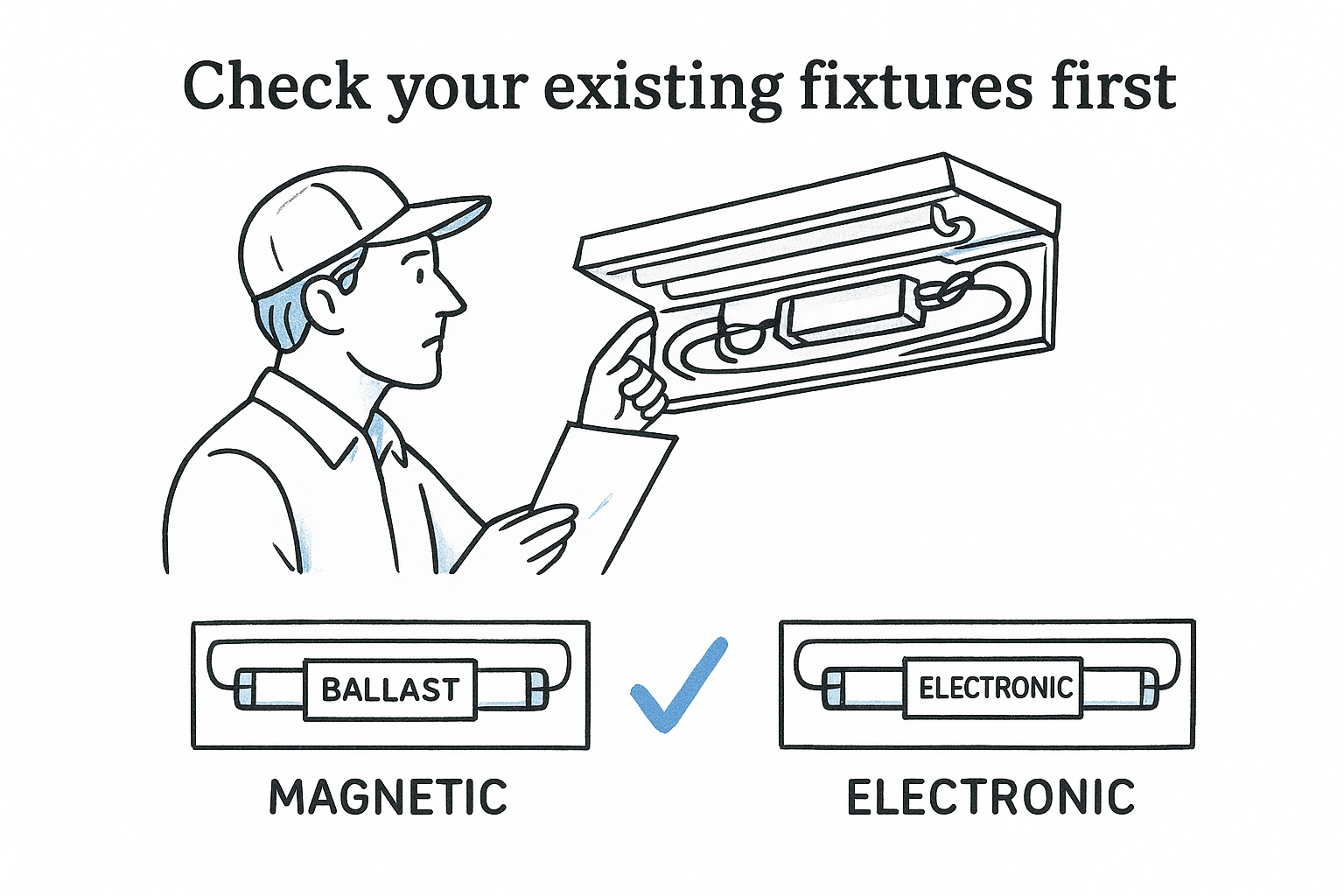
Bypassing the ballast during your upgrade is often the smarter long-term move, since ballasts are a common failure point in aging fluorescent fixtures.
When comparing led lighting vs fluorescent lighting upgrade paths, you’ll typically encounter three tube types:
- Type A LED tubes: Plug directly into existing ballast-compatible fixtures with no rewiring needed.
- Type B LED tubes: Require ballast bypass and connect directly to line voltage.
- Type A+B LED tubes: Work both ways, giving you flexibility during a staged rollout.
Installation: retrofit vs full replacement
For a straightforward retrofit, a Type A LED tube swap takes minutes per fixture and requires no special tools. However, if your ballast is aging or already failing, bypassing it now saves you from revisiting the same fixture in a year or two.
Full fixture replacement makes the most sense when your fluorescent housings are old, corroded, or visually dated. A licensed electrician can remove the old fixture and wire in a new LED panel cleanly, which is the better long-term investment for most commercial spaces and residential kitchens or garages.
A simple next step
The led lighting vs fluorescent lighting comparison comes down to a clear conclusion: LED wins on energy use, lifespan, comfort, and safety. The upfront cost is higher, but the payback period is short, and everything after that is money staying in your pocket rather than going to your utility company.
If you’re ready to upgrade your home or commercial space in the Greater Phoenix area, the next step is getting a licensed electrician to assess your current fixtures and give you an accurate quote. Knowing exactly what you’re working with before you buy anything saves time and avoids compatibility problems that can turn a simple swap into a frustrating project.
AZ DC Electric serves homeowners and businesses across the Phoenix metro with lighting installations, retrofits, and full electrical upgrades. Book a lighting consultation with AZ DC Electric and find out what a switch to LED would cost and save for your specific space.