Adding outdoor lighting to your Phoenix-area home does more than make the yard look good after dark, it extends your usable living space, improves safety along walkways, and can bump up property value. But before you call a contractor, you probably want a straight answer on landscape lighting installation cost so you can set a realistic budget. The problem is that pricing varies widely depending on the number of fixtures, the type of lighting system, and how complex the wiring and layout actually are.
Most homeowners in the Greater Phoenix Metro Area spend somewhere between $2,000 and $6,000 on a professional landscape lighting project, though that number can climb higher for large properties or premium fixtures. The quotes you receive will typically include materials, labor, and any electrical work needed to safely connect everything. Without understanding what goes into those numbers, it’s hard to know whether a contractor’s estimate is fair or inflated.
That’s exactly what this guide breaks down. At AZ DC Electric, we handle outdoor and backyard lighting installations across Scottsdale, Mesa, Chandler, and the surrounding area, so we see real project costs every week. Below, you’ll find a detailed look at per-fixture pricing, labor rates, common project totals, and the factors that push costs up or keep them down. Whether you’re comparing quotes or just starting to plan, this breakdown will give you the numbers you need to move forward with confidence.
Why landscape lighting costs vary so much
When you get two quotes for the same general project concept and they’re thousands of dollars apart, it’s not necessarily because one contractor is trying to overcharge you. Landscape lighting installation cost depends on several independent variables that can each shift the total significantly. Understanding what drives those differences gives you a much stronger position when reviewing bids or deciding where to allocate your budget.
The type of lighting system you choose
The biggest single factor in your project cost is whether you install a low-voltage system or a line-voltage system. Low-voltage systems run on 12 volts and use a transformer to step down power from a standard 120-volt outlet. They’re safer to work around, easier to adjust, and the fixtures themselves tend to cost less. Line-voltage systems run at full 120 volts, require conduit and more involved wiring, and are typically used for high-output fixtures like large flood lights or commercial-grade path lighting.
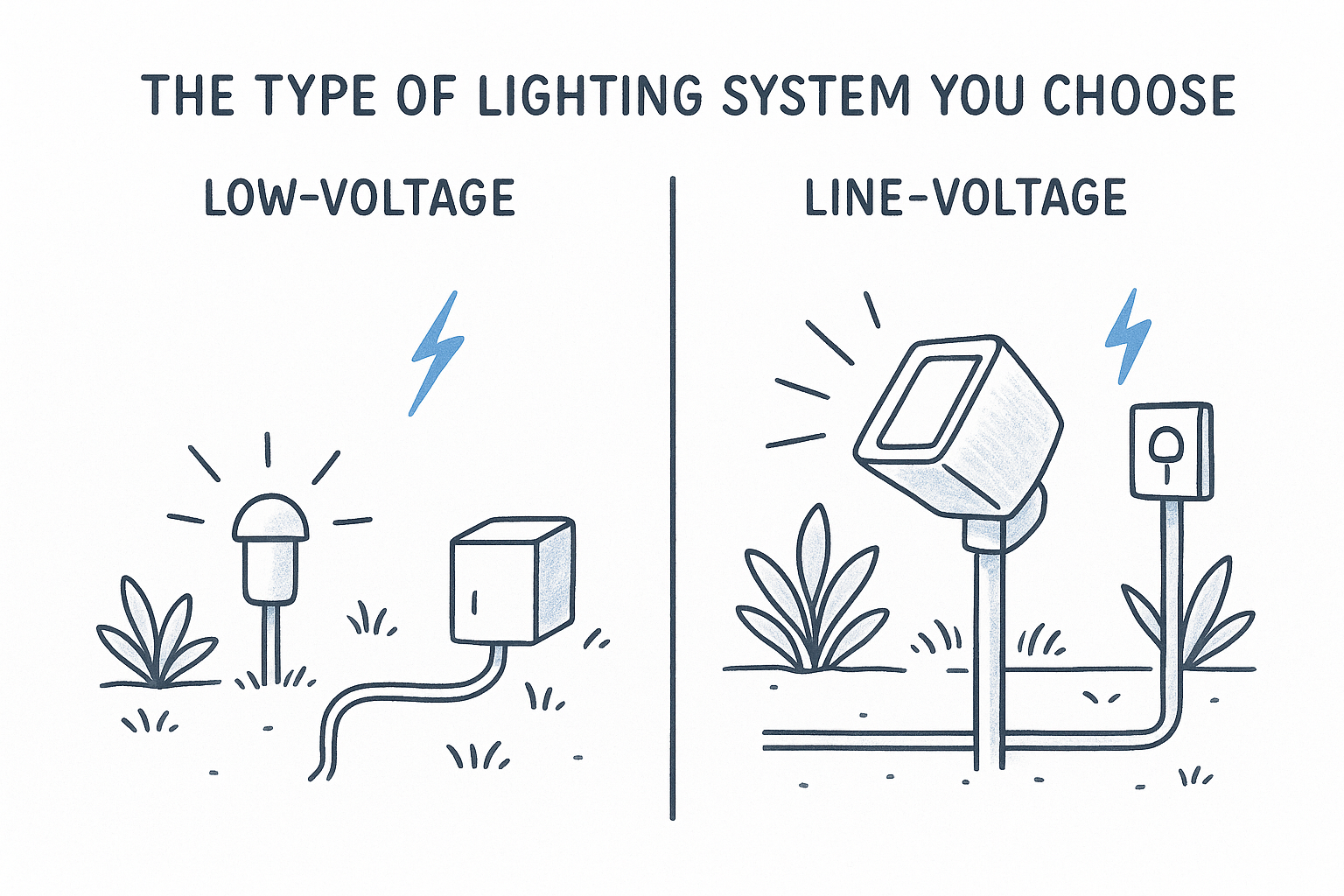
Choosing between low-voltage and line-voltage is the first decision that shapes every other cost in your project.
LED fixtures have become the default for most residential installs because they use far less power and last significantly longer than halogen alternatives. However, LED fixtures at the premium end, such as smart-enabled or color-tunable models, can cost two to three times more per unit than basic options.
The number of fixtures and layout complexity
The more lights you install, the higher your material and labor costs climb, but the relationship isn’t always linear. Installing 20 fixtures in a compact front yard is faster and less expensive per fixture than spreading 20 fixtures across a large backyard with multiple garden beds, a pool, trees, and a long driveway. The layout itself determines how many transformer circuits, wire runs, and connection points a technician needs to map out and install.
Complex layouts also increase the time spent on planning and testing. Your electrician has to calculate load per circuit, plan wire routing to avoid roots and irrigation lines, and test each zone after installation. All of that additional labor adds up separately from the cost of the fixtures themselves.
Labor and electrical work requirements
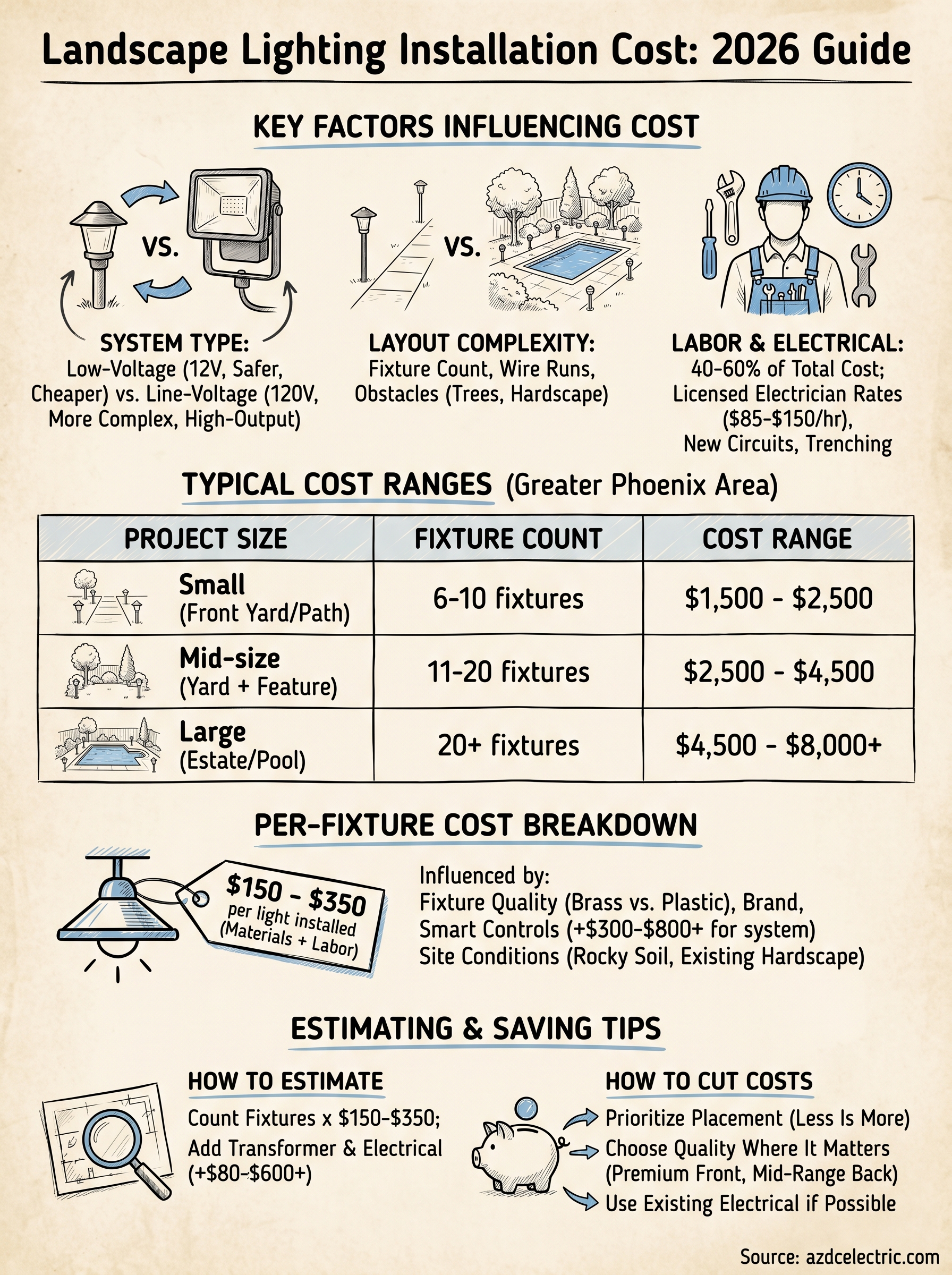
Labor typically makes up 40 to 60 percent of a landscape lighting project’s total cost. Simple installs with a surface-mounted transformer and short wire runs take less time. Projects that require trenching for buried conduit, adding a new circuit to the electrical panel, or working around existing hardscape take considerably more time and expertise.
In the Phoenix area, licensed electricians typically charge between $85 and $150 per hour. Projects requiring panel work or dedicated circuits add both parts and time to the bill, which is why two projects with the same number of fixtures can land at very different final totals.
Landscape lighting cost ranges in 2026
Having a clear sense of what projects actually cost helps you evaluate quotes without second-guessing yourself. Landscape lighting installation cost in 2026 generally falls into three tiers based on project scope, fixture count, and the amount of electrical work required. Knowing which tier fits your yard gives you a realistic starting point before you contact a single contractor.
Small and mid-size residential projects
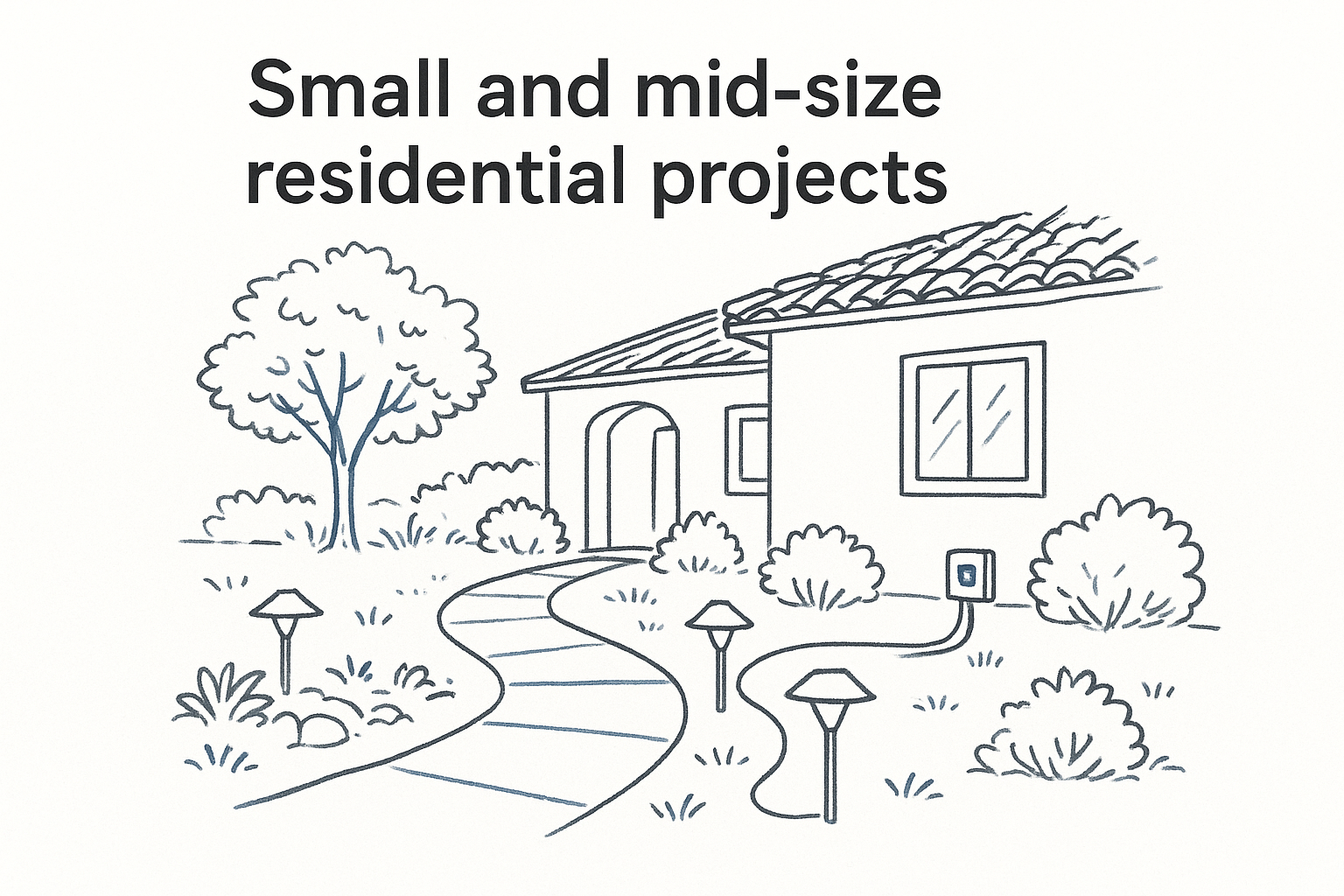
Most homeowners in the Phoenix area start with a focused install covering a front yard, a single garden bed, or a walkway from the driveway to the front door. Projects at this scale typically include 6 to 15 fixtures and connect through a standard low-voltage transformer plugged into an existing outdoor outlet. Total costs for these installs usually land between $1,500 and $4,500, with the lower end covering basic path lights and the upper end including uplighting on trees or architectural details on the home’s facade.
| Project size | Fixture count | Typical cost range |
|---|---|---|
| Small | 6-10 fixtures | $1,500 – $2,500 |
| Mid-size | 11-20 fixtures | $2,500 – $4,500 |
| Large | 20+ fixtures | $4,500 – $8,000+ |
Once your fixture count exceeds 20, costs scale faster because multi-zone transformers, additional wire runs, and dedicated circuits all start entering the picture.
Larger and more complex installs
Properties with large backyards, pools, mature trees, or long driveways typically need 20 or more fixtures and multi-zone control systems to achieve consistent coverage after dark. These projects frequently require a licensed electrician to add a dedicated circuit or upgrade the panel connection, which pushes the total into the $5,000 to $8,000 range. Premium smart lighting setups with app-based controls, color tuning, or integrated timers can push a large project past $10,000 depending on the brands and fixture count involved.
Per-fixture costs at this scale generally run $150 to $350 per light installed, covering both the fixture and the labor to wire it properly. Specialty fixtures like in-ground well lights or waterproof spotlights rated for pool surrounds sit at the higher end of that range, while standard path lights or basic uplights tend to stay toward the lower end.
What drives the price up or down
Two projects with the same number of fixtures can land at very different price points depending on the specific choices you make upfront and the conditions on your property. Once you understand which decisions actually move the needle on landscape lighting installation cost, you can make smarter trade-offs rather than simply accepting or rejecting a quote as a whole.
Fixture quality and brand selection
Not all fixtures are built the same, and the difference in price between a budget path light and a commercial-grade equivalent can be three times the cost or more. Brass and copper fixtures hold up far better in the Arizona heat than plastic or zinc-alloy options, but they cost significantly more per unit. Mid-range fixtures from reputable manufacturers typically land between $25 and $80 per fixture, while premium architectural-grade options can run $150 or higher per light before labor.
Choosing durable materials upfront almost always costs less over time than replacing failed cheap fixtures every few years.
Site conditions and your property’s layout
Your yard’s physical characteristics have a direct impact on installation time and therefore labor cost. Rocky or compacted soil, which is common across the Phoenix Metro Area, makes trenching for buried wire runs slower and harder. Existing concrete, pavers, or hardscape that needs to be worked around adds additional time to route wiring cleanly without damaging finished surfaces.
Properties with mature trees, irrigation systems, or retaining walls also require more planning to position fixtures and pull wire without creating future problems. Each added complexity translates directly into billable hours.
Smart controls and automation features
Adding timer controls, motion sensors, or a Wi-Fi-enabled smart transformer lifts the cost of both materials and setup time. Basic programmable timers add relatively little to a project. Full smart-home integration with zone-based app control and dimming can add $300 to $800 or more depending on the system you select.
How to estimate your landscape lighting cost
Before you call a contractor, doing a rough estimate on your own gives you a useful baseline to compare against professional quotes. Start by walking your property at night and noting which areas feel unsafe or underwhelming. Counting the approximate number of fixtures you want, even if that number changes later, gives you a concrete starting point for calculating materials and labor.
Build your fixture count first
Your fixture count drives the bulk of your estimate. For a basic walkway or front yard install, plan for one fixture every 6 to 8 feet along path edges, then add uplights for any trees or architectural features you want to highlight. Once you have a rough count, multiply it by a per-fixture installed cost of $150 to $350, which includes both the fixture itself and the labor to wire and position it. A yard needing 12 fixtures lands you somewhere between $1,800 and $4,200 in materials and labor alone before accounting for any electrical upgrades.
Use the lower end of that range for simple low-voltage installs and the upper end when your layout involves specialty fixtures or buried conduit runs.
Factor in electrical and control system costs
Your landscape lighting installation cost estimate is not complete until you account for the transformer and controls. A standard low-voltage transformer capable of handling 10 to 15 fixtures costs $80 to $300 for the unit, plus an hour or so of an electrician’s time to mount and connect it. If your project requires a new outdoor circuit or panel work, budget an additional $300 to $600 on top of fixture costs. Smart transformers with app-based controls add another $200 to $500 depending on the brand. Adding these line items to your fixture estimate gives you a realistic total range before any contractor sets foot on your property.
How to cut costs without a bad install
Cutting your landscape lighting installation cost does not require skimping on materials or skipping professional labor. The most effective savings come from making smarter decisions at the planning stage, before a single fixture is purchased or a wire is pulled.
Prioritize placement over quantity
More fixtures do not always mean better results. A well-placed uplight on a large oak tree or a focal wall delivers more visual impact than six mediocre path lights scattered randomly across a lawn. Start with a focused lighting plan that identifies the three or four areas where lighting will matter most, then fill in secondary areas later if your budget allows. Phasing your project this way lets you spread the cost across time without compromising the quality of the initial install.
A smaller, well-executed install almost always outperforms a larger one done on a tight budget with cheap fixtures and rushed wiring.
Choose where to invest and where to save
Not every fixture on your property needs to be premium. High-visibility locations like your front entryway, a featured tree, or the pool surround deserve durable, weather-rated fixtures built to last in Arizona’s heat. In lower-traffic or secondary zones like a side yard or a back fence line, mid-range fixtures perform adequately and can bring your per-unit cost down considerably without affecting the overall look.
Use your existing electrical setup where possible
New circuits and panel work add real cost to any project. If your property already has outdoor outlets in useful locations, a licensed electrician can often connect a low-voltage transformer there without any additional electrical upgrades. Ask your contractor to assess your current outdoor electrical setup before assuming you need new circuits. In many Phoenix-area homes, existing infrastructure covers a straightforward landscape lighting install without extra panel work, which keeps the final total lower without cutting any corners on quality.
Next steps for pricing your project
You now have a solid picture of what landscape lighting installation cost actually looks like in 2026, from per-fixture pricing to labor rates and the factors that shift your total in either direction. The most useful next step is to walk your property at night, identify the areas that matter most to you, and put together a rough fixture count before you reach out to a contractor. That simple exercise turns a vague project idea into something specific enough to get an accurate quote on.
From there, the goal is finding a licensed electrician who gives you upfront pricing before any work begins and stands behind the installation with a clear workmanship guarantee. At AZ DC Electric, we serve homeowners across Scottsdale, Mesa, Chandler, and the Greater Phoenix Metro Area with exactly that approach. Request your outdoor lighting consultation today and get a clear number before committing to anything.