Most homeowners test their smoke alarms when the low-battery chirp starts, and that’s about it. But testing only tells you the battery and circuit work right now. It doesn’t tell you whether the sensor inside can actually detect smoke fast enough to save your life. If you’re wondering how often to replace smoke alarms, the short answer is every 10 years, and the reasons behind that timeline matter more than you might expect.
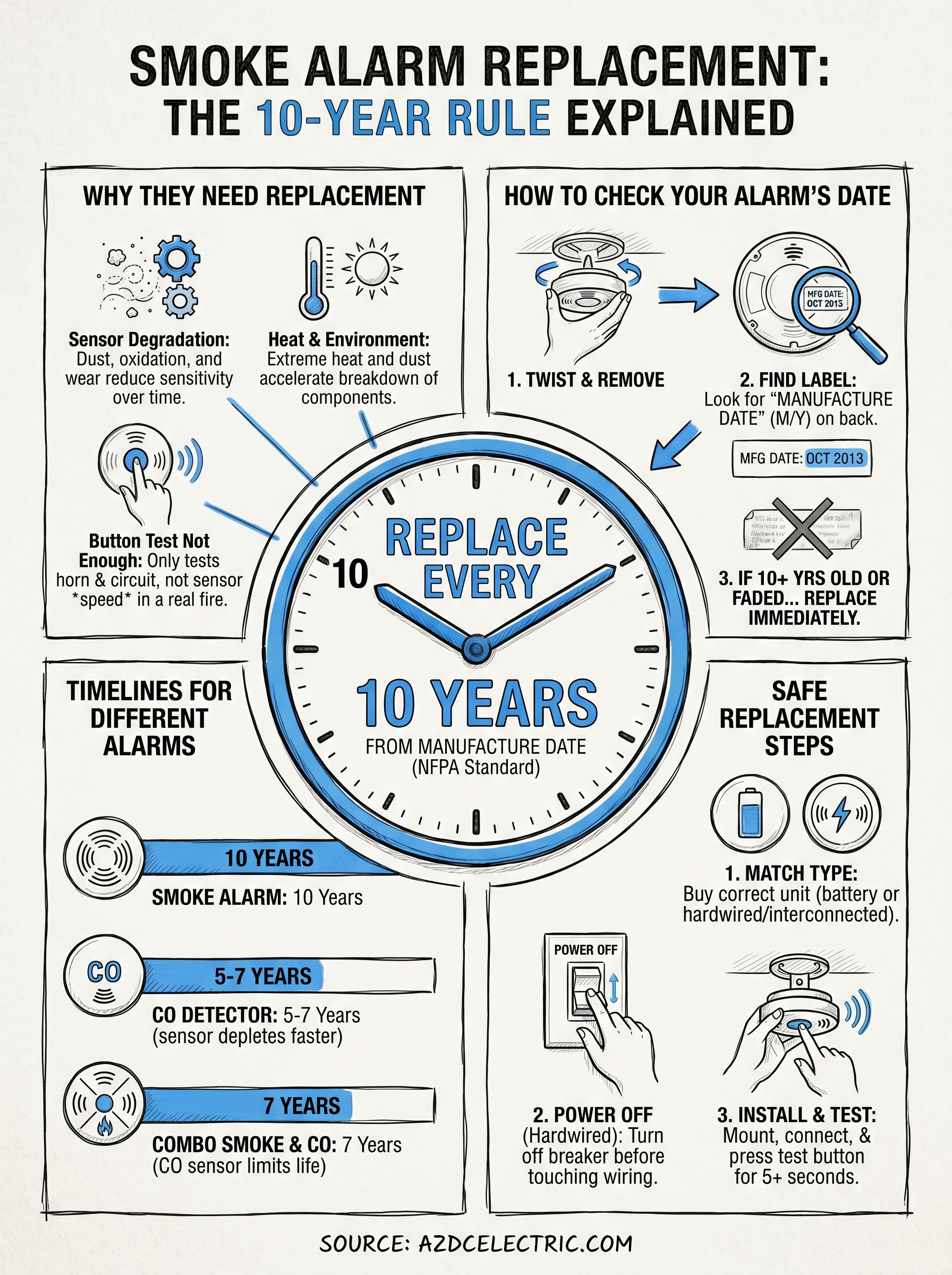
Smoke alarm sensors degrade over time due to dust, oxidation, and general wear. After a decade, even a unit that beeps during testing may fail to respond quickly enough in a real fire. The National Fire Protection Association (NFPA) and every major manufacturer agree on this 10-year replacement standard, yet millions of homes across the Phoenix Metro Area still have alarms well past their expiration.
At AZ DC Electric, we handle smoke alarm installations and home electrical safety inspections throughout Scottsdale, Mesa, Chandler, and the surrounding valley. We see expired alarms on a regular basis during service calls, units with faded labels, missing date stamps, or sensors older than the roof above them. This article breaks down the 10-year rule, explains how to check your alarm’s manufacture or expiration date, and walks you through what to do when it’s time for a replacement.
What the 10-year smoke alarm rule means
The 10-year smoke alarm rule is the industry-standard guideline stating that every smoke alarm should be replaced a full decade after its manufacture date, regardless of whether it still passes a button test. This rule applies to virtually every residential smoke detector on the market, from basic battery-operated units to hardwired alarms with backup batteries. Following this timeline is not optional maintenance; it is the minimum safety standard backed by national fire codes and every major alarm manufacturer.
The NFPA 72 National Fire Alarm and Signaling Code requires smoke alarms to be replaced no later than 10 years from the manufacture date stamped on the unit.
Where the rule comes from
The National Fire Protection Association (NFPA) establishes this standard through NFPA 72, and manufacturers are required to comply with it. Most units print an expiration or manufacture date directly on the back or side of the housing. The U.S. Consumer Product Safety Commission also recommends this same replacement cycle for residential smoke alarms. These are independent organizations reaching the same conclusion based on how alarm sensor technology ages in real-world conditions.
What the rule actually covers
Understanding how often to replace smoke alarms means recognizing that the rule covers the entire unit, not just the battery. Many homeowners assume that swapping batteries every year keeps an alarm fully functional, but that assumption is wrong. The internal sensing chamber accumulates microscopic dust and debris over time, and the electrochemical or photoelectric components gradually lose their sensitivity. A fresh battery in a nine-year-old alarm does not make that alarm reliable in a real fire.
Your replacement clock also starts from the manufacture date, not the installation date. If a unit sat in a box in your garage for two years before you mounted it, you count from the label date, which means your remaining service life may be shorter than you expect.
Why smoke alarms need replacement over time
Smoke alarms do not fail all at once. Sensor sensitivity declines gradually over years, often without any visible sign, which means a unit can appear functional while delivering significantly slower detection in an actual fire. This gradual decline is why how often to replace smoke alarms is tied to science, not just a manufacturer preference.
How sensors lose their sensitivity
The two main residential alarm types degrade in different ways. Ionization sensors contain a small radioactive element that slowly loses its charge, reducing its ability to detect fast-flaming fires. Photoelectric sensors rely on a light beam inside a chamber, and accumulated dust and oxidation gradually obscure that beam, slowing detection of smoldering fires.
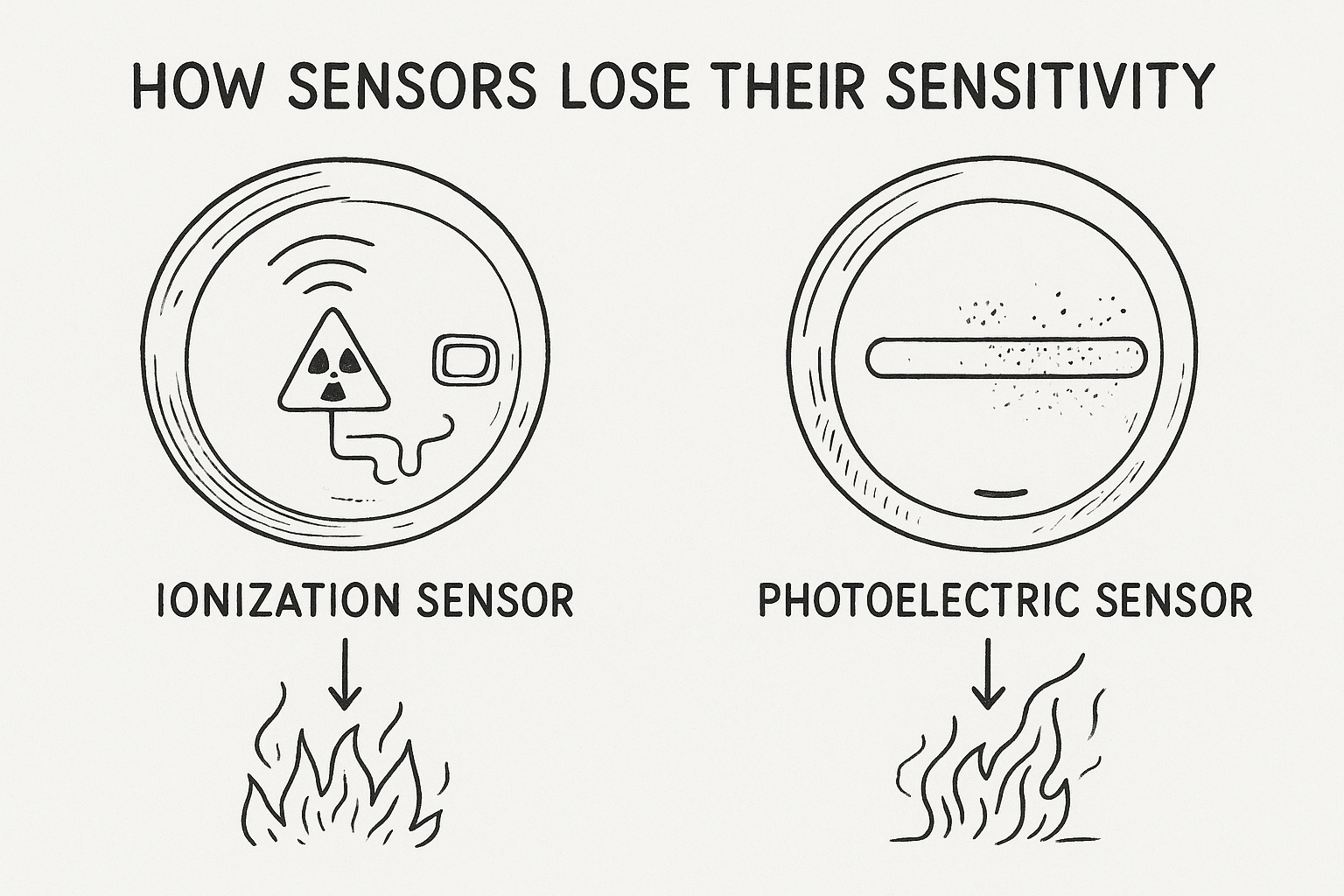
A successful button test only confirms the horn and circuit work. It does not verify that the sensor can detect smoke quickly enough to give you time to escape.
Heat and environment accelerate wear
Arizona’s climate adds extra stress on your alarms. Extreme summer heat accelerates the breakdown of plastic housing and internal components beyond what standard lab conditions account for.
Desert dust also plays a role. Fine particulate matter common in the Phoenix Metro Area infiltrates sensing chambers faster than in other climates, shortening the practical life of your units even further.
How to check your alarm date and service life
Knowing how often to replace smoke alarms only helps if you can identify when your current units were manufactured. Every residential smoke alarm is required to display a manufacture date on the unit itself, and locating it takes less than a minute per alarm.
Finding the manufacture date label
Twist the alarm counterclockwise off its mounting bracket and look at the back of the housing. The manufacture date is typically stamped or printed in small text near the model and serial number.
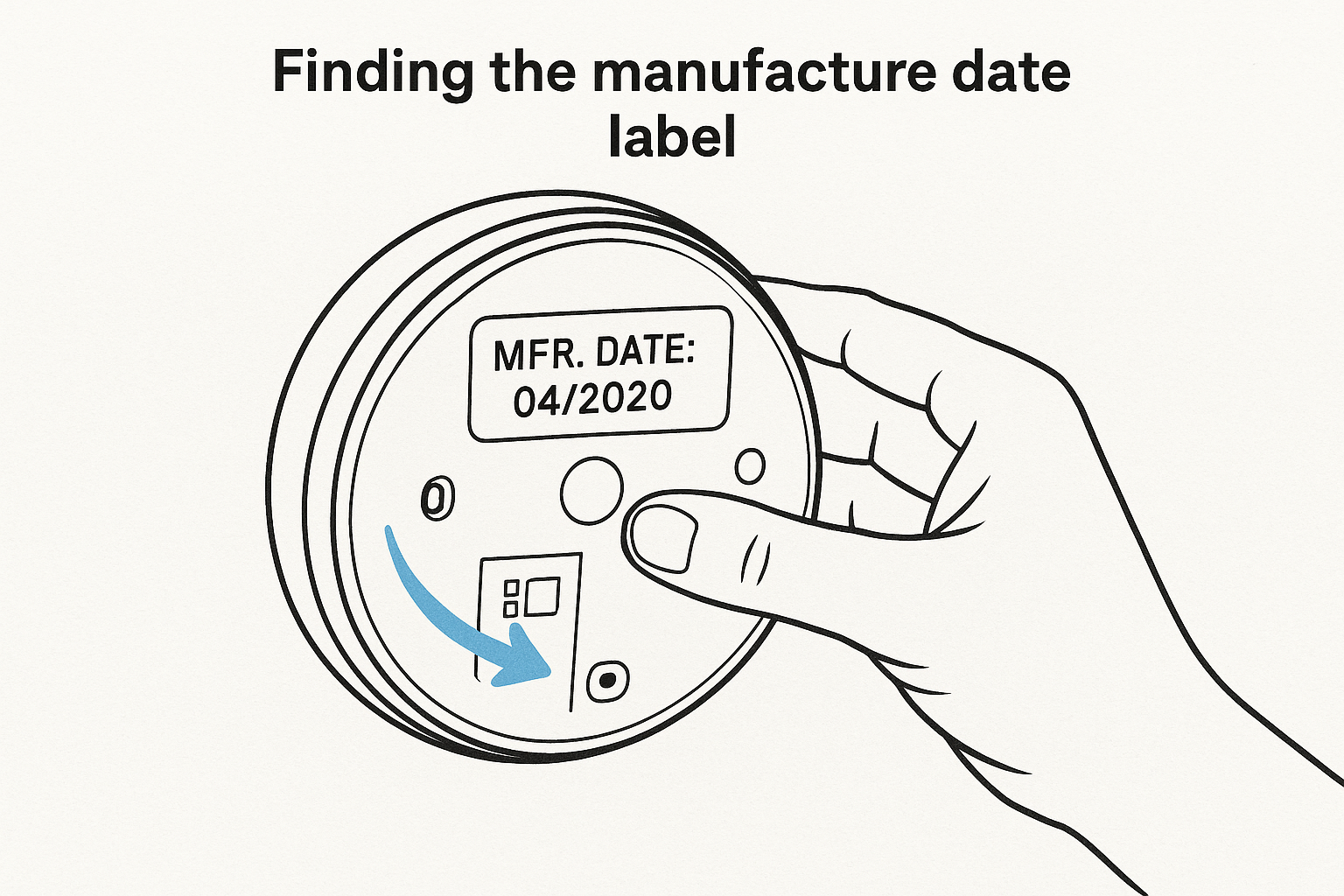
Some units print it on a white sticker, while others mold it directly into the plastic casing. Either way, the date format is usually month and year, and it tells you exactly where your alarm stands against the 10-year replacement window.
What to do if the label is unreadable
Heat and age sometimes fade label ink to the point where you cannot read the date clearly. In that case, treat the unit as expired and schedule a replacement. A faded or missing date label is itself a strong indicator the alarm has been installed long enough to warrant immediate action.
If the manufacture date on your unit is 10 years ago or earlier, replace the alarm right away, regardless of whether it still beeps when tested.
If you are not sure about any unit in your home, a licensed electrician can inspect your alarms and confirm whether they meet current safety standards during a scheduled visit.
Replacement timelines for smoke, CO, and combo alarms
Not all alarms in your home follow the same replacement schedule. Knowing how often to replace smoke alarms is straightforward, but carbon monoxide (CO) detectors and combination units operate on different timelines you should track separately.
Smoke alarms and CO detectors compared
Smoke alarms must be replaced every 10 years from the manufacture date. Carbon monoxide detectors have a shorter service life, typically 5 to 7 years depending on the manufacturer. CO sensors use an electrochemical cell that depletes faster than smoke-sensing components, which is why the replacement window is tighter.
Check the label on every CO detector in your home right now. Many homeowners replace batteries annually but never replace the unit itself.
| Alarm Type | Replacement Timeline |
|---|---|
| Smoke alarm | 10 years from manufacture date |
| CO detector | 5 to 7 years from manufacture date |
| Combination smoke/CO alarm | 7 years from manufacture date |
Combination smoke and CO alarms
Combo units detect both smoke and carbon monoxide in a single device. Because the CO sensor inside a combination alarm degrades faster, most manufacturers set the replacement window at 7 years, not 10.
Your safest approach is to treat each alarm type as a separate item on your home safety checklist and replace every unit based on its own labeled date and the guidelines above.
How to replace smoke alarms safely in your home
Once you know how often to replace smoke alarms and have confirmed your units are due, the actual replacement process is straightforward. You do not need special tools for battery-operated units, though hardwired alarms require turning off the correct circuit breaker before you touch any wiring.
What to buy before you start
Choose a replacement unit that matches your existing alarm type, whether that is battery-operated, hardwired, or hardwired with a backup battery. If your current alarm is hardwired and interconnected with others in the home, buy a compatible interconnected model so all alarms still communicate.
Check your replacement unit’s packaging for the manufacture date before purchasing to confirm you’re starting the 10-year clock with a fresh unit.
Steps to remove and install the unit
Twist the old alarm counterclockwise off its mounting bracket to detach it. For hardwired units, flip the breaker first, then disconnect the wiring harness before removing the bracket. Attach the new bracket, connect the harness, and lock the new alarm into place. Test the unit immediately after installation by pressing and holding the test button for at least five seconds.
Quick wrap-up and what to do next
Knowing how often to replace smoke alarms comes down to one core number: 10 years from the manufacture date stamped on the unit. CO detectors expire sooner at 5 to 7 years, and combination alarms follow a 7-year window. Battery swaps and button tests don’t extend that timeline, and Arizona’s heat and desert dust make staying on schedule even more critical for your household.
Start by checking the back of every alarm in your home today. If any unit carries a manufacture date from 2016 or earlier, it’s already past due. Pull it down, confirm the date, and replace it before your next service call.
If you’d rather have a professional handle the inspection and installation, the team at AZ DC Electric serves the entire Phoenix Metro Area with no call-out fees. Schedule a smoke alarm installation or home safety inspection and get every unit confirmed and current.