Most Arizona homes don’t have enough smoke alarms, and many that do have them installed in the wrong spots. If you’re asking how many smoke alarms do I need, the answer depends on your home’s layout, the number of bedrooms, and what local and national fire codes actually require. It’s not a one-size-fits-all number.
The general rule is straightforward: you need at least one on every level of your home, one inside each bedroom, and one outside every sleeping area. But once you factor in kitchens, basements, hallways, and garages, the count adds up faster than most people expect. Getting the placement right matters just as much as getting the count right, a poorly placed alarm can mean delayed warnings when seconds count.
At AZ DC Electric, we handle smoke alarm installations across the Greater Phoenix Metro Area and see firsthand how often homes fall short of code. Below, we’ll walk you through a room-by-room breakdown so you know exactly how many you need, where each one should go, and when it’s worth calling a licensed electrician to get them hardwired properly.
Smoke alarm rules that apply in most homes
Before you can answer how many smoke alarms do I need for your specific home, you need to know the rules that drive that number. Two sources shape what’s required in most U.S. homes: NFPA 72 (the National Fire Alarm and Signaling Code) and the International Residential Code (IRC). Most state and local jurisdictions, including those across Arizona, adopt these standards as their baseline and enforce them through local building departments.
What NFPA 72 requires
NFPA 72 sets the minimum placement rules that apply to most residential construction and renovation projects nationwide. Under this standard, you must install at least one smoke alarm inside every sleeping room, outside each separate sleeping area, and on every level of the home, including the basement. That means a two-story home with three bedrooms needs a minimum of six alarms before you factor in hallways, stairwells, or open living areas.
If your home has a basement, it counts as a separate level and needs its own alarm, even if nobody sleeps down there.
How Arizona and local codes apply
Arizona follows the International Residential Code, which aligns closely with NFPA 72 but gets enforced at the city and county level. Building departments in Scottsdale, Phoenix, Mesa, and Chandler inspect new construction and major remodels for compliance. If you’re updating an older home that predates these standards, a retrofit may not be legally required, but skipping it is a serious risk. Homes built before the mid-1990s often have alarms only in hallways, which leaves bedrooms unprotected during the most dangerous hours. Current code exists for a reason, and matching it is the smartest starting point regardless of when your home was built.
Step 1. Count alarms room by room
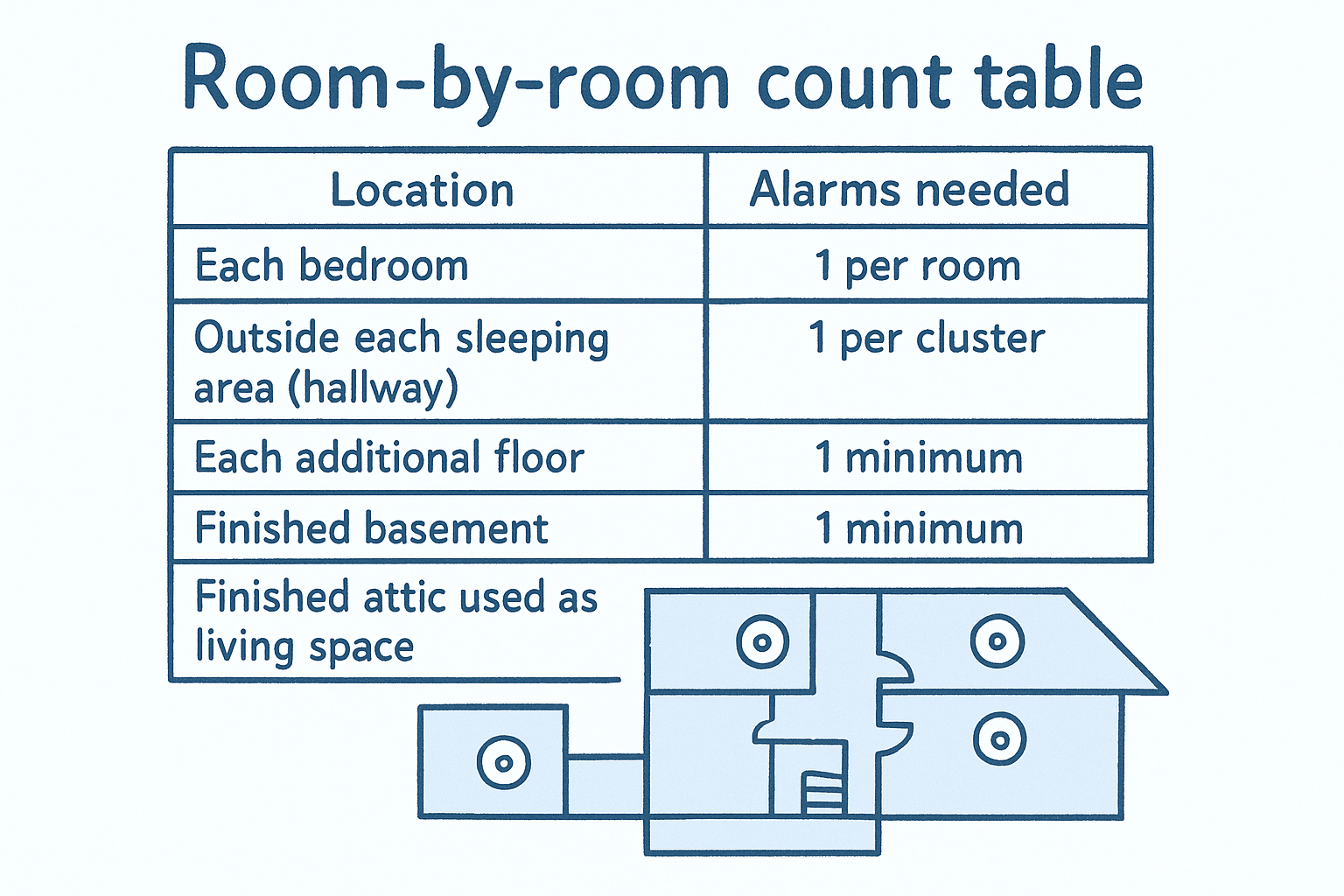
The fastest way to figure out how many smoke alarms do I need is to count each room type in your home and apply a simple rule to each one. Use the table below as your starting checklist before you buy anything.
Room-by-room count table
Work through each area of your home and mark off what applies. Every bedroom gets its own alarm, and any level without a sleeping area still needs at least one alarm to meet code.
| Location | Alarms needed |
|---|---|
| Each bedroom | 1 per room |
| Outside each sleeping area (hallway) | 1 per cluster |
| Each additional floor | 1 minimum |
| Finished basement | 1 minimum |
| Finished attic used as living space | 1 minimum |
A three-bedroom, two-story home with a basement typically needs a minimum of seven alarms: three in bedrooms, one in the upstairs hallway, one on the main floor, and one in the basement.
For most Phoenix-area homes with two to four bedrooms, the final count lands between six and ten alarms once you account for all levels, hallways, and individual sleeping rooms properly.
Step 2. Put each alarm in the right spot
Counting alarms gets you halfway there. Placement determines whether that alarm actually wakes you in time, and the wrong spot can mean a 30-second delay that costs lives.
Mount alarms on the ceiling, not walls
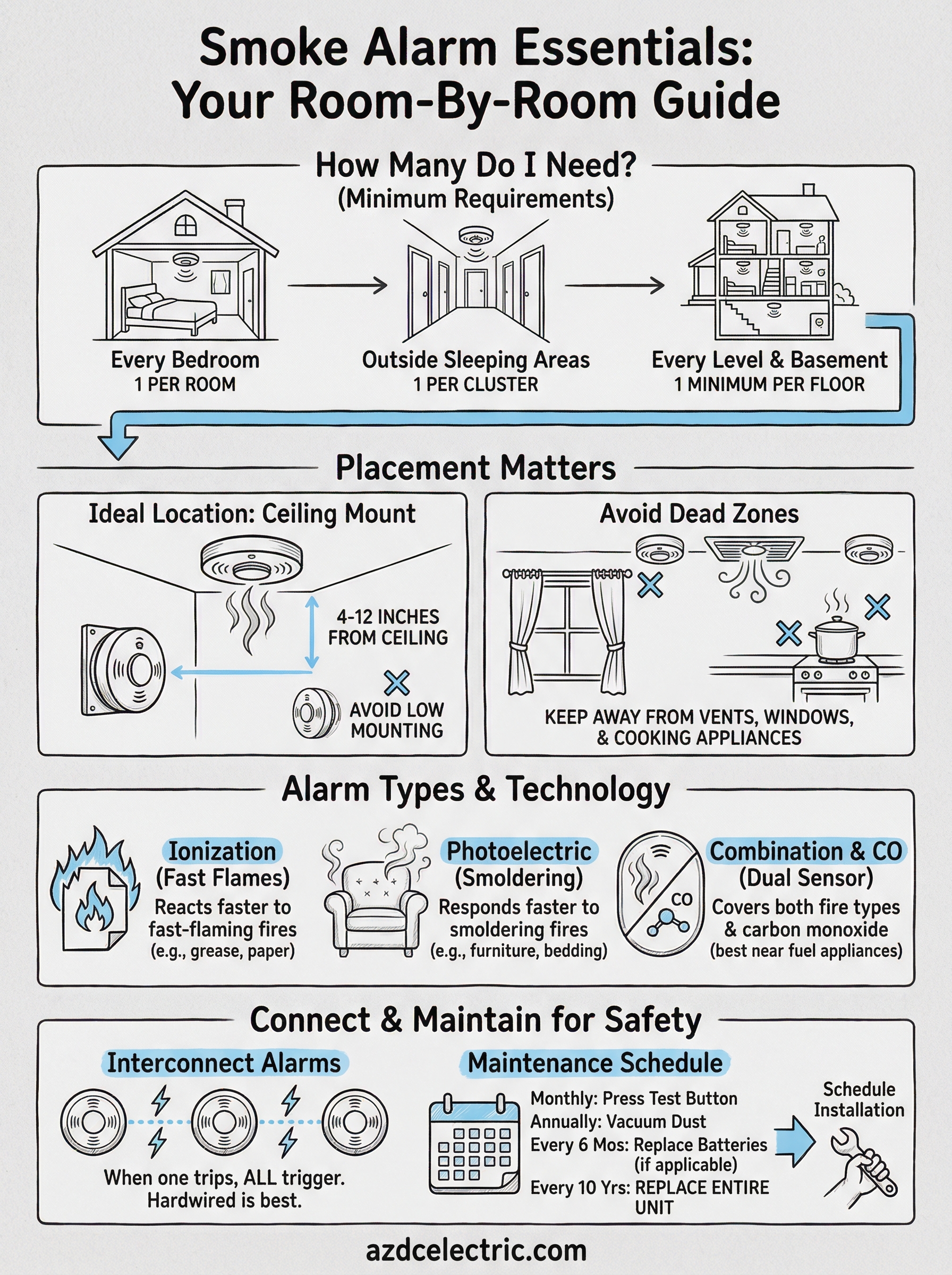
Ceiling mounting is the standard for a reason: smoke rises, and a ceiling-mounted alarm catches it faster. If you must use a wall, mount the alarm 4 to 12 inches from the ceiling, never lower.
Alarms mounted too low on walls can miss smoke entirely until a fire has grown significantly.
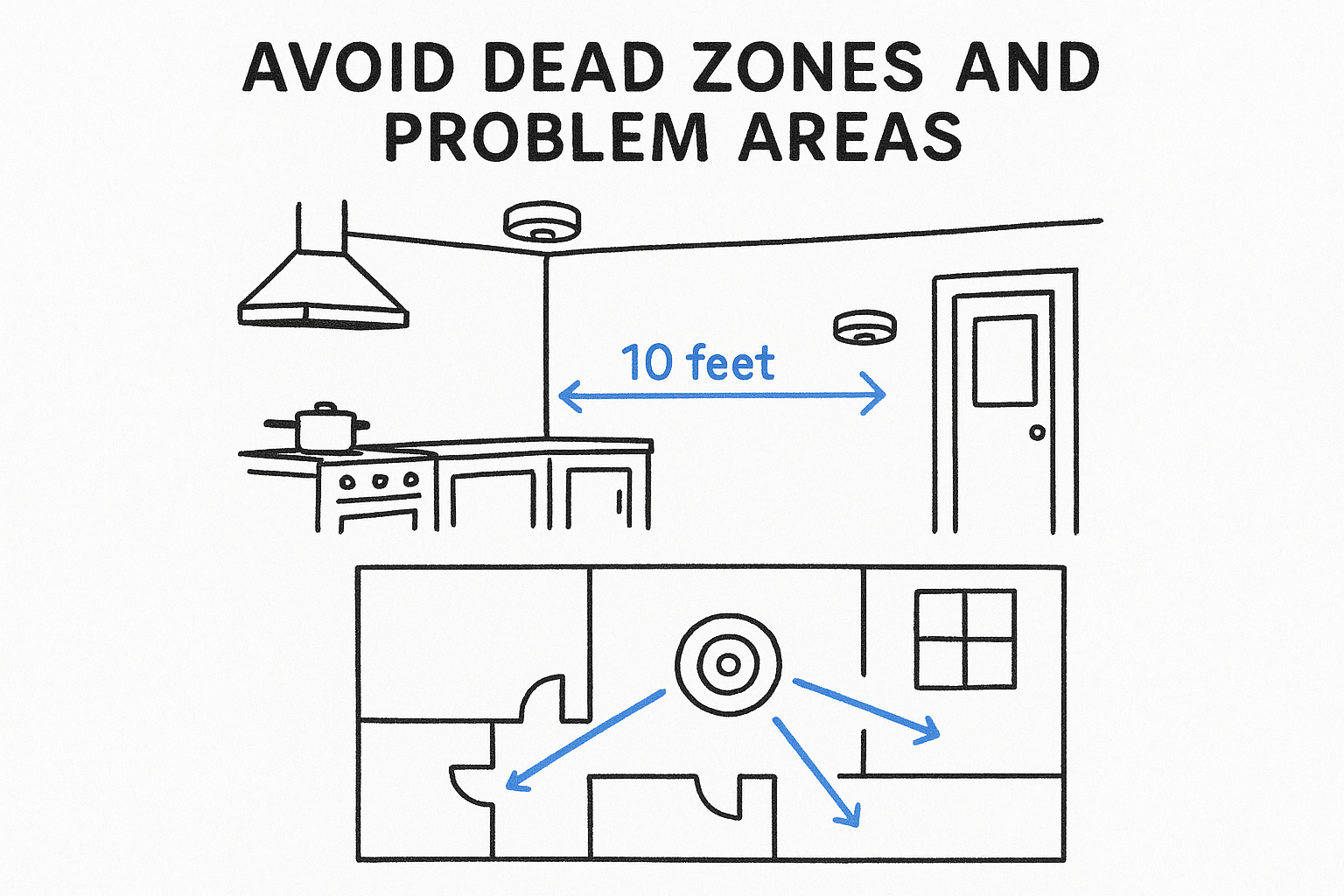
Avoid dead zones and problem areas
Some spots in your home actively reduce alarm performance. Keep alarms at least 10 feet from cooking appliances to cut down on false triggers without sacrificing coverage. Also avoid placing them near windows, exterior doors, or vents where airflow can push smoke away from the sensor before it registers.
If you’re still working out how many smoke alarms do I need and where each one goes, sketch a quick floor plan and mark each room with the placement rules above before you buy.
Step 3. Pick alarm types that fit your risks
Not all smoke alarms detect fire the same way, and choosing the wrong type for a specific room can leave you with slower warnings. Once you’ve settled on how many smoke alarms do I need for your home, your next decision is which technology goes where.
Ionization vs. photoelectric
Ionization alarms react faster to fast-flaming fires, like burning paper or grease. Photoelectric alarms respond faster to slow, smoldering fires, which are more common in bedrooms where upholstered furniture catches from an ember or overheated wire. For bedrooms specifically, photoelectric is the better choice. For kitchens and living areas where fast flames are more likely, ionization performs better.
If you can only choose one type for your whole home, a dual-sensor alarm covers both detection methods in a single unit.
Combination and CO detectors
Combination smoke and carbon monoxide (CO) detectors make sense in areas near gas appliances, attached garages, or utility rooms. CO is invisible and odorless, and installing a combo unit in those spots adds a layer of protection without requiring extra hardware. Hardwired combo units, installed by a licensed electrician, give you the most reliable coverage since they connect directly to your home’s electrical system and include battery backup.
Step 4. Interconnect and maintain your alarms
Once you’ve answered how many smoke alarms do I need and installed the right number, interconnection and maintenance are what keep your system working when it matters most.
Wire them together
Interconnected alarms trigger every unit in your home the moment one detects smoke. If a fire starts in the basement while you sleep on the second floor, a standalone alarm downstairs won’t wake you. A hardwired, interconnected system installed by a licensed electrician solves that problem directly. All alarms trip simultaneously, giving you the maximum warning time possible.
Wireless interconnect technology now lets you link alarms without running new wiring, which makes it a practical upgrade for older homes.
Test and replace on a schedule
Regular testing keeps your alarms reliable between inspections. Follow this maintenance schedule to stay on top of it:
- Monthly: Press the test button on each unit
- Annually: Vacuum dust from sensor openings to prevent false triggers
- Every 6 months: Replace batteries in battery-only units before a low-battery signal activates
- Every 10 years: Replace the entire alarm unit
Smoke alarms have an expiration date, and replacing units on time prevents sensor degradation that can leave your home unprotected without any visible warning sign.
Quick wrap-up and what to do next
If you’ve worked through this guide, you now have a clear answer to how many smoke alarms do I need: at minimum, one in every bedroom, one outside each sleeping area, and one on every level including the basement. For most Phoenix-area homes with two to four bedrooms, that puts your total between six and ten alarms once you account for all levels, hallways, and finished spaces below grade.
Placement, alarm type, and interconnection are what separate a code-compliant system from one that genuinely protects your household. Hardwired, interconnected alarms give you the fastest warning time, and a licensed electrician can install them correctly in a single visit without the guesswork. If you’re unsure whether your current setup meets Arizona code or you want new alarms wired in properly, schedule a smoke alarm installation with AZ DC Electric and get it handled by a licensed professional who knows exactly what your home requires.