Adding outlets during a remodel or planning circuits for new construction always leads to the same question: how many outlets can be on one circuit? The answer depends on the circuit’s amperage, the expected load, and what the National Electrical Code (NEC) actually requires, which isn’t always as straightforward as a single number.
Whether you’re working with a 15-amp or a 20-amp circuit, the rules and best practices differ. Get it wrong and you risk tripped breakers, overloaded wiring, or failed inspections. Get it right, and your electrical system runs safely for decades without issues.
At AZ DC Electric, we wire and rewire homes across the Greater Phoenix Metro Area every day, from panel upgrades in Scottsdale to full new-construction circuits in Chandler. This article breaks down exactly how many outlets each circuit type supports, what the NEC says, and where the common mistakes happen. By the end, you’ll know how to plan your circuits correctly, or when it’s time to call a licensed electrician to handle it for you.
Why outlet limits matter for safety and convenience
Understanding how many outlets can be on one circuit isn’t just a code question, it’s a practical safety calculation. Every circuit carries a maximum amperage rating, and every device you plug in draws a share of that capacity. Add too many outlets, load them with too many devices, and you push the circuit past its safe limit.
What overloading actually does to your wiring
A circuit breaker trips when the load exceeds its rating, which is an intentional safety response. The problem is that tripping isn’t the only danger. Sustained or repeated overloads build heat in the wire insulation long before the breaker reacts, and heat inside walls degrades insulation over time, creating a fire risk you cannot see.
Overloaded wiring inside walls is one of the leading causes of residential electrical fires in the United States.
This slow heat buildup is why simply having a breaker doesn’t make every load safe. Old or undersized wiring is especially vulnerable, since it has less thermal tolerance than modern conductors rated for today’s household loads.
How outlet count connects to real-world convenience
Too many outlets on one circuit also creates daily frustration. Running a high-draw appliance like a hair dryer while a space heater operates on the same circuit will trip the breaker almost immediately. Spreading your outlets across dedicated circuits prevents that kind of interruption and keeps your home functional throughout the day.
Common situations where overloaded circuits cause real inconvenience:
- Kitchen countertop outlets tripping when multiple appliances run simultaneously
- Bathroom outlets losing power mid-use because a bedroom heater shares the same circuit
- Home office circuits dropping when a laser printer cycles on alongside a desktop computer and monitor
How NEC rules handle outlet counts in homes
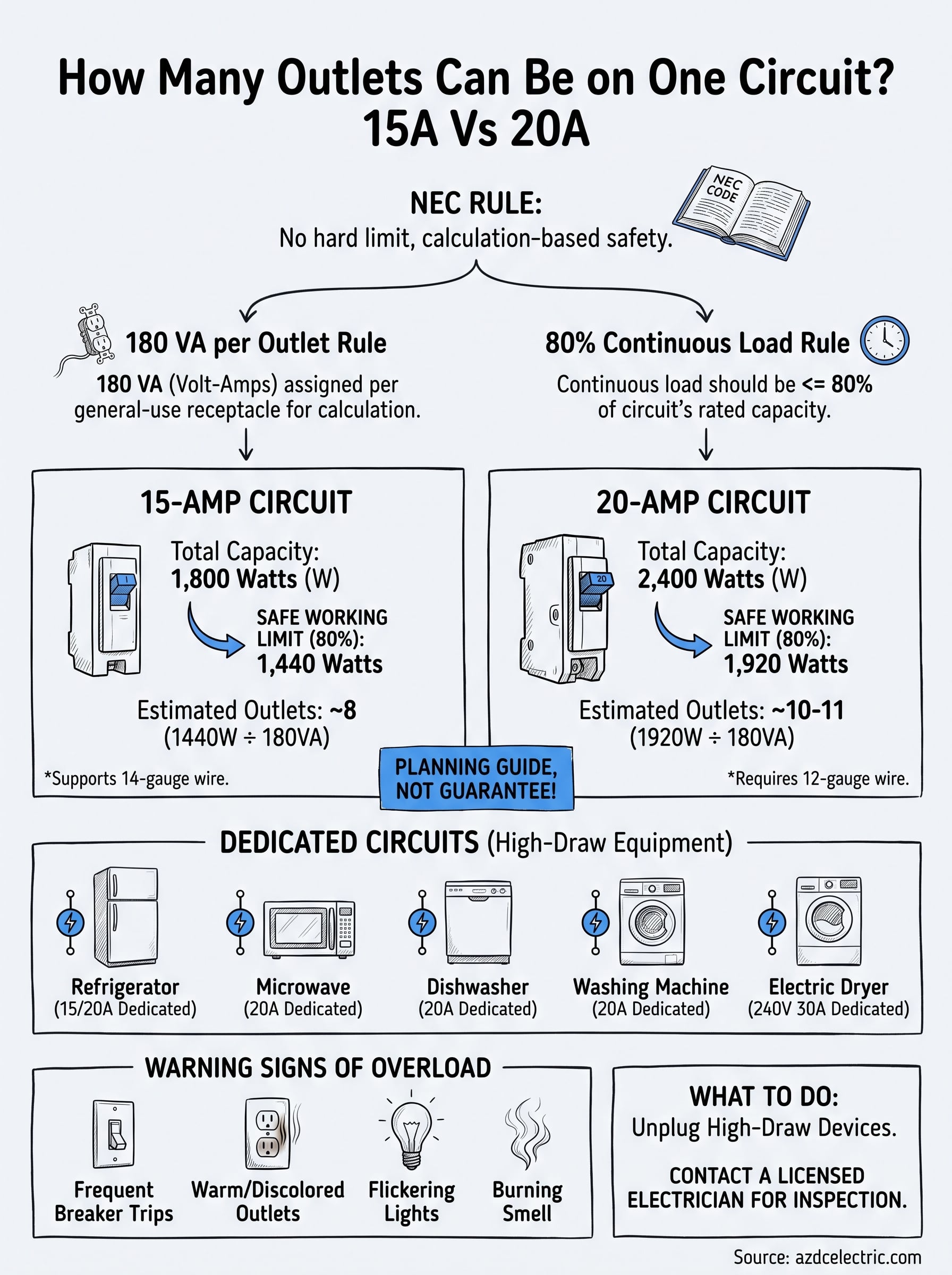
The National Electrical Code does not set a hard limit on how many outlets can be on one circuit. Instead, it provides calculation-based rules that determine safe capacity, which means the answer depends on the math behind your specific setup rather than a single fixed number.
The 180 VA per outlet rule
NEC rules assign 180 volt-amps (VA) to each general-use receptacle outlet for load calculation purposes. On a 15-amp, 120-volt circuit, you have 1,800 VA of total capacity, which works out to roughly 10 outlets before hitting the theoretical maximum. A 20-amp circuit gives you 2,400 VA, supporting around 13 outlets by that same calculation.
These numbers represent the electrical ceiling, not the recommended working load for daily use.
The 80 percent continuous load rule
Beyond the per-outlet calculation, the NEC requires that continuous loads stay at or below 80 percent of a circuit’s rated capacity. That means a 15-amp circuit should carry no more than 12 amps under sustained use, and a 20-amp circuit caps at 16 amps. Staying inside that threshold protects your wiring, keeps your breaker from nuisance tripping, and extends the life of every device on the circuit.
How to estimate safe outlets on 15A and 20A
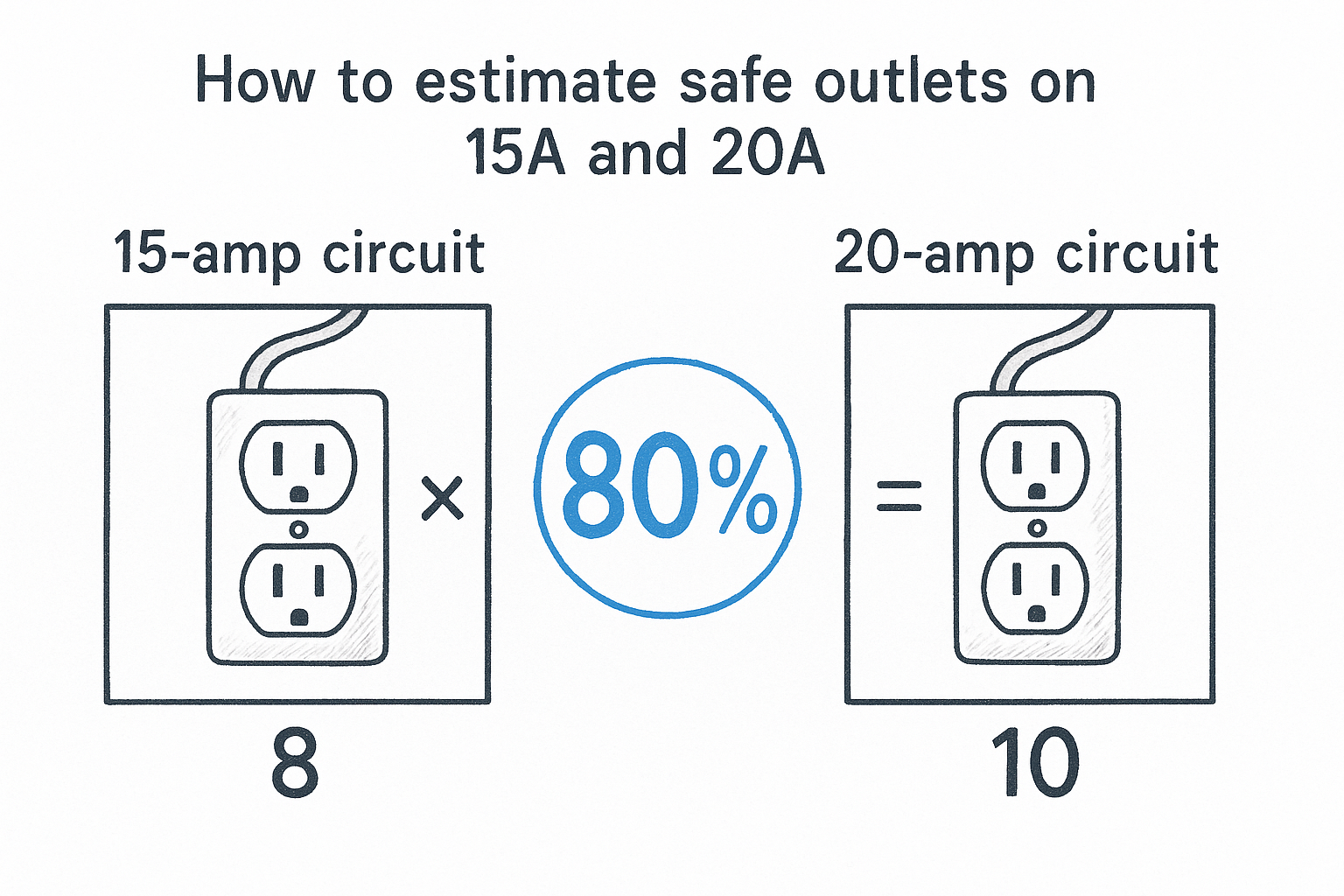
Knowing how many outlets can be on one circuit becomes practical once you apply a simple formula to your specific setup. Take the circuit’s total wattage capacity, multiply it by 80 percent, and use that figure as your working ceiling rather than the absolute maximum.
15-amp circuit
A 15-amp, 120-volt circuit delivers 1,800 watts of total capacity. Applying the 80 percent rule gives you a safe working limit of 1,440 watts. Divide that by 180 VA per outlet and you land at eight outlets as a reasonable maximum for general-use receptacles on that circuit.
Keep your total connected load below 1,440 watts on a 15-amp circuit at any time to avoid nuisance tripping and heat buildup in the wiring.
20-amp circuit
On a 20-amp, 120-volt circuit, you have 2,400 watts of total capacity. Your 80 percent working limit rises to 1,920 watts, which supports up to ten or eleven general-use outlets comfortably. That extra headroom makes 20-amp circuits a better fit for rooms where multiple devices run at the same time.
Treat these numbers as a planning guide, not a guarantee that running every outlet at full draw is safe.
Upgrading to a 20-amp circuit also requires 12-gauge wire instead of 14-gauge, so confirm your wiring grade before assuming a larger breaker alone is sufficient.
When you need dedicated circuits and special protection
Some appliances should never share a circuit with anything else, regardless of how many outlets can be on one circuit under normal conditions. High-draw equipment pulls so much power that sharing a circuit creates constant tripping and real fire risk. Knowing which loads require isolation protects your home and keeps inspections clean.
Appliances that require their own circuit
Kitchen refrigerators, dishwashers, microwaves, and washing machines each need a dedicated circuit because their motors pull heavy startup current on top of their running load. Running these on shared circuits almost guarantees repeated breaker trips and potential wiring damage over time.
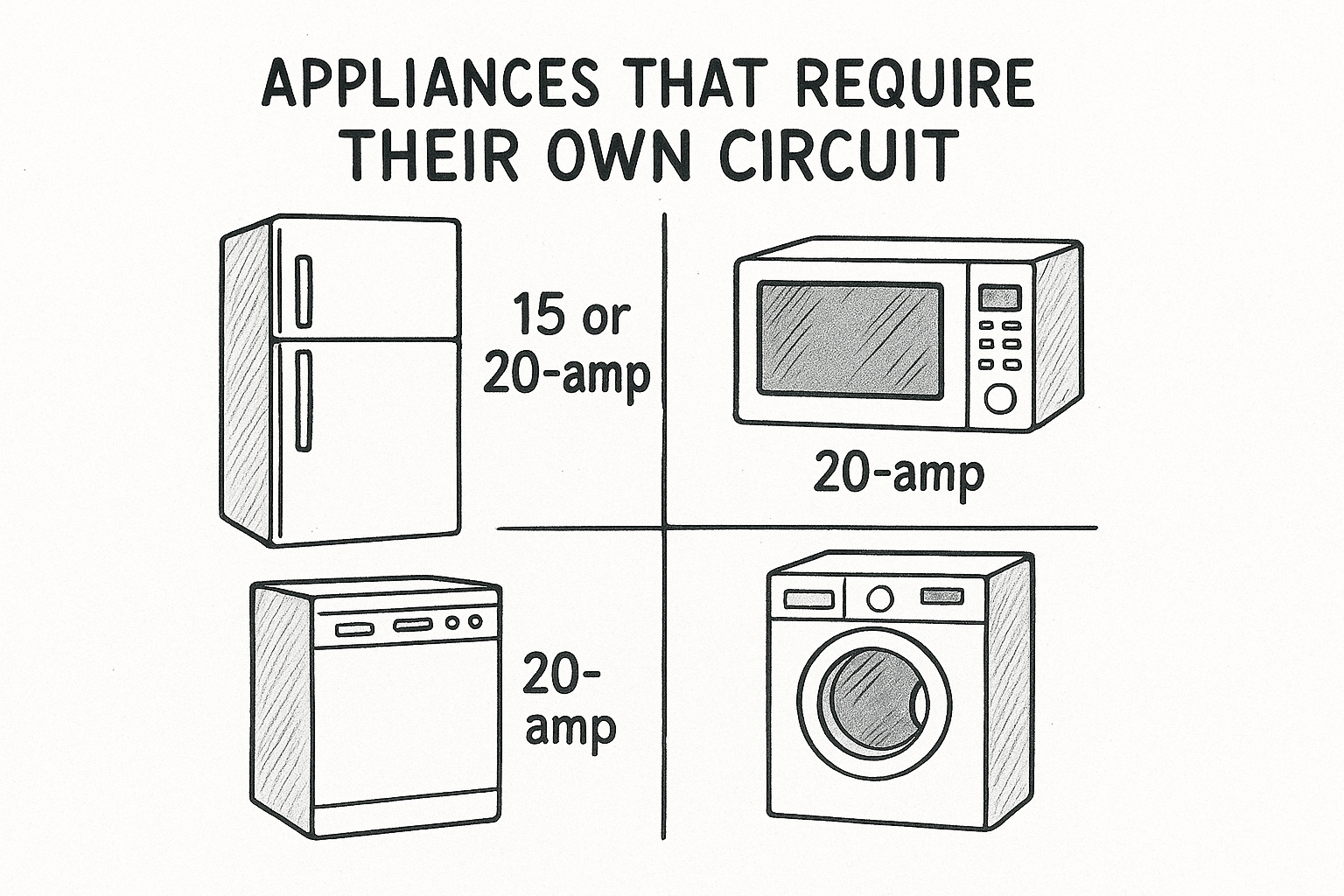
- Refrigerators: 15 or 20-amp dedicated
- Microwaves: 20-amp dedicated
- Dishwashers: 20-amp dedicated
- Washing machines: 20-amp dedicated
- Electric dryers: 240-volt, 30-amp dedicated
Where GFCI and AFCI protection is required
Beyond dedicated circuits, the NEC mandates GFCI (Ground Fault Circuit Interrupter) protection in areas where water and electricity are close together, including bathrooms, kitchens, garages, and outdoor locations. GFCI outlets cut power within milliseconds of detecting a ground fault, which is a critical layer of protection your home needs.
AFCI (Arc Fault Circuit Interrupter) protection is required in bedrooms and most living spaces under current NEC editions to guard against hidden arc faults inside walls.
How to spot an overloaded circuit and what to do
Your home gives you clear signals when a circuit is struggling. Frequent breaker trips, warm outlet covers, and flickering lights are the most common warnings, and ignoring them puts your wiring at risk. Understanding these symptoms helps you act before a small problem grows into a serious hazard.
Signs your circuit is carrying too much load
Several physical and electrical clues point to an overloaded circuit. Buzzing sounds from outlets or switches and breakers that trip repeatedly under normal use indicate the circuit is drawing more current than it can safely handle. These signs matter regardless of how many outlets can be on one circuit by the numbers, because real-world usage often exceeds what calculations predict.
A breaker that trips repeatedly under normal use is warning you that your circuit is undersized for its actual load.
Common warning signs to watch for:
- Warm or discolored outlet cover plates
- Flickering or dimming lights when appliances cycle on
- Burning smell near outlets or the electrical panel
What to do when you identify the problem
Unplug high-draw devices immediately to reduce the load on the circuit. Then contact a licensed electrician to inspect the wiring, evaluate the breaker, and determine whether you need an additional circuit or a panel upgrade to match your home’s actual demand safely.
Next steps for a safer circuit
Now that you understand how many outlets can be on one circuit, put that knowledge to work in your home. Planning your circuits around the 80 percent rule and placing high-draw appliances on dedicated lines gives your wiring room to handle real-world demand without constant trips or heat buildup inside your walls.
If you already notice warning signs like warm outlets, tripping breakers, or flickering lights, do not wait. Overloaded circuits get worse over time, and the repair becomes more involved the longer it goes unaddressed. A licensed electrician can inspect your panel, map your existing circuits, and recommend whether you need additional circuits or a full panel upgrade to match your home’s actual load safely.
The team at AZ DC Electric serves homeowners across the Greater Phoenix Metro Area with upfront pricing and a 5-year workmanship guarantee. Book a circuit inspection or consultation and get your electrical system running safely.