Your electrical panel is the hub of your home’s entire electrical system, and most people never think about it until something goes wrong. Understanding how does an electrical panel work gives you a real advantage as a homeowner. It helps you recognize warning signs early, communicate clearly with electricians, and make smarter decisions about upgrades or repairs. That gray metal box on your garage wall does a lot more than flip breakers back on after a trip.
At its core, the electrical panel takes the single feed of electricity coming from your utility company, divides it into smaller circuits, and distributes power safely throughout your home. Each circuit is protected by a breaker designed to shut off automatically if it detects an overload or short circuit. Without this system, a single fault could send dangerous levels of current through your wiring, a serious fire and safety risk.
At AZ DC Electric, we handle panel upgrades, breaker troubleshooting, and full electrical inspections across the Greater Phoenix Metro Area every day. That hands-on experience is exactly what shaped this guide. Below, we’ll walk through every major component inside your electrical panel, explain how power flows from the utility meter to your outlets, and cover the built-in safety mechanisms that protect your home. By the end, you’ll know what’s happening behind that panel door, and when it’s time to call a licensed electrician.
Why your electrical panel matters
Your electrical panel sits at the intersection of convenience and safety in your home. Every time you flip on a light, run a dishwasher, or plug in an EV charger, electricity routes through that panel first. Most homeowners in the Phoenix area give it no thought until the lights go out or a breaker refuses to reset, but that gap in awareness can cost you more than just an inconvenient evening without power.
It controls every circuit in your home
Understanding how does an electrical panel work starts with recognizing that every single circuit in your home connects back to this one box. The panel acts as the traffic controller for your electrical load. It receives a large block of power from the utility and then divides it into smaller, managed circuits for your kitchen, bedrooms, HVAC system, garage, and outdoor spaces.
When your home was built, an electrician calculated the expected electrical load for the size and intended use of the property, then installed a panel rated to handle that demand. That calculation made sense for the appliances and devices common at the time of construction. Modern homes are a different story. A 100-amp panel that worked fine in 1985 is almost certainly undersized for a home now running multiple high-draw appliances, a home office, a heat pump, and an EV charger at the same time. Your panel sets the ceiling on how much electrical capacity your home can support, and once you hit that ceiling, you’re operating outside safe limits.
An undersized or outdated panel doesn’t just limit your electrical capacity, it creates real safety risks including chronic overheating, nuisance tripping, and conditions that can cause a fire inside your walls.
It directly impacts your safety
A panel that works correctly is one of your home’s most important protective systems. The breakers inside interrupt power automatically when a circuit draws more current than it can safely carry. This response happens in fractions of a second, and it’s a primary reason electrical fires caused by overloaded wiring don’t occur far more frequently than they do.
When that protection weakens or fails, the risks rise fast. Faulty breakers, corroded bus bars, and loose connections can allow excessive current to move unchecked through your wiring, generating heat inside the walls where you have no way to see it. The National Fire Protection Association consistently identifies electrical failures as a leading cause of home structure fires across the United States, which puts the stakes around a functioning panel in clear perspective.
It determines what upgrades you can add
Your panel also plays a direct role in every renovation or addition you plan. Adding a home office, finishing a basement, or installing a pool all place new electrical loads on the system. A licensed electrician will evaluate your panel’s remaining capacity before adding any new circuits. If the available headroom is too small, a panel upgrade has to happen before new wiring goes in.
Skipping that step isn’t just a building code violation. It puts real stress on a system that’s already at its limit. Knowing the condition and capacity of your panel before you start any project saves you from mid-renovation surprises and keeps your home and everyone in it protected throughout the process.
The parts inside a typical home panel
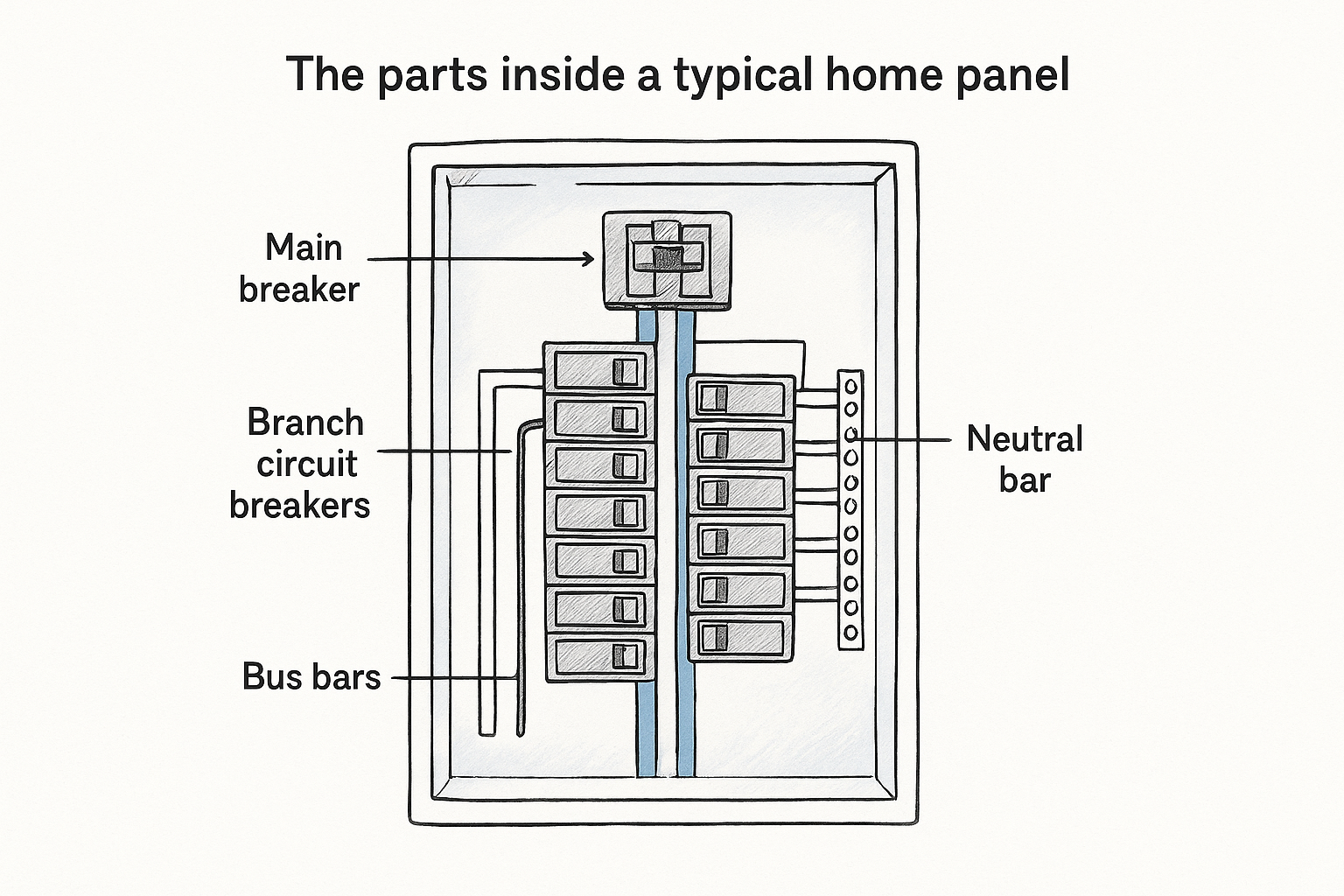
Opening the panel door reveals several distinct components, each playing a specific role in how an electrical panel works. Knowing what each part does helps you describe problems accurately to an electrician and understand what they’re telling you during an inspection. The layout looks complex at first glance, but the logic behind it is straightforward once you identify the key pieces.
The main breaker
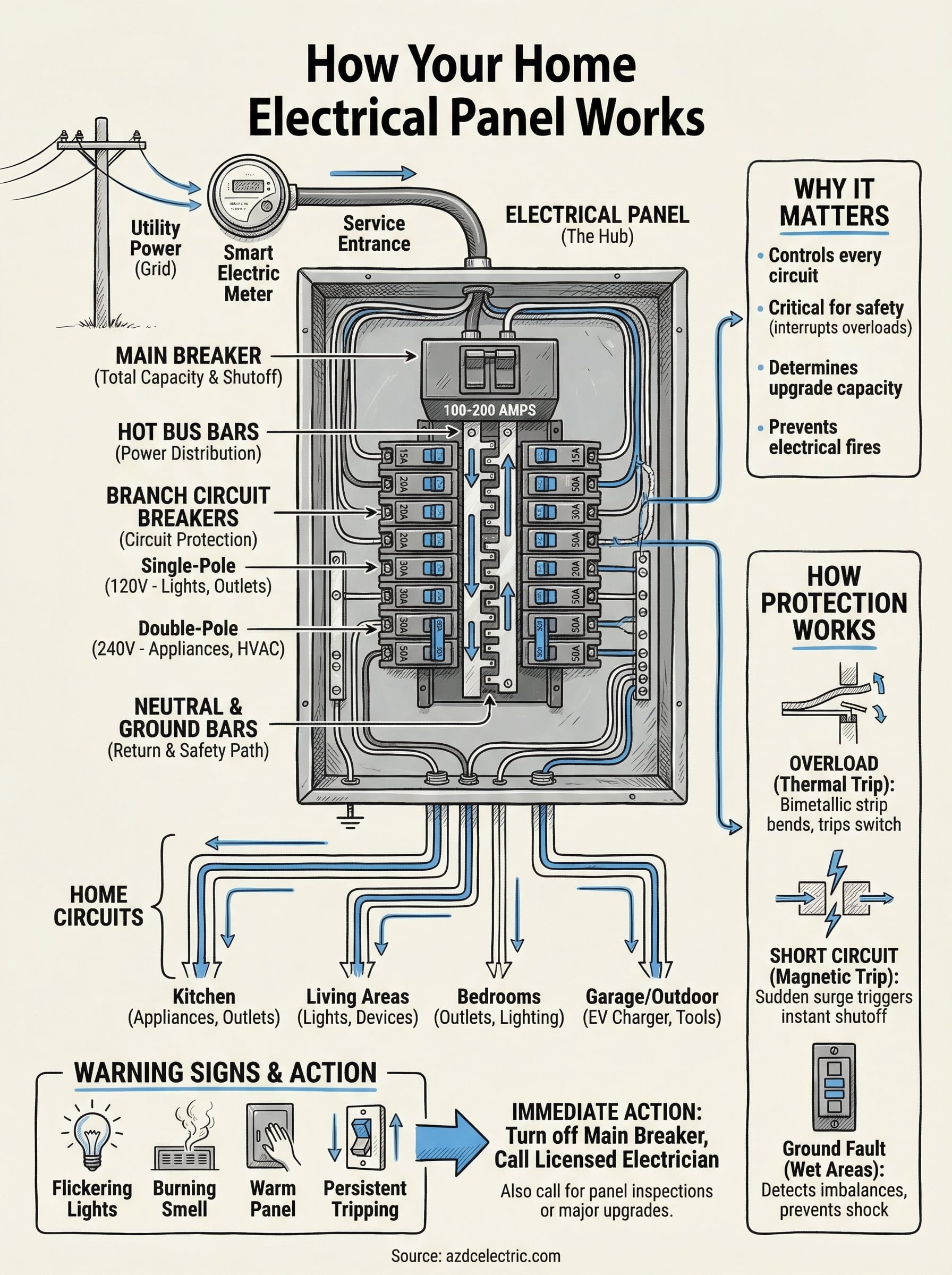
The main breaker sits at the top of the panel and controls the entire load entering your home from the utility. It’s a double-pole breaker, meaning it handles both legs of your incoming power simultaneously. When you switch it off, it cuts power to every circuit in the panel at once.
Its amperage rating, typically 100, 150, or 200 amps, defines the maximum electrical capacity your panel can deliver. Electricians use the main breaker to work safely inside the panel, and you can use it to shut down your home’s electricity quickly in an emergency.
Branch circuit breakers
Below the main breaker, you’ll find rows of smaller branch circuit breakers. Each one controls a single circuit running to a specific area or appliance in your home. Standard single-pole breakers handle 120-volt circuits like outlets and lights, while double-pole breakers serve 240-volt loads used by dryers, water heaters, and HVAC equipment.
If a breaker trips repeatedly on the same circuit, that’s the panel telling you something is drawing too much current or that the wiring itself has a problem.
Common branch circuit amperage ratings include:
- 15 amps for standard lighting and general outlet circuits
- 20 amps for kitchen counters, bathrooms, and laundry
- 30 to 50 amps for large appliances like dryers and ranges
Bus bars and the neutral bar
The hot bus bars are the metal rails running down the center of the panel. Each branch circuit breaker clips onto one of these bars to receive power from the main feed. Without these bars, routing individual wires from every breaker back to the utility source would be impractical and unsafe.
Your panel also contains a neutral bar and a ground bar, which in most residential panels are bonded together at the main panel only. Neutral wires return current back to the source after it completes its path through a device, while ground wires provide a safe fault path that directs stray current away from people and equipment.
How power moves from the utility to your circuits
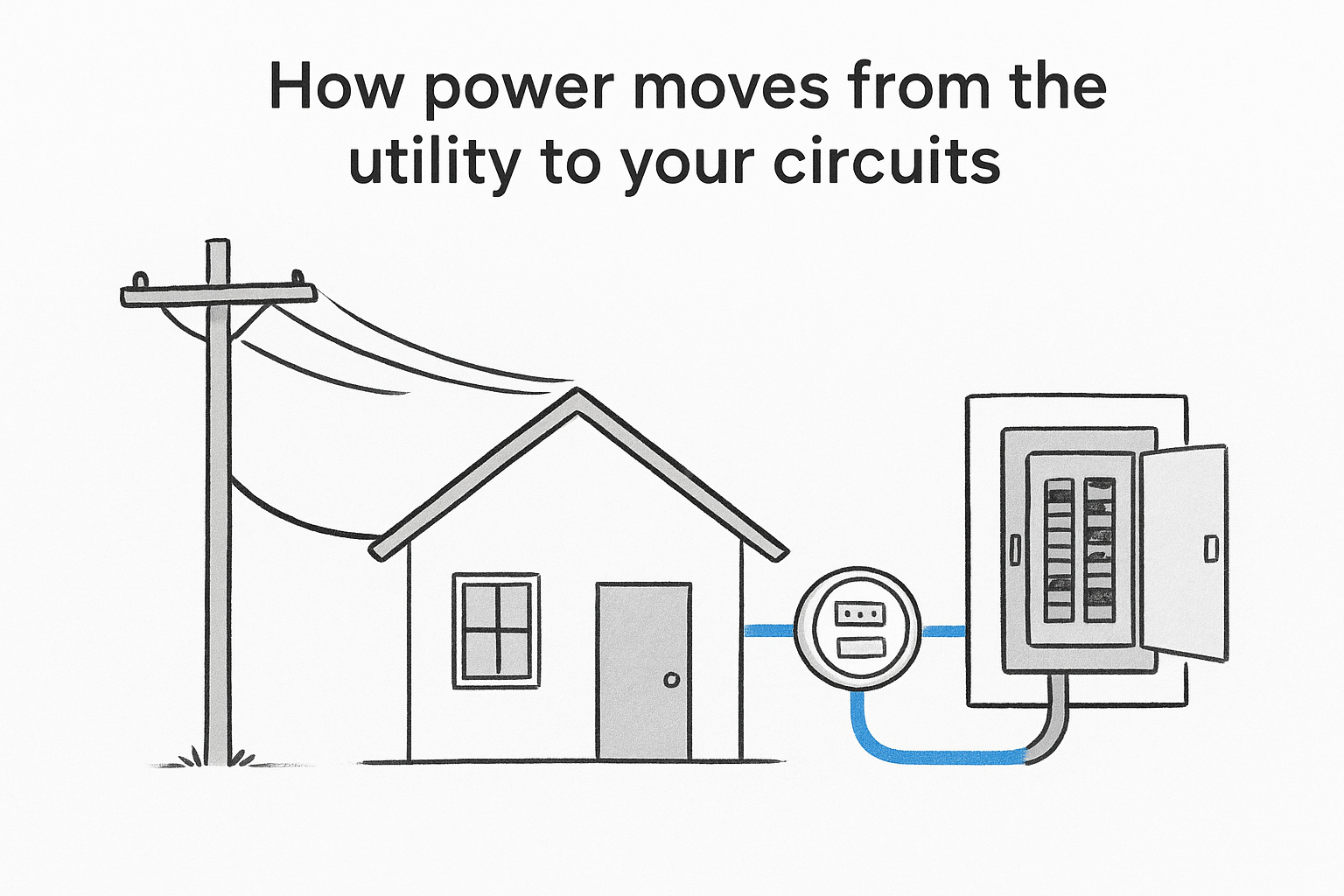
Electricity doesn’t arrive at your home ready to use. It travels through several distinct stages before reaching a single outlet or appliance, and understanding how does an electrical panel work requires following that path from the outside in. Each step either measures the incoming load or divides it into the smaller, protected circuits your home’s wiring can safely carry.
From the service drop to your meter
The utility company delivers power through overhead or underground lines that connect at the service drop on your home’s exterior. In most residential setups, this feed carries three wires: two hot conductors at 120 volts each and one neutral wire. Combined, those two hot legs give you 240 volts for large appliances and 120 volts for standard outlets and lights.
Those service lines connect directly to your electric meter, which records every watt your household consumes. The meter passes electricity through without changing it, and every amp your home draws runs through that metering point before going anywhere else.
The utility company owns and controls everything up to and including the meter. From the meter forward, your panel and wiring are the responsibility of a licensed electrician.
From the meter into the panel
After passing through the meter, power travels through service entrance cables directly to the main breaker’s terminals at the top of your panel. Both hot legs feed into the panel separately, connecting one to each side of the main breaker and then continuing down to the hot bus bars running along each side of the panel interior.
The neutral conductor from the service entrance terminates at the neutral bar inside the panel, completing the return path for current moving through any 120-volt circuit in your home.
How the panel divides power across circuits
Each branch circuit breaker taps one or both bus bars to pull the power its circuit needs. A single-pole breaker connects to one hot leg and delivers 120 volts to its circuit. A double-pole breaker spans both bus bars and provides 240 volts for high-draw equipment like dryers or water heaters.
From each breaker, a hot wire runs out to the devices on that circuit, while a neutral wire carries return current back through the neutral bar. This design keeps each circuit independent, so a fault on one branch doesn’t disrupt the rest of your home.
How breakers protect against overloads and faults
A circuit breaker does two jobs: it carries current under normal conditions and it interrupts that current the moment something goes wrong. Understanding how does an electrical panel work means understanding how that protection actually triggers, because the mechanism behind it is what stands between your wiring and a potential fire inside your walls.
How a breaker detects an overload
Every breaker contains a bimetallic strip that bends when current exceeds the breaker’s rated limit. As current flows through the strip, heat builds up. When the strip bends far enough from sustained overheating, it releases a spring-loaded contact that snaps the breaker open and cuts power to the circuit.
The timing here is intentional. A brief startup surge from a motor won’t trip your breaker, but sustained overcurrent from running too many high-draw appliances on one circuit builds heat steadily until the strip trips. Once you reduce the load and reset the breaker, it’s ready to protect that circuit again.
A breaker that trips repeatedly on the same circuit is not malfunctioning. It’s telling you the circuit is drawing more current than the wiring can safely handle on a continuous basis.
What happens during a short circuit or ground fault
A short circuit occurs when a hot wire contacts a neutral wire directly, bypassing the resistance of any load. The sudden drop in resistance creates a massive current spike that trips the breaker almost instantly. This is a different response than an overload trip. The electromagnetic trip mechanism inside the breaker reacts to that spike in microseconds, far faster than the thermal strip can respond.
Ground faults are similar in outcome but different in cause. Here, a hot wire contacts a grounded surface like a metal appliance body or a wet floor, creating an unintended current path through whatever is in the way. Standard breakers catch severe ground faults, but GFCI breakers go further. They measure tiny imbalances between the outgoing and returning current on a circuit, down to 5 milliamps, and trip fast enough to prevent electrocution. The Consumer Product Safety Commission recommends GFCI protection in all wet areas of your home, including kitchens, bathrooms, garages, and outdoor circuits.
Common panel problems and what to do first
Knowing how does an electrical panel work gives you a clear framework for diagnosing issues when they appear. Most panel problems fall into a few recognizable patterns, and understanding what you’re seeing helps you take the right first steps rather than making the situation worse.
Breakers that trip repeatedly or won’t reset
A breaker that trips once and stays off until you reset it is doing exactly what it should. A breaker that trips again immediately after you reset it is a different situation. That persistent tripping means the circuit is still drawing more current than the breaker allows, or the wiring itself has a fault. Before you reset it a third time, unplug devices on that circuit and then try the reset again with the load removed.
If a breaker trips immediately even with no load connected, stop resetting it. A fault exists somewhere in the wiring, and forcing the breaker on repeatedly creates a real fire risk.
A breaker that feels loose in its slot, moves without resistance, or sits visibly between the on and off positions may have a worn internal mechanism. These breakers no longer provide reliable protection and need replacement by a licensed electrician.
Warm panel door, burning smell, or visible corrosion
Your panel exterior should feel close to room temperature. A panel door that feels warm to the touch points to heat buildup inside, which can come from overloaded circuits, a failing main breaker, or loose connections generating resistance and heat along the bus bars. None of these conditions resolve on their own.
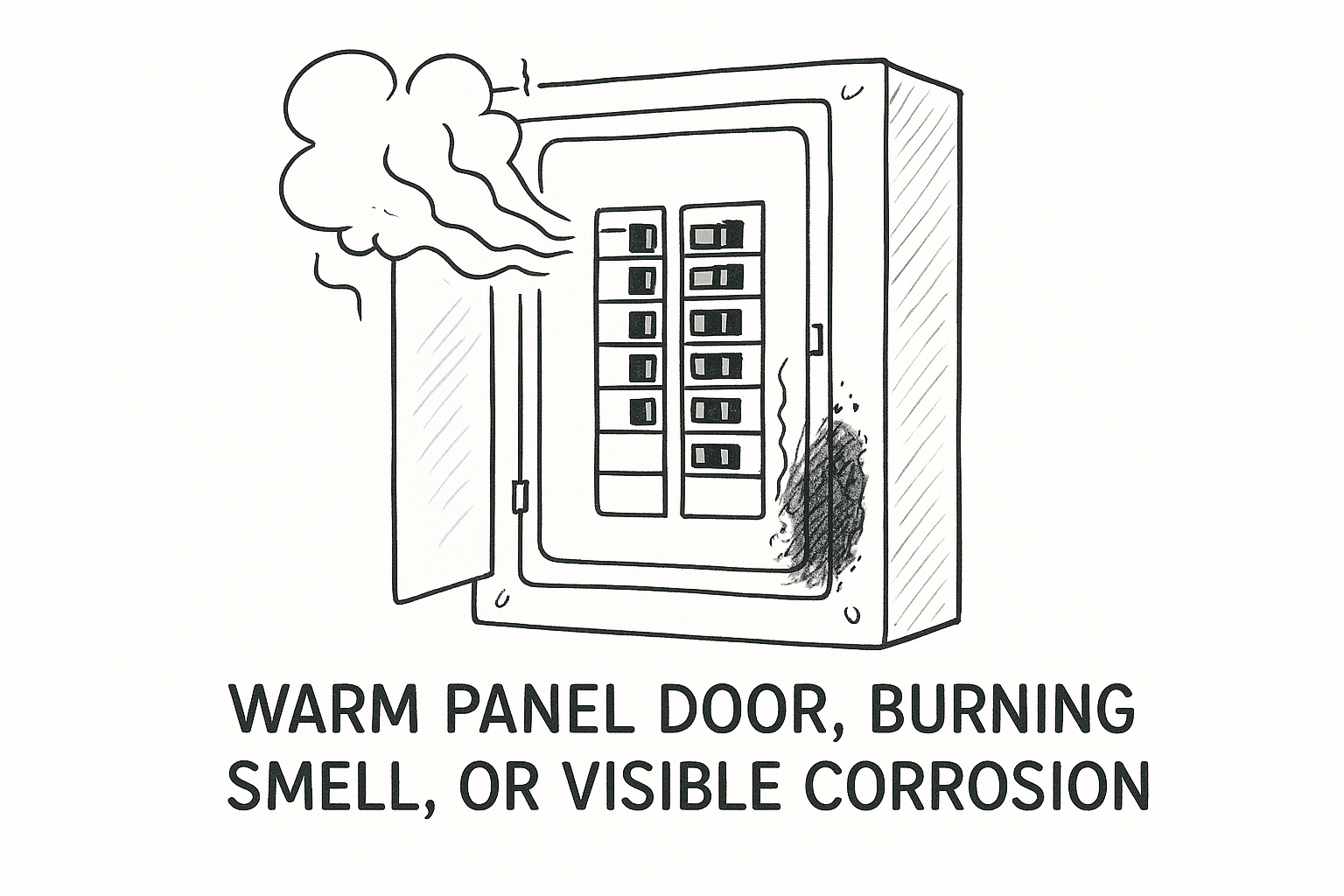
A burning or plastic smell near your panel is a more urgent warning. That odor often means insulation is degrading somewhere inside the enclosure, which is a direct fire risk. Turn off the main breaker if it is safe to reach, clear the area, and call a licensed electrician the same day rather than waiting.
What to check before calling an electrician
Gathering basic information before you call saves time and helps the electrician arrive prepared. Check these items first:
- Which circuit tripped and what devices were running on it at the time
- Whether the breaker resets successfully or trips again immediately
- Any visible signs of scorching, rust, or moisture inside or around the panel
- The age of your panel and whether it has been inspected recently
When to call an electrician or upgrade your service
Some electrical issues sit at the edge of your comfort zone where a reset or a replaced outlet covers the problem. Others point to deeper issues with your panel that require a licensed electrician to diagnose and fix safely. Knowing how does an electrical panel work gives you the judgment to separate the two, so you act quickly when the situation actually demands it.
Signs that point to an immediate call
Certain warning signs mean you should stop what you’re doing and call an electrician the same day. A burning smell near your panel, flickering lights across multiple circuits, or a breaker that feels warm to the touch all indicate a problem that is already active and worsening. These are not situations where waiting a few days makes sense.
If you ever see scorch marks around a breaker slot or smell burning plastic near your panel, turn off the main breaker, clear the area, and call a licensed electrician immediately.
You should also call right away if your panel is more than 30 to 40 years old and has never been inspected. Older panels, particularly brands with documented reliability problems, may no longer provide the protection your home needs. A licensed electrician can assess the condition and give you a clear picture of what your system requires before a larger failure occurs.
Situations that require a panel upgrade
Several common life events signal that your panel needs more than repairs. Adding a major new circuit, such as an EV charger, a hot tub, or a central air system, requires available capacity in your panel. If your panel is already loaded close to its limit, a new circuit places stress on a system that cannot safely absorb it.
Finishing a basement, remodeling a kitchen, or adding a home addition all fall into the same category. Each project introduces new electrical loads that your existing service capacity may not support. Your electrician will review the panel’s current load and tell you whether an upgrade from 100 to 200 amps is necessary before work begins.
Upgrading your panel is also worth considering if you’re selling your home. A modern, properly rated panel is a selling point, and an outdated one can surface as a liability during a buyer’s home inspection.
Conclusion
Understanding how does an electrical panel work puts you in a much better position as a homeowner. You now know the purpose of every major component inside that gray box, how electricity travels from the utility meter through the bus bars and out to each circuit, and how breakers catch overloads before they become something far more dangerous. That knowledge helps you recognize warning signs early instead of finding out the hard way.
Your panel handles every amp your home draws, and it does that job quietly until a problem forces your attention. If you notice repeated tripping, warm surfaces near the panel, or a burning smell, those signals deserve a same-day response from a licensed electrician. Waiting rarely makes the situation better.
If your home is due for an inspection, a breaker replacement, or a full panel upgrade, the team at AZ DC Electric is ready to help you get it done right.