A single power surge can destroy thousands of dollars worth of electronics in a fraction of a second. TVs, smart home systems, HVAC controls, appliances, anything plugged into your home’s electrical system is a potential casualty. Most homeowners in the Phoenix Metro Area don’t think about surge protection until something expensive stops working. Understanding how does a whole house surge protector work gives you a real advantage, because this one device sits at your electrical panel and shields every circuit in your home before a surge ever reaches your outlets.
The concept is straightforward, but the details matter. A whole house surge protector detects excess voltage, from lightning strikes, utility grid fluctuations, or even your own AC unit cycling on, and diverts that energy safely to the ground. It’s a first line of defense that power strips alone can’t replace, and it works around the clock without any input from you.
At AZ DC Electric, we install and service whole house surge protectors across Scottsdale, Mesa, Chandler, and the greater Phoenix area. Our licensed electricians see firsthand what unprotected electrical systems look like after a monsoon season surge, and it’s not pretty. This guide breaks down exactly how these devices function, what they protect against, the different types available, and whether the investment makes sense for your home. We’ll also cover installation considerations and common questions homeowners ask before making the decision.
What causes power surges in a home
A power surge is any sudden spike in voltage that exceeds the standard 120 volts your home’s circuits are designed to carry. Most surges last less than a millisecond, but that fraction of a second is more than enough time to damage or destroy sensitive electronics. Before you can fully understand how does a whole house surge protector work, you need to know what you’re actually protecting against, because surges come from multiple directions, and some are far more destructive than others.
External surge sources
Lightning strikes are the most dramatic and destructive external source. Even a strike that doesn’t hit your house directly can travel through overhead power lines and push tens of thousands of volts into your electrical system in an instant. Utility grid switching is another external culprit that most homeowners never think about. Power companies regularly shift loads between circuits during peak demand or after outages, and those transitions create brief but significant voltage spikes that travel straight through your service lines into your home.
The National Electrical Manufacturers Association estimates that over 60% of power surges originate from inside the home rather than outside, which surprises most homeowners who assume lightning is their biggest threat.
Internal surge sources
Your own appliances generate the majority of surges your home deals with on any given day. Large motor-driven equipment like air conditioners, refrigerators, washing machines, and pool pumps draw a heavy electrical load when they start up and again when they shut off. That cycling sends a voltage spike back through the circuit every single time it happens. In the Phoenix Metro Area, where air conditioners run hard for five or more months a year, this internal cycling creates a near-constant stream of smaller surges that gradually wear down electronics instead of destroying them all at once.
Other internal sources include arc faults from aging or loose wiring, breakers being reset after a trip, and devices like laser printers that cycle power frequently. These smaller surges are easy to ignore because no single one causes obvious damage you can see. Over months and years, though, repeated low-level surges degrade the sensitive components inside TVs, computers, smart home controllers, and kitchen appliances. By the time a device fails, the damage has already been building for a long time.
How a whole-house surge protector works at the panel
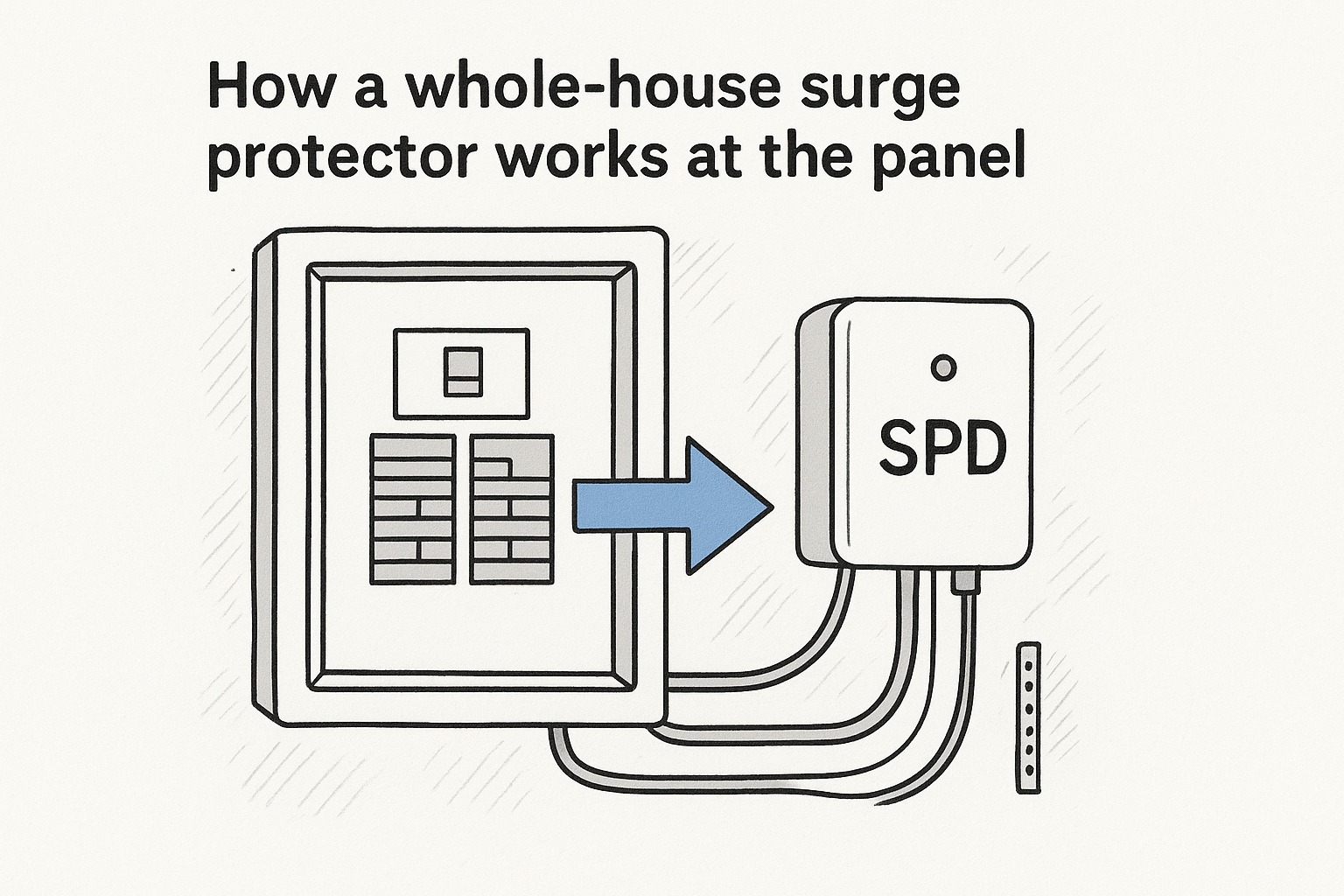
A whole-house surge protector, also called a surge protective device (SPD), installs directly at your main electrical panel. That location is critical. By sitting at the entry point of your home’s electrical system, the device intercepts excess voltage before it can travel down any branch circuit to your outlets, appliances, or wiring. Understanding how does a whole house surge protector work starts with what happens in those first microseconds after a voltage spike enters your service lines.
The role of metal oxide varistors
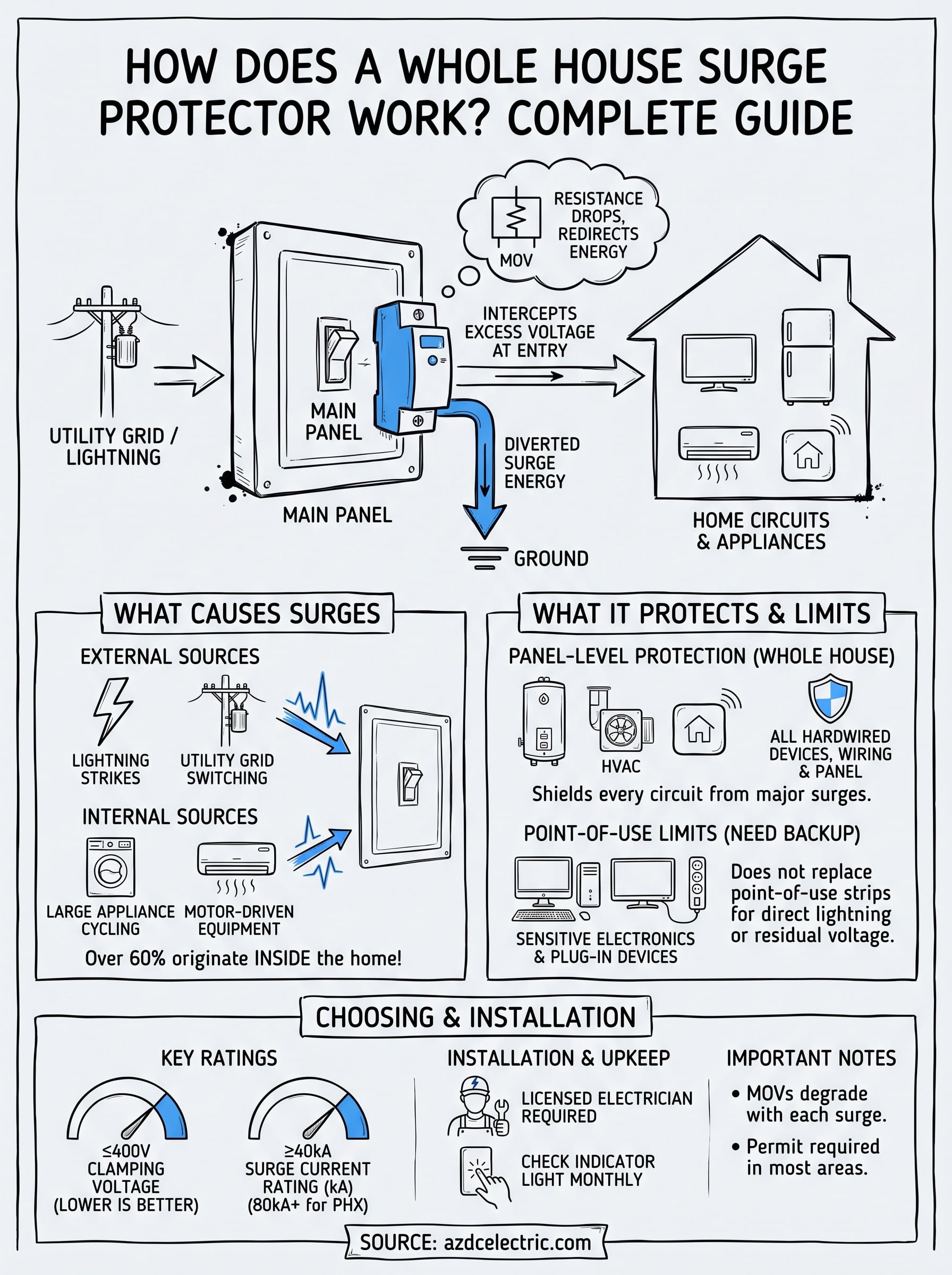
The core component inside most whole-house SPDs is a metal oxide varistor, or MOV. Under normal voltage conditions, the MOV sits idle and allows current to pass through without interference. The moment voltage climbs above a set threshold, the MOV’s resistance drops sharply, and it redirects the excess energy away from your circuits and into the grounding wire connected to your panel. That diverted energy dissipates safely into the earth rather than reaching your devices.
MOVs degrade slightly with each surge they absorb, which is why quality whole-house units include an indicator light that tells you when the device needs replacement.
How the device connects to your system
A licensed electrician connects the SPD directly to the main breaker or a dedicated breaker inside your panel using short wire leads. The shorter those leads, the faster and more effective the protection. Most units also connect to the neutral and ground bars inside the panel, which completes the path that allows excess voltage to flow to ground instead of into your home’s circuits.
What it protects and what it cannot protect
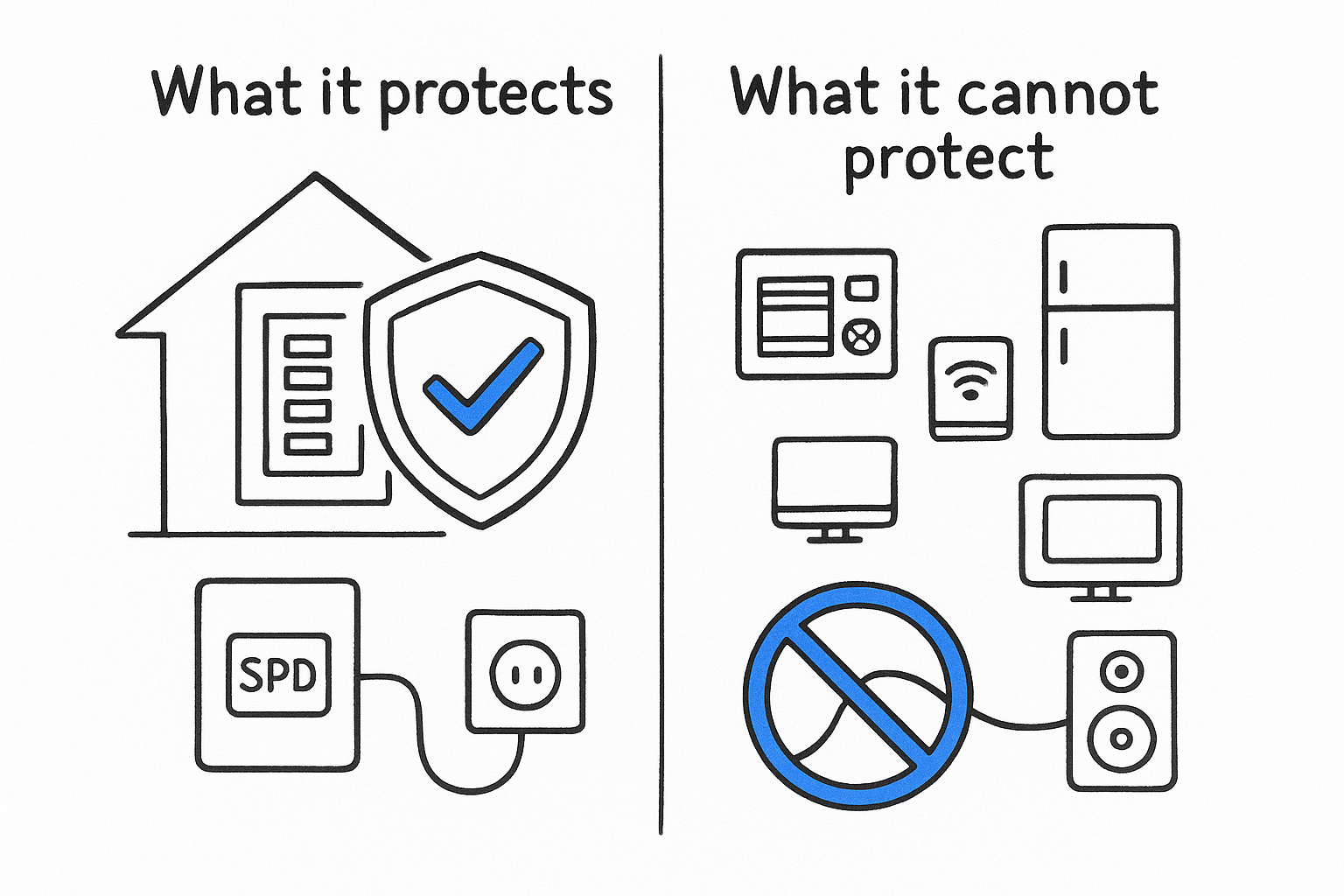
Understanding how does a whole house surge protector work is useful, but knowing what the device covers is equally important before you invest. A whole-house SPD intercepts voltage spikes at the panel level, handling surges from utility lines and large appliances cycling on and off. That coverage is broad, but it has real limits you should know about.
What a whole-house SPD covers
A panel-level surge protector shields every hardwired device and outlet in your home, including HVAC systems, refrigerators, dishwashers, water heaters with electronic controls, and smart home hubs. It also guards wiring and panel components themselves from surge-related overheating and gradual degradation over time.
For homes in the Phoenix Metro Area, where air conditioners run hard through long summers, protection against internal cycling surges is one of the most practical day-to-day benefits a panel-mounted SPD delivers.
Where the protection ends
A whole-house SPD does not replace point-of-use surge protectors for sensitive electronics like computers, TVs, and audio equipment. High-energy direct lightning strikes can still overwhelm a panel-mounted device, which is why pairing both types gives you the strongest possible coverage. The whole-house unit absorbs the bulk of incoming surge energy, and the point-of-use strips handle whatever residual voltage slips through to your outlets.
No single device eliminates all surge risk in every scenario. Your best strategy is a layered approach where the panel SPD handles large-scale events and individual power strips with surge ratings cover your most valuable electronics at the outlet level.
How to choose a whole-house surge protector
Once you understand how does a whole house surge protector work, the next step is selecting the right device for your home. Not all SPDs are built the same, and picking one based on price alone leaves real gaps in your protection. Two specs matter most: clamping voltage and surge current rating (kA). Clamping voltage tells you at what point the device activates to divert excess energy; lower is better, with 400 volts or below being a solid benchmark for residential use.
Key ratings to look for
The surge current rating, measured in kiloamperes (kA), tells you how much surge energy the device can handle in a single event. The National Electrical Manufacturers Association recommends a minimum rating of 40 kA for whole-house devices, but homes in lightning-prone areas like the Phoenix Metro Area benefit from units rated at 80 kA or higher. Also confirm the unit carries a UL 1449 listing, which means an independent lab has verified that the device meets established safety and performance standards before it ever reaches your panel.
Choosing a unit with a built-in diagnostic indicator light lets you confirm at a glance that the device is still functional after a significant surge event, without needing a technician visit.
Matching the device to your home
Your panel type, age, and available breaker slots all affect which SPD installs correctly. Newer panels typically accept plug-on neutral SPDs that mount cleanly without extra hardware, while older panels may require a hardwired unit that a licensed electrician fits to your specific setup. If your home runs a large HVAC system, pool equipment, or well pump, choose a device rated to handle repeated internal cycling surges without degrading prematurely.
Installation, upkeep, and code basics
Knowing how does a whole house surge protector work is only half the picture. Getting the device installed correctly and keeping it functional over time determines how much protection you actually receive. A poorly installed SPD provides a false sense of security, which is worse than no protection at all.
What to expect during installation
A licensed electrician mounts the SPD directly at your main electrical panel and connects it using short wire leads to minimize response time. The shorter the lead length, the faster the device reacts to an incoming surge. Most installations take one to two hours and require no rewiring of your existing circuits.
The National Fire Protection Association NFPA 70 (National Electrical Code) Article 285 outlines the requirements for SPD installation, including approved connection methods and locations within the panel.
Maintenance and replacement
Your SPD requires very little day-to-day attention, but you should check the indicator light on the unit every few months to confirm it is still active. After a significant surge event like a nearby lightning strike, inspect the indicator immediately. MOVs degrade each time they absorb energy, so a unit that has handled a major event may need replacement even if no visible damage is present.
Code and permit basics
Most jurisdictions across the Phoenix Metro Area require a permit for panel-level electrical work. Your electrician pulls the permit, schedules the inspection, and ensures the device meets local code requirements before the job closes out. Skipping the permit process can affect your homeowner’s insurance coverage if a surge-related claim is ever filed.
Final takeaways
Understanding how does a whole house surge protector work puts you in a position to make a real decision rather than guessing. Your home faces voltage spikes from two directions: the utility grid outside and your own appliances inside. A panel-mounted SPD intercepts that excess energy and diverts it to ground before it reaches a single outlet, circuit, or hardwired device. No other single product gives you that level of coverage from one installation point.
Protecting your home well means pairing the whole-house unit at your panel with point-of-use strips at your most valuable electronics. After a major surge event, check the indicator light on your device and replace the unit if it has absorbed significant energy. Permits, short lead lengths, and correct ratings all determine how well the device actually performs.
If you’re ready to protect your home’s electrical system, contact the licensed electricians at AZ DC Electric to schedule your installation today.