Every time you flip a light switch or plug in an appliance, electricity flows through your home’s wiring, and the only thing standing between a safe circuit and a potential fire is your breaker panel. But how does a circuit breaker work, exactly? Most homeowners in the Phoenix Metro Area rely on these devices daily without understanding the simple mechanics happening inside the panel.
A circuit breaker monitors electrical current and automatically shuts off power when it detects an overload or short circuit. It does this through physical components, like bimetallic strips and electromagnets, that respond to excess heat and magnetic force. When something goes wrong, the breaker trips, cutting the circuit before wires overheat or damage spreads through your home.
At AZ DC Electric, our licensed electricians troubleshoot, repair, and upgrade breaker panels across Scottsdale, Mesa, Chandler, and the greater Phoenix area every day. That hands-on experience is exactly why we put this guide together. Below, we’ll walk you through each component inside a circuit breaker, explain the step-by-step process that makes it trip, and cover the different types you’re likely to find in residential and commercial properties.
Why circuit breakers matter for safety
Your home’s electrical system carries current through dozens of circuits, and each one has a rated limit. When too much current flows through a wire, the wire heats up fast. Left unchecked, that heat can melt insulation, ignite nearby wood or drywall, and start a fire inside your walls where nothing is visible until it is already serious. Circuit breakers exist to stop that process before it ever reaches that point.
Understanding how does a circuit breaker work comes down to one core idea: protection. Every circuit in your panel is rated for a specific amperage, and your breaker’s job is to cut power the moment current exceeds that rating. Without that automatic shutoff, a faulty appliance, a worn wire, or a simple overload could cause thousands of dollars in structural damage or put your family at real risk.
A single tripped breaker can prevent a house fire that starts inside the wall before you ever notice a problem.
What happens when a circuit overloads
An overload happens when too many devices draw current simultaneously on one circuit, pushing the load beyond what the wiring can safely handle. In a Phoenix-area home, this commonly occurs in kitchens where microwaves, toasters, and coffee makers share the same circuit. Your wires start to heat up, and without a breaker in place, that heat builds until insulation breaks down.
Your breaker detects the excess current and trips the circuit automatically, cutting power before the wiring reaches a dangerous temperature. This is not a malfunction. It is the system doing exactly what it was engineered to do. The trip also gives you a clear signal that something on that circuit needs attention before you restore power.
The difference between a breaker and a fuse
Older homes in the Phoenix area used fuses instead of breakers, and both serve the same protective purpose. A fuse contains a thin metal wire that physically melts when current exceeds a safe level, breaking the circuit. Once it blows, you have to replace it entirely with a matching unit.
A circuit breaker uses mechanical components to accomplish the same job, but you can reset it after it trips. That resettable design is why modern electrical codes require breakers in new construction and most panel upgrade projects. It also makes routine maintenance far more practical, since a tripped breaker takes seconds to address rather than requiring a full replacement part every single time.
How a circuit breaker trips step by step
Understanding how does a circuit breaker work in practice means tracing the exact sequence from the moment electricity enters your panel to the moment a circuit goes dark. The process takes only milliseconds, but each stage involves a distinct mechanical action that prevents damage to your wiring and appliances.
Step 1: Current enters through the breaker
Electricity flows from the utility supply into your [main breaker panel](https://azdcelectric.com/siemens-circuit-breaker-compatibility-chart/), where it divides into individual branch circuits. Each circuit routes through its own dedicated breaker, which sits in series with the wiring it protects. As current flows through, the breaker continuously monitors amperage in real time against its rated limit.
Step 2: The detection mechanism activates
When current stays within the rated limit, the breaker holds its internal contacts closed and power flows normally to your outlets and fixtures. The moment current surpasses the rated amperage, either a bimetallic strip bends due to heat buildup or an electromagnet generates enough force to trigger the internal mechanism. Both responses are fully automatic and require no manual input from you.
That automatic response is exactly what separates a properly functioning breaker from a circuit with no overcurrent protection at all.
Step 3: The breaker trips and cuts power
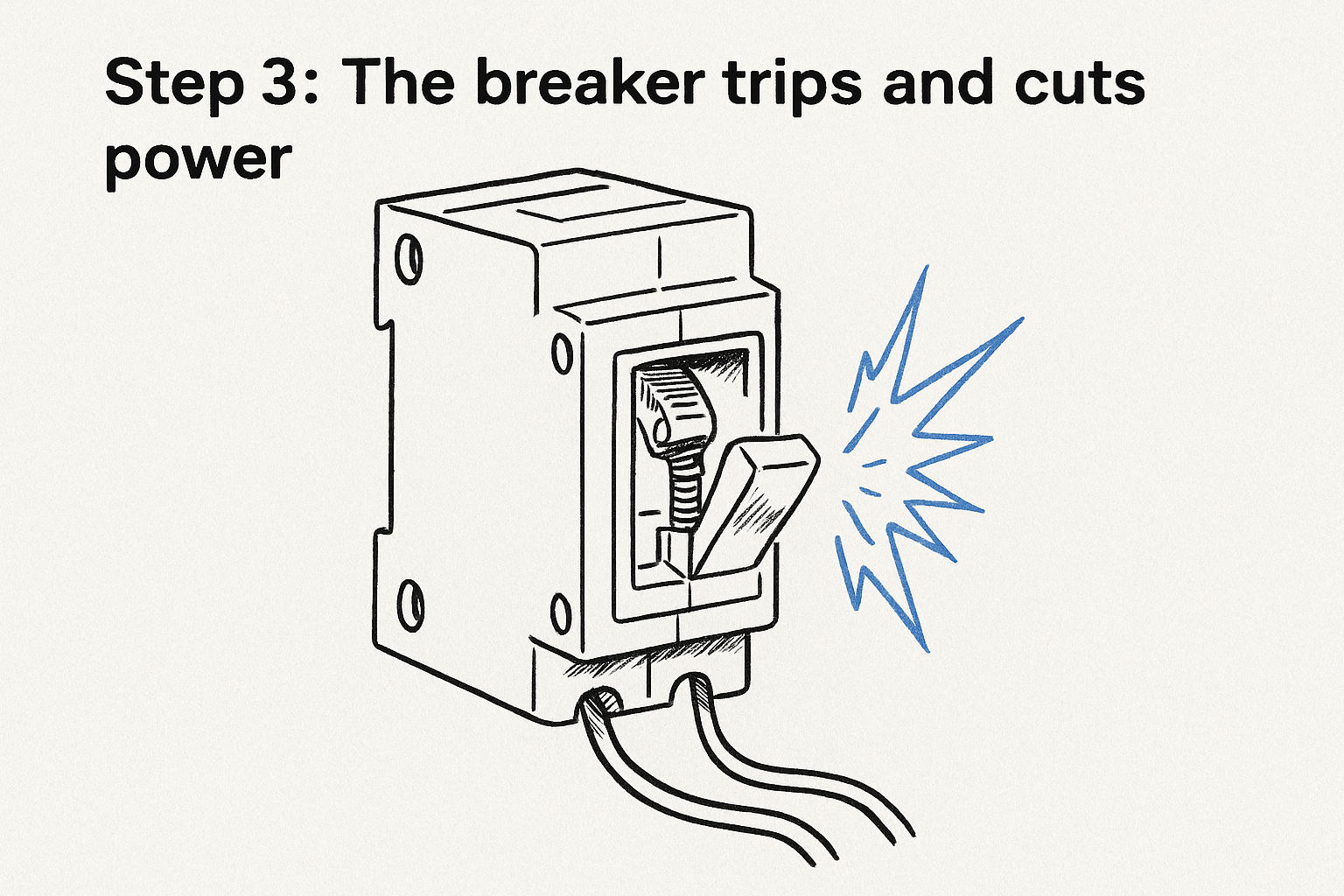
Once the detection mechanism fires, a spring-loaded latch releases inside the breaker housing. This snaps the contact arms apart, breaking the electrical path and cutting power to that circuit instantly. Your breaker handle shifts to the middle or tripped position, giving you a clear visual cue that the breaker acted and the circuit needs your attention before power is restored.
Thermal and magnetic trips explained
Most modern residential breakers use two separate mechanisms inside the same housing: a thermal trip and a magnetic trip. Each one targets a different type of fault, and understanding how does a circuit breaker work fully means knowing what triggers each response.
How the bimetallic strip handles overloads
The thermal trip relies on a bimetallic strip made from two different metals bonded together. When a circuit overloads and current climbs above the rated limit, the excess current heats that strip. Because the two metals expand at different rates, the strip bends toward a trip lever. The longer the overload continues, the more the strip bends, until it finally pushes the latch and trips the breaker.
This gradual response is intentional. It gives brief current spikes, like a motor starting up, time to settle without unnecessarily cutting power.
Keep in mind that a sustained overload trips faster than a mild one. If your circuit is running at 110 percent of its rated amperage, the bimetallic strip may take several minutes to bend far enough. At 200 percent of rated amperage, the trip happens in seconds.
How the electromagnet handles short circuits
A short circuit is far more dangerous than an overload because current spikes almost instantaneously to levels that can damage wiring before a bimetallic strip has time to react. That is where the magnetic trip takes over. The breaker contains a coil of wire wrapped around a metal core, and when a short circuit sends a massive surge of current through it, the magnetic field that generates pulls the trip lever immediately.
Your wiring and appliances get protected because this response happens in fractions of a second, well before any thermal mechanism could react quickly enough to stop the damage.
Common breaker types in a house
Knowing how does a circuit breaker work in general is useful, but your panel likely contains several different breaker types, each designed for a specific job. Recognizing what each one does helps you understand your electrical system and spot potential gaps in your home’s protection.
Standard single-pole breakers
Single-pole breakers are the most common type you’ll find in a residential panel. They protect a single 120-volt circuit and are rated at either 15 or 20 amps. Your bedroom outlets, lighting circuits, and most general-use circuits run through single-pole breakers. They occupy one slot in your panel and use the thermal and magnetic trip mechanisms covered earlier.
Double-pole breakers
Double-pole breakers occupy two adjacent slots in your panel and protect 240-volt circuits. You’ll find them connected to high-draw appliances like your electric dryer, water heater, central air conditioning unit, or electric range. Because these appliances pull significantly more power, the double-pole design monitors both legs of the 240-volt supply simultaneously.
If a double-pole breaker trips in your Phoenix-area home during summer, your air conditioner is usually the first thing to check.
GFCI and AFCI breakers
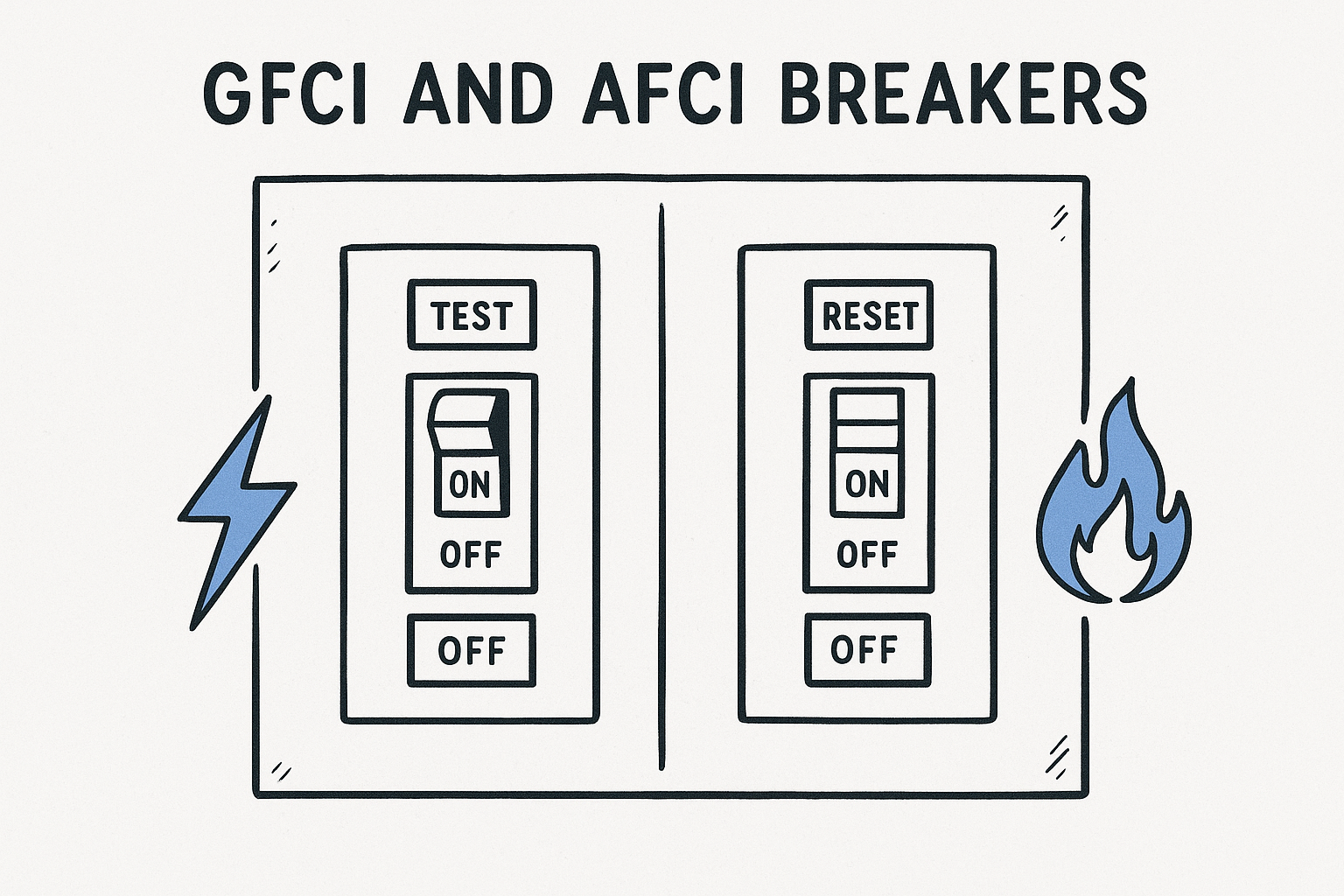
GFCI breakers (Ground Fault Circuit Interrupter) protect against ground faults, where current escapes its intended path and travels through water or a person. They are required in kitchens, bathrooms, garages, and outdoor circuits. AFCI breakers (Arc Fault Circuit Interrupter) detect dangerous arcing inside wiring before it ignites nearby materials. Modern building codes in Arizona require AFCI protection in bedrooms and living areas of new construction, making both types standard features in any updated panel.
How to reset and troubleshoot a tripped breaker
Knowing how does a circuit breaker work gives you the foundation to handle a trip confidently instead of guessing. When a breaker trips, your panel gives you a clear visual signal, and following a simple process gets your circuit back online safely. Skipping steps or forcing a reset without investigating first puts your home at unnecessary risk.
Locate and identify the tripped breaker
Open your main panel and scan the breaker handles. A tripped breaker sits in the middle or off position, visually distinct from the breakers that are fully switched on. Most panels include a circuit directory label on the inside of the door that maps each breaker to a specific area of your home, so you can identify exactly which circuit went down and which devices were on it.
Reset the breaker the right way
Before you reset, unplug or switch off devices on that circuit to reduce the load. Push the breaker handle firmly to the full off position first, then flip it back to on. You should feel a solid click when it engages correctly.
A breaker that trips again immediately after reset is signaling an underlying fault that needs professional diagnosis, not repeated resets.
If the breaker trips again under normal conditions, stop resetting it and investigate what changed on that circuit before restoring power.
When to stop and call an electrician
Some situations go beyond a simple reset. If you notice a burning smell or scorch marks around the panel, stop using that circuit immediately. A warm breaker housing or buzzing sound coming from your panel means the problem requires a licensed electrician before you restore power to anything connected to that circuit.
Key takeaways
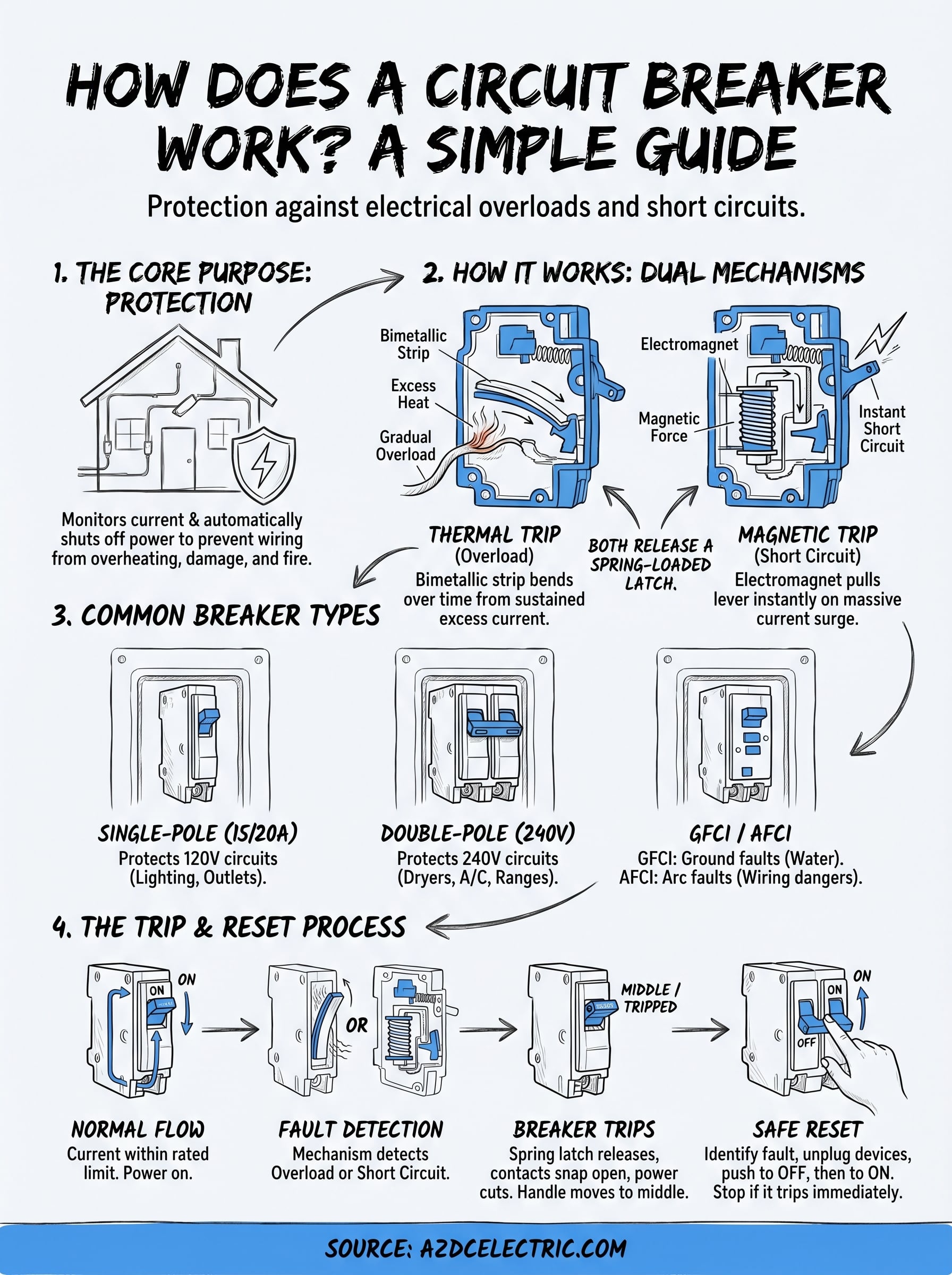
Understanding how does a circuit breaker work puts you in control of your home’s electrical safety instead of guessing when something goes wrong. Circuit breakers monitor current continuously and use either a bimetallic strip for gradual overloads or an electromagnet for instant short circuit protection. Both mechanisms trip automatically, cutting power before your wiring overheats or damage spreads.
Your panel likely contains a mix of single-pole, double-pole, GFCI, and AFCI breakers, each protecting a specific circuit type. When a breaker trips, reducing the load before resetting is always the right first step. A breaker that keeps tripping signals an underlying fault that needs professional attention, not repeated resets.
If your panel needs an inspection, upgrade, or repair anywhere in the Phoenix Metro Area, contact the licensed electricians at AZ DC Electric to get the job done safely and correctly.