A tripped breaker in your kitchen is an inconvenience. A total power failure across your warehouse, restaurant, or office building is a crisis. When electrical problems hit a commercial property, every minute without power means lost revenue, safety risks, and operational chaos. That’s exactly when you need an emergency commercial electrician, a licensed professional equipped to diagnose and resolve urgent electrical failures in business environments, day or night.
Unlike standard service calls that can wait until Monday morning, commercial electrical emergencies demand immediate response. We’re talking about panel failures that shut down refrigeration units, arcing circuits that threaten building occupancy, or storm damage that leaves an entire storefront dark during business hours. These situations don’t follow a convenient schedule, and the electrician you call shouldn’t either.
At AZ DC Electric, we provide 24/7 emergency electrical services across the Greater Phoenix Metro Area, backed by licensed and insured technicians who show up fast and get to work immediately. This article breaks down what qualifies as a commercial electrical emergency, what to expect from professional emergency response, and how to protect your business from extended downtime when the unexpected hits.
What an emergency commercial electrician does
An emergency commercial electrician is a licensed technician trained specifically for the scale and complexity of business electrical systems. When your building loses power, a circuit fails, or a piece of equipment starts behaving dangerously, this person shows up, identifies the source of the problem, and repairs it, often within a single visit. Their job goes well beyond flipping a breaker back on. They use specialized diagnostic tools to trace faults through large-scale wiring systems, load centers, and equipment panels that would be far outside the scope of a standard residential call.
Core diagnostic and repair skills
The first thing an emergency commercial electrician does when they arrive is assess the situation for immediate safety hazards. Before touching anything, they identify whether there’s active arcing, burning smells, or exposed wiring that needs to be isolated right away. From there, they use instruments like thermal imaging cameras, clamp meters, and circuit analyzers to pinpoint exactly where the fault is occurring without guessing. This diagnostic precision matters because commercial systems run on three-phase power, multiple sub-panels, and circuits that serve dozens of devices at once. A wrong assumption wastes your time and extends your downtime.
Accurate diagnosis is what separates a fast, lasting fix from a repeat failure two days later.
Once the fault is located, they move into repair. That might mean replacing a failed breaker, repairing damaged wiring inside a conduit run, restoring a neutral connection at a distribution panel, or isolating a faulty circuit so the rest of your building stays operational while the damaged section gets corrected. The goal is always to restore as much function as possible as quickly as possible.
Types of systems they work on
Commercial electricians handle a much broader range of systems than a typical residential technician. When you call for emergency help, you can expect a qualified technician to be trained and equipped to work on the following:
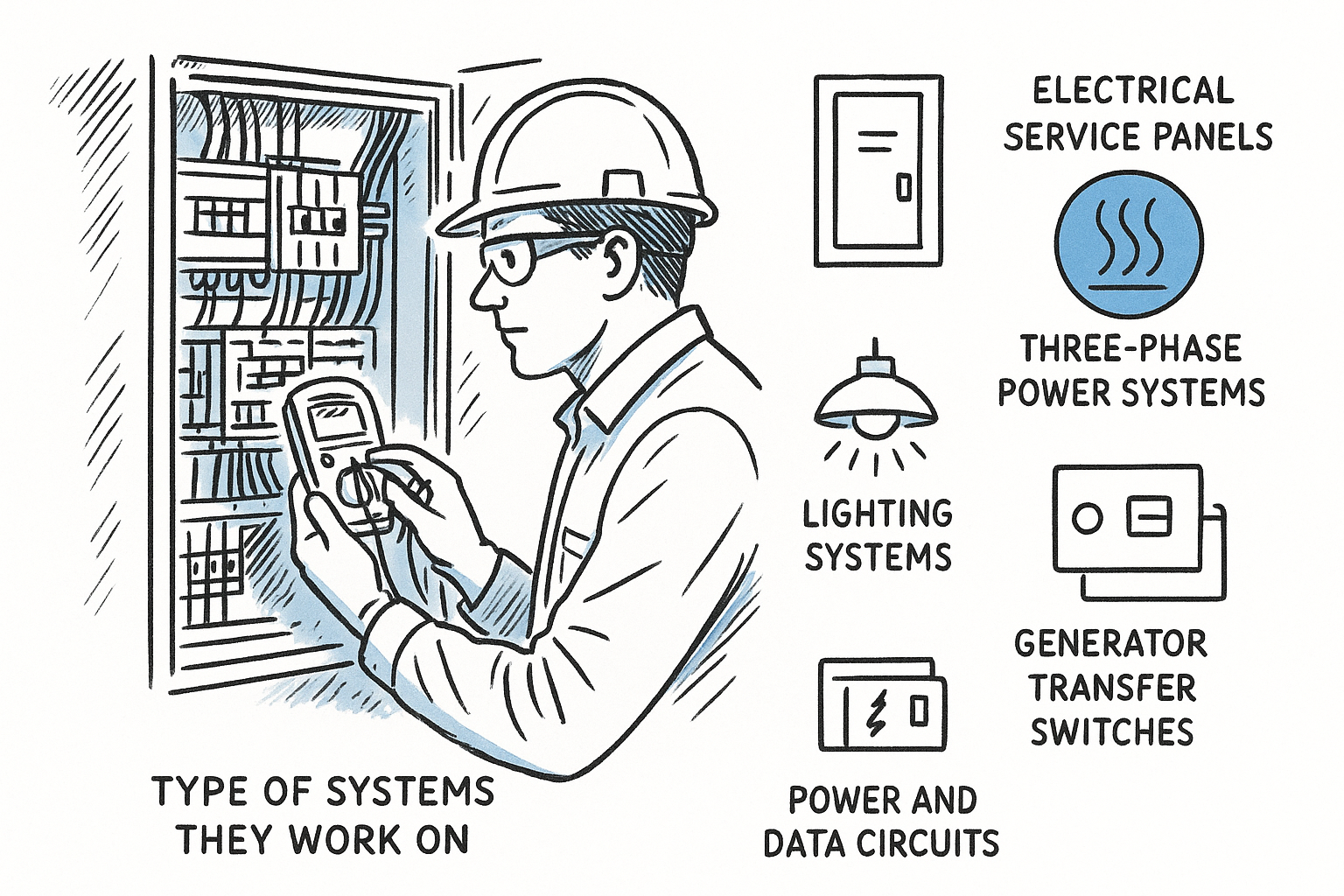
- Electrical service panels and sub-panels, including 200-amp to 800-amp commercial services
- Three-phase power systems used by HVAC equipment, industrial machinery, and commercial refrigeration
- Lighting systems, including parking lot fixtures, emergency egress lighting, and interior controls
- Generator transfer switches that keep critical systems running during grid outages
- Power and data circuits for offices, retail environments, and hospitality facilities
How commercial work differs from residential
Commercial properties operate under stricter code requirements than residential buildings. The National Electrical Code (NEC) sets detailed standards for commercial installations, covering load calculations, conduit specifications, panel labeling, and circuit protection at a level that goes well beyond residential rules. An emergency commercial electrician works within those standards even under pressure, because code violations during emergency repairs can create liability exposure and cause problems at your next inspection.
Your building also carries more operational risk when electrical faults hit during open hours. Customers, employees, and specialized equipment are all part of the picture. A qualified commercial electrician knows how to isolate the affected circuits while keeping the rest of your operation running, which is a skill that requires both technical experience and solid judgment under pressure.
When it’s an emergency and when it can wait
Not every electrical issue at your business demands a middle-of-the-night phone call. Understanding the difference between a true emergency and a manageable problem helps you act fast when it counts and avoid unnecessary costs when it doesn’t. A good rule of thumb: if the problem creates immediate safety risks, shuts down revenue-generating operations, or threatens your building’s systems, you need help right now.
Situations that need an immediate call
Some problems simply cannot wait until morning. If you’re dealing with any of the following, call an emergency commercial electrician without hesitation:
- Total power loss affecting your entire building or a critical area like a kitchen, server room, or production floor
- Burning smells or visible sparks coming from panels, outlets, or wiring
- Repeated breaker trips on circuits that power essential equipment
- Flickering lights combined with buzzing sounds, which can indicate a loose connection or a failing panel
- Water intrusion near electrical panels or outdoor equipment after a storm
If your fire suppression system, security system, or emergency egress lighting is affected, treat the situation as an emergency without exception.
Problems that can be scheduled
Plenty of issues are serious without being urgent. Upgrading your service capacity ahead of a renovation, adding new circuits for additional equipment, or replacing aging fixtures are all important jobs that don’t require dropping everything tonight. If the issue doesn’t interrupt operations and poses no immediate safety risk, you can book a standard appointment and have the work done properly during business hours.
The key question to ask yourself is whether the problem is getting worse by the hour or creating a dangerous condition right now. If the answer is yes, call immediately. If the answer is no, schedule it soon but don’t ignore it. Electrical problems that seem minor have a consistent habit of escalating when left unaddressed.
What to do before the electrician arrives
The window between spotting an electrical problem and the moment your emergency commercial electrician walks through the door is not wasted time. The actions you take during that period directly affect how fast the technician can diagnose the issue and how safe your building stays in the meantime. A few focused steps can protect your employees, limit damage, and speed up the repair.
Isolate the problem safely
Your first priority is to remove people from the immediate hazard zone. If the issue is localized to a specific room, server closet, or section of the building, clear that area and restrict access until help arrives. Do not attempt to open electrical panels, pull wires, or investigate behind equipment covers yourself. Commercial electrical systems carry voltages that cause serious injury or death on contact, and diagnosing faults without proper tools only makes the situation harder to resolve.
If you smell burning, see smoke, or notice discoloration around an outlet or panel, treat it as a potential fire hazard and contact emergency services before calling an electrician.
If it is safe to do so and you know exactly which breaker controls the affected area, switch it off at the panel to stop power from flowing to damaged wiring. If you are unsure which breaker is responsible, leave the panel alone and let the technician handle it.
Gather key information
Before the technician arrives, write down or photograph everything you observed. Note the time the problem started, what equipment was running when it happened, any sounds or smells you noticed, and whether any breakers tripped. This information helps the electrician skip past guesswork and move straight to the likely cause.
You should also locate your building’s electrical panel directory if one exists, and have it ready. Knowing which circuits control which zones saves diagnostic time. If your building has a recent inspection report or electrical drawings, pull those too. The faster the technician gets the full picture, the faster your business gets back online.
What happens during an emergency service call
Knowing what to expect when a technician shows up at your building reduces stress and helps you communicate clearly during a high-pressure situation. An emergency commercial electrician follows a structured process from the moment they arrive, moving through assessment, diagnosis, and repair in a deliberate order designed to restore your operation as quickly and safely as possible.
Arrival and initial assessment
The technician’s first action is to talk with you directly about what happened. They want to hear your description of the problem, review any notes you gathered, and understand which parts of your building are affected. This conversation is not a formality. The information you provide about when the fault appeared, what equipment was running, and what you observed cuts diagnostic time significantly.
The more specific your description, the faster the technician can identify the source and begin repairs.
From there, the electrician does a visual walkthrough of the affected area, checking panels, outlets, equipment connections, and any visible wiring for obvious signs of damage, overheating, or failure. They are looking for immediate safety hazards before pulling out diagnostic equipment.
Diagnosis and repair
Once the initial walkthrough is complete, the technician brings in specialized diagnostic tools to trace the fault precisely. This typically includes a clamp meter to measure current draw, a multimeter to check voltage at critical points, and in many cases a thermal imaging camera to detect heat signatures that indicate overloaded or failing connections that are invisible to the naked eye.
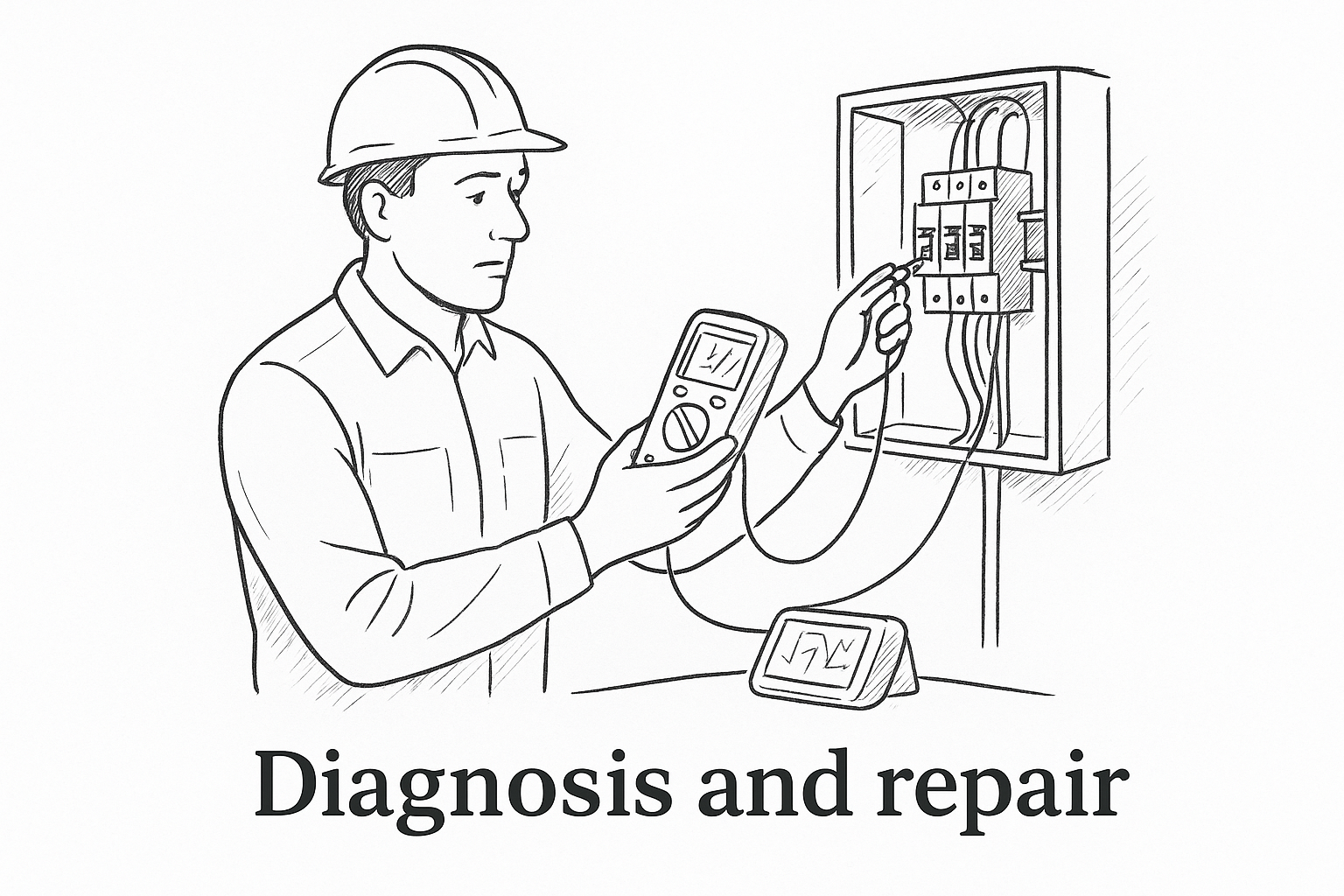
After pinpointing the fault, the electrician explains what they found and walks you through the repair plan before touching anything. You get a clear picture of the scope, the expected time to complete, and the cost upfront. Repairs then begin immediately, with the technician working to isolate damaged sections, replace failed components, and restore circuits in order of operational priority so your business recovers as much function as possible before they leave the site.
Costs, timelines, and how to choose a pro
Calling in an emergency commercial electrician costs more than scheduling standard work, and that difference reflects real factors: immediate availability, faster dispatch, and the technical capability to resolve complex faults under pressure. Knowing what drives the cost and what a realistic timeline looks like helps you make a faster, more confident decision when the situation is urgent.
What emergency electrical work typically costs
Hourly rates for emergency commercial electrical work typically range from $150 to $300 per hour, depending on your location, the complexity of the fault, and whether the call falls outside normal business hours. Most emergency calls also include a diagnostic fee on top of the hourly rate. A qualified technician can usually diagnose and resolve straightforward faults within two to four hours, which keeps the total cost predictable for most situations. For larger failures involving panel replacements or extensive rewiring, expect a more detailed estimate once the technician has assessed the full scope on-site.
Ask for upfront pricing before any work begins so you know exactly what you are agreeing to.
How to choose the right electrician
When selecting a commercial electrician for emergency work, confirm that the technician holds a valid state license and carries both general liability and workers’ compensation insurance. These are not optional considerations. If an unlicensed technician causes additional damage or is injured on your property, you carry the financial exposure.
Beyond credentials, look for a company that offers a written workmanship guarantee and transparent pricing before work starts. Response time matters too. An electrician who arrives quickly and communicates clearly throughout the repair is one you can rely on for future emergencies. AZ DC Electric serves the Greater Phoenix Metro Area with no call-out fees across a wide range of cities and backs every job with a five-year workmanship guarantee, so you know exactly what you are getting before a technician sets foot on your property.
Quick recap
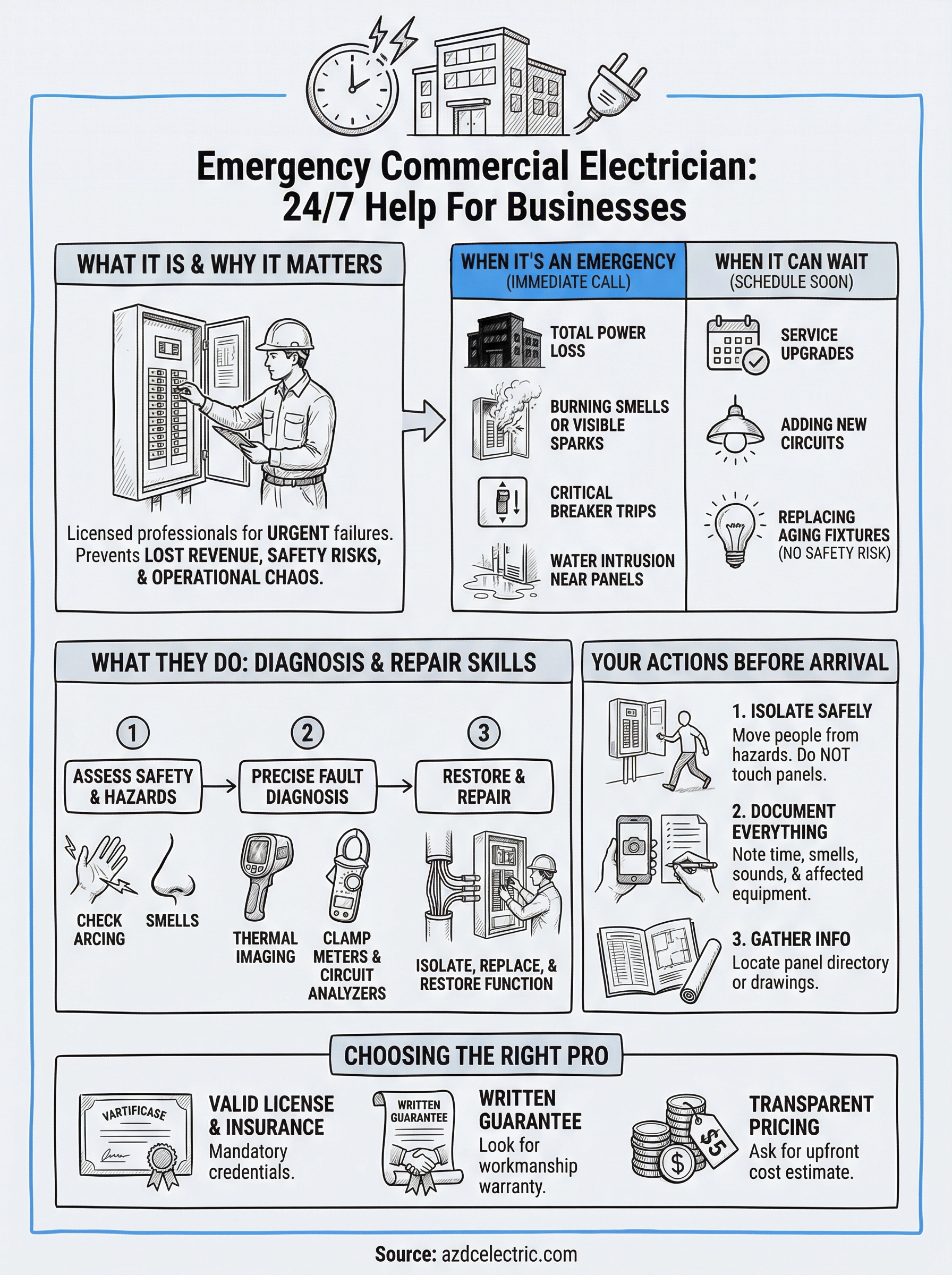
A commercial electrical failure moves fast, and the decisions you make in the first few minutes determine how quickly your business recovers. An emergency commercial electrician handles everything from panel failures and arcing circuits to complete power outages, using specialized diagnostic tools to identify the fault and restore operations without guesswork. True emergencies, like burning smells, total power loss, or tripped breakers on critical equipment, demand an immediate call. Problems that don’t interrupt operations or create safety risks can wait for a scheduled appointment.
Before help arrives, clear the affected area, switch off the relevant breaker if it’s safe to do so, and document what you observed so the technician can move straight to diagnosis. When choosing a pro, confirm their license, insurance, and workmanship guarantee before any work begins. If your Phoenix-area business needs fast, reliable help right now, contact AZ DC Electric and get a licensed technician on-site quickly.