You got a quote for a 240V outlet and now you’re wondering whether that number is reasonable or inflated. Fair question. The cost to install a 240V outlet depends on several factors, your electrical panel’s current capacity, how far the new circuit needs to run, and whether permits are required in your city. Across the Phoenix Metro Area, homeowners typically see prices ranging from a few hundred dollars to well over a thousand, and the spread between quotes can be surprising.
At AZ DC Electric, we install 240V outlets for EV chargers, dryers, ranges, welders, and other high-draw equipment throughout Scottsdale, Mesa, Chandler, and the surrounding valley. We’ve seen what these jobs actually cost from the inside, the wire, the breaker, the labor, the permit fees, so we’re in a good position to break down real numbers rather than vague national averages. Our pricing is upfront, meaning you know the total before we start, and we back our work with a 5-year workmanship guarantee.
This guide covers 2026 pricing for 240V outlet installations, including labor rates, material costs, permit expenses, and the variables that push a job toward the higher or lower end. By the end, you’ll have the context you need to evaluate any quote you’ve received and make a confident hiring decision.
What a 240V outlet install includes
A 240V outlet isn’t a simple swap. When you pay for this job, you’re paying for a complete electrical circuit, not just the receptacle on the wall. Every component in that circuit, from the breaker to the wire gauge to the outlet itself, must match the amperage rating of the device you plan to run. Getting any element wrong creates a fire hazard, so professional installation covers the full system, not just what’s visible once the job is done.
The dedicated circuit
Most 240V applications require their own dedicated circuit, meaning no other device shares the breaker. An EV charger running on a shared circuit can trip breakers repeatedly or cause dangerous overloading. The electrician installs a new double-pole breaker in your panel, which draws from both legs of your home’s 120V service to produce the 240V supply the outlet needs.
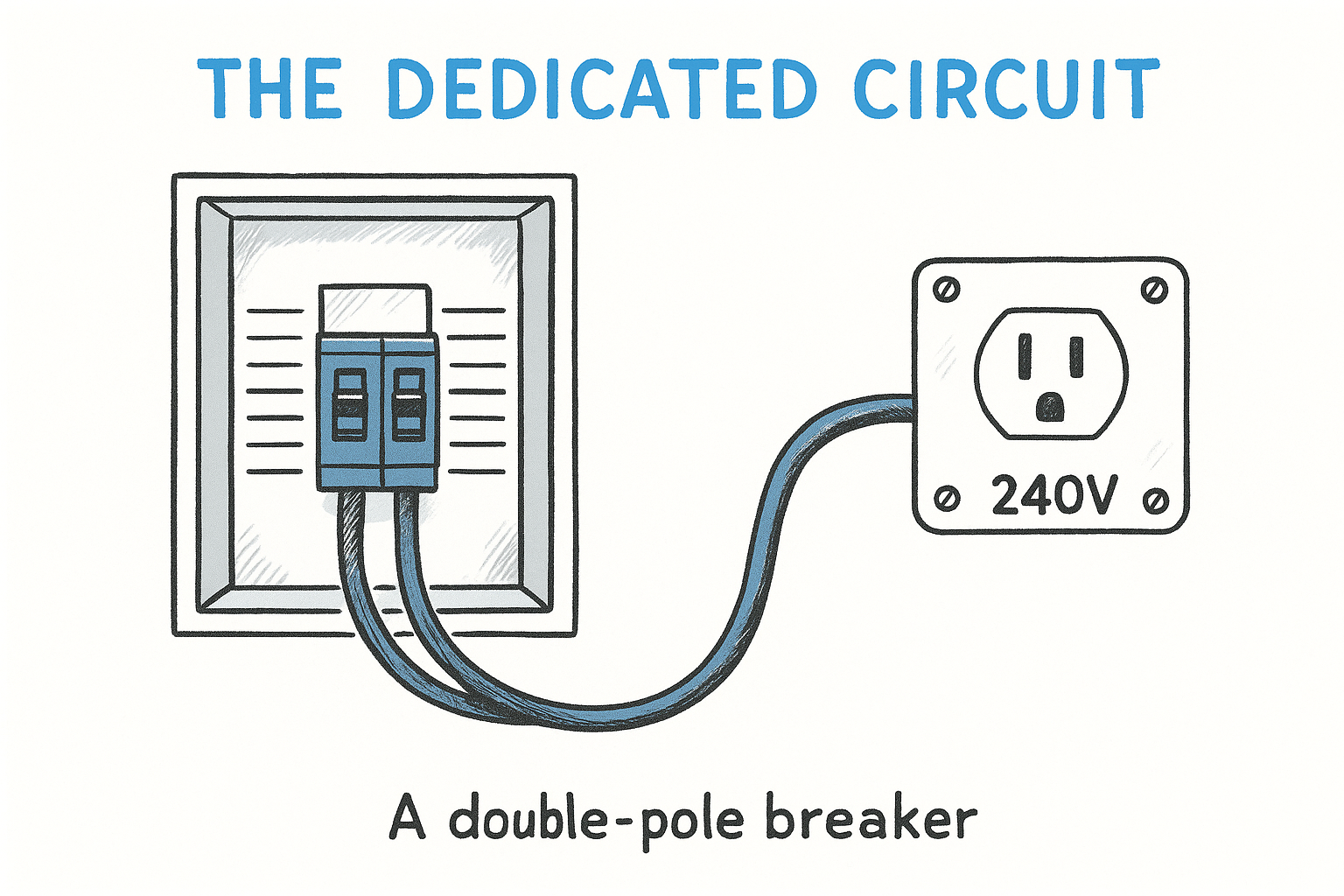
A double-pole breaker occupies two slots in your panel, which is why panel capacity matters before any 240V work begins.
Your panel needs available space. If your breaker box is already full, the installer may need to consolidate circuits using tandem breakers or recommend a panel upgrade, which adds to the total cost of the project.
Wiring runs and materials
Once the breaker is in place, the electrician runs wire from the panel to the outlet location. Wire gauge depends on amperage: a 30-amp circuit requires 10-gauge wire, while a 50-amp circuit needs 6-gauge wire. Heavier gauge wire costs more per foot and is harder to route through walls, so longer runs and higher amperage both push the cost to install a 240V outlet higher.
Materials used in a standard installation typically include:
- Double-pole breaker (30A or 50A depending on the load)
- Copper wire in the correct gauge, usually 10/2 or 6/3 with ground
- Conduit or wire protection for exposed runs such as garage walls
- The outlet receptacle (NEMA 14-30, 14-50, or 6-50 are the most common configurations)
- Junction boxes and mounting hardware
Labor and panel work
Labor covers more than the time spent pulling wire. Your electrician will assess your panel’s current load, verify the grounding system, test the outlet under full draw, and clean up the work area before leaving. These steps protect you from problems that wouldn’t show up until the device is actually running.
The time on-site for a straightforward install in a single-story home with a panel in the garage runs roughly two to four hours. Add complexity such as a long wire run, finished walls that require fishing wire through, or a crowded panel, and that time increases. Labor rates in the Phoenix Metro Area reflect the actual complexity of each job, so two installs with the same outlet type can land at different prices depending on what the electrician has to work around.
2026 cost ranges and real-world pricing
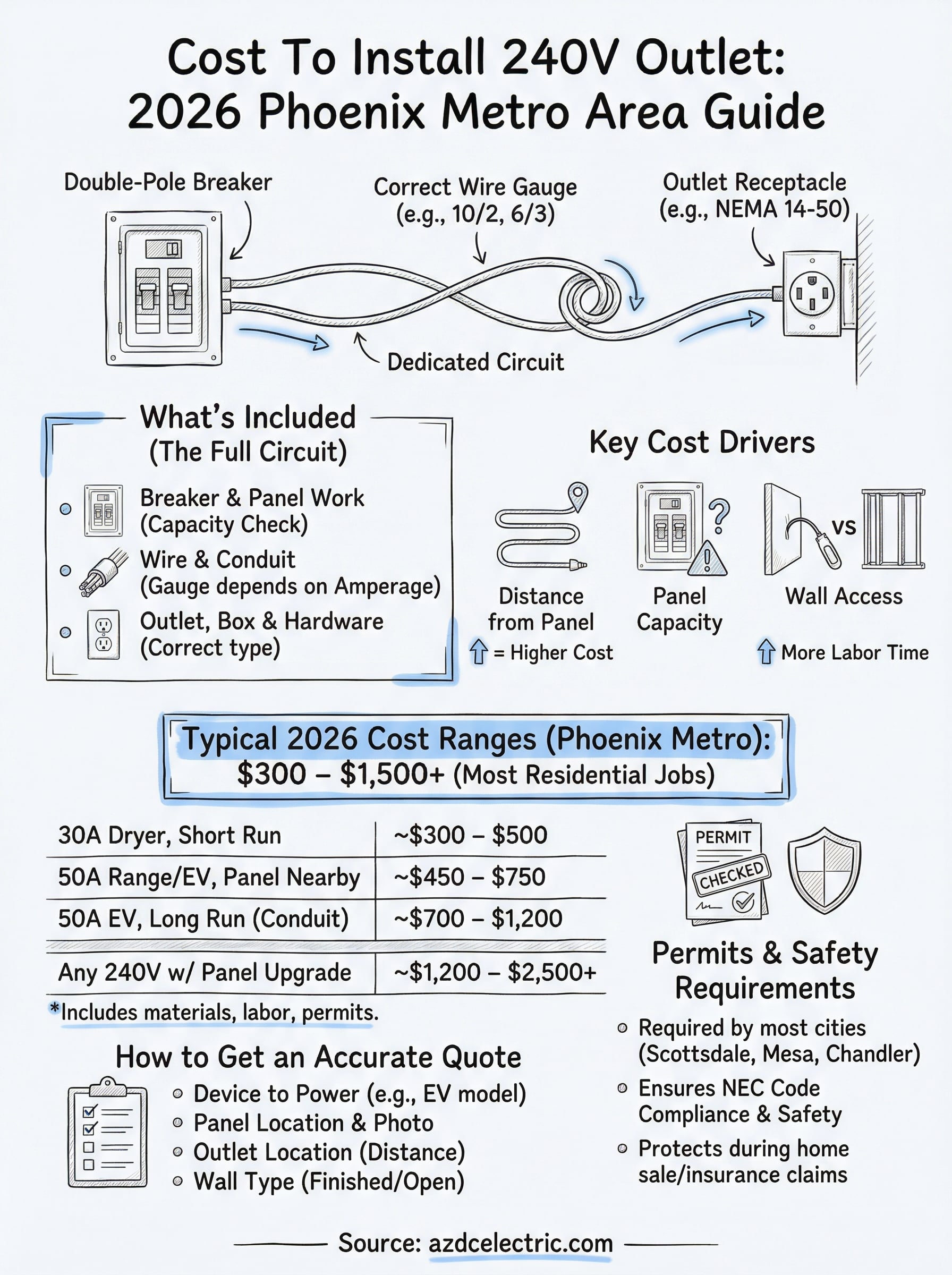
The cost to install a 240V outlet in the Phoenix Metro Area in 2026 falls between $300 and $1,500 for most residential jobs. That range exists because the variables covered in the previous section, wire run length, panel availability, and amperage, all move the needle on what you pay. A simple 30-amp dryer outlet in a home with an accessible panel and open breaker slots sits at the low end. A 50-amp EV charger installation with a long conduit run through a finished garage wall sits at the high end.
Typical price ranges by job type
Not all 240V installs carry the same scope, and the outlet type you need directly shapes what you’ll pay. Below are realistic price ranges for the most common jobs in the valley, with materials, labor, and permit fees included:
| Job Type | Typical Range |
|---|---|
| 30-amp dryer outlet, short run | $300 – $500 |
| 50-amp range or EV charger, panel nearby | $450 – $750 |
| 50-amp EV charger, long run with conduit | $700 – $1,200 |
| Any 240V outlet when a panel upgrade is required | $1,200 – $2,500+ |
These are not parts-only figures. Treat any quote that falls well below the lower end with caution, because permits and materials are often what get left out of a low estimate.
If a quote looks unusually low, ask specifically whether it includes the permit fee and all materials before you agree to anything.
What labor alone typically costs
Licensed electricians in Arizona charge between $80 and $150 per hour in 2026. At two to four hours for a standard install, your labor cost alone lands between $160 and $600 before you factor in wire, breaker, receptacle, and permit. Some contractors quote a flat rate per job rather than by the hour, which can simplify comparison shopping as long as you confirm the quote covers everything.
What drives the price up or down
Several variables directly affect the cost to install a 240V outlet, and understanding them helps you assess whether a quote reflects your specific situation. The job is not priced on the outlet alone. Your electrician prices the full scope of work needed to get power from your panel to that outlet safely and up to code, and each of these factors below can shift that scope considerably.
Distance from panel to outlet location
The longer the wire run, the more you pay. Wire material costs rise quickly at six-gauge thickness, and a 50-foot run through a garage wall costs significantly more in both labor and materials than a 10-foot run from an adjacent panel. When the outlet location sits far from the electrical panel, the electrician also needs more conduit, more connection hardware, and more time on-site, all of which are legitimate cost drivers.
Choosing an outlet location close to your panel, when practical, is the single most effective way to reduce your total installation cost.
Panel capacity and breaker availability
Your panel needs two open slots for a double-pole breaker before any 240V work can begin. If your panel is full, your installer either adds tandem breakers to free up space or recommends a full panel upgrade. Both options add cost. A crowded or outdated panel is one of the most common reasons a job that sounds simple ends up at the higher end of the price range.
Wall and ceiling access
Finished walls require the electrician to fish wire through tight spaces rather than staple it along open framing. This takes considerably more time, which means higher labor cost. In a garage with exposed framing or an unfinished basement, the wire run is direct and quick. In a finished living space, the same run can take two to three times as long, and drywall repairs may add to the final bill depending on what you arrange with your contractor.
Permits, code, and safety requirements
Pulling a permit for a 240V outlet installation is not optional in most Arizona cities. The permit requirement exists to protect you, not to generate revenue for the municipality. When work is permitted, a licensed inspector verifies that the wiring, breaker, and outlet all meet the current National Electrical Code (NEC) standards before the job is considered complete. Skipping this step creates real problems when you sell your home or file an insurance claim after an electrical fire.
When a permit is required
Most jurisdictions in the Phoenix Metro Area require a permit for any new circuit installation, including a dedicated 240V circuit. This applies whether the outlet is for an EV charger, a dryer, a range, or shop equipment. The cities of Scottsdale, Mesa, and Chandler all follow this rule. Your electrician handles the permit application as part of the job, and the fee is typically factored into your total quote.
If a contractor tells you a permit is unnecessary for a new 240V circuit installation, treat that as a serious red flag and get a second opinion before agreeing to the work.
The cost to install a 240V outlet in Arizona typically includes a permit fee ranging from $50 to $150, depending on the city and the scope of work. Some jurisdictions base the fee on the value of the project, so larger installs carry slightly higher permit costs.
What the inspection covers
After your electrician completes the work, a city inspector reviews the installation. The inspector checks wire gauge relative to breaker amperage, proper grounding, conduit installation where required, and correct receptacle type for the load. This step confirms the work is safe and meets local code.
Passing inspection also creates a documented record of the work, which protects you if questions arise during a home sale or with your insurance carrier. Permitted work carries legal standing that unpermitted work simply does not.
How to get an accurate quote in Phoenix
Getting an accurate quote for the cost to install a 240V outlet starts before you pick up the phone. The more specific you are about your project, the more useful the number you get back will be. A vague request produces a vague estimate, and that estimate almost never holds once the electrician sees the actual job.
What to tell the electrician upfront
When you contact an electrical contractor in the Phoenix area, give them four pieces of information: the device you’re powering, the location of your electrical panel, where you want the outlet installed, and whether your walls are finished or open. This lets the electrician give you a quote that reflects your actual situation rather than a general range.
Sharing a photo of your panel’s current breaker layout when you reach out saves time and helps the electrician identify any capacity issues before they arrive.
If you’re installing an EV charger, also mention the make and model of your vehicle or the charger unit you’ve selected. Different chargers require different outlet configurations, and confirming that upfront prevents surprises on installation day.
Questions to ask before you agree
Before you commit to any quote, ask these questions directly:
- Does this price include the permit fee for my city?
- Are all materials covered, including wire, breaker, conduit, and the outlet receptacle?
- Is there a workmanship guarantee, and how long does it last?
- Will you pull the permit and schedule the inspection, or is that my responsibility?
A reputable electrician answers all of these without hesitation. At AZ DC Electric, our quotes cover labor, materials, and permit fees as a single upfront number so you know the full cost before work begins. We serve Scottsdale, Mesa, Chandler, and the surrounding valley with no call-out fees for most cities in the Phoenix Metro Area.
Next steps for your 240V outlet project
You now have a realistic picture of the cost to install a 240V outlet in the Phoenix Metro Area, from the breaker and wire materials through to permit fees and labor. The price range makes more sense once you understand what drives it, and you’re in a better position to evaluate any quote sitting in your inbox right now. The most important next step is getting a specific number based on your actual panel, your actual outlet location, and your actual device requirements, not a rough range from a national average.
At AZ DC Electric, we serve Scottsdale, Mesa, Chandler, and the greater valley with upfront pricing, no call-out fees, and a 5-year workmanship guarantee on every job we complete. We handle the permit and schedule the inspection so you don’t have to. When you’re ready to move forward, request a quote from AZ DC Electric and get a firm number before any work begins.