Commercial properties across the Greater Phoenix Metro Area are adding EV charging stations at a rapid pace, and for good reason. Tenants, employees, and customers increasingly expect charging access wherever they park. But commercial EV charger installation services involve far more than mounting a unit on a wall. Between electrical load calculations, permit applications, utility coordination, and ADA compliance, the process has real complexity that demands licensed professionals who know local codes inside and out.
At AZ DC Electric, we handle commercial EV charger installations throughout Scottsdale, Mesa, Chandler, and the surrounding valley. As a licensed and insured electrical contractor, we work with property managers, business owners, and developers to plan, permit, and install charging infrastructure that meets both current needs and future demand. Our team deals with Arizona-specific permitting requirements and utility processes daily, which means fewer delays and fewer surprises on your invoice.
This guide breaks down what’s actually involved in a commercial EV charger installation, from the real costs you should budget for to the permits you’ll need before any work begins. We’ll cover Level 2 vs. DC fast charger considerations, common electrical upgrades that come with the territory, and the timeline you can realistically expect from project kickoff to energized stations. Whether you’re outfitting a retail parking lot, an office garage, or a multi-tenant complex, you’ll walk away knowing exactly what this project requires.
Why commercial EV charging matters for your property
Electric vehicle adoption in Arizona has accelerated sharply over the past few years, and the gap between available charging infrastructure and actual driver demand keeps widening. Property owners who install commercial charging stations now are not reacting to a trend; they are positioning their properties ahead of a shift that is already well underway. Ignoring that gap carries its own financial and competitive cost, in lost tenants, reduced foot traffic, and a property that looks dated compared to similar options nearby.
The tenant and customer demand is real
Today’s renters, employees, and retail customers increasingly factor EV charging availability into their decisions about where to live, work, and shop. JD Power research consistently shows that EV drivers rank charging access as a top priority when evaluating apartment complexes and workplaces. If your property lacks charging stations, you are effectively handing that decision to a competitor who has them.
When a potential tenant or customer has to choose between two otherwise comparable properties, EV charging availability often becomes the deciding factor.
This demand is especially pronounced in the Phoenix Metro Area, where long suburban commute distances and extreme summer heat reduce real-world EV range and make reliable charging infrastructure more critical than in cooler, denser cities. Providing charging at your property removes a daily friction point for EV drivers and makes your location more attractive by default.
EV charging as a financial asset
Investing in professional commercial EV charger installation services does more than attract tenants or customers. It creates a measurable financial asset that can generate revenue, increase property value, and qualify for significant tax incentives. Properties with EV infrastructure command higher rental rates and sale prices, and paid charging stations can generate ongoing income that offsets installation costs over time.
The federal Alternative Fuel Vehicle Refueling Property Tax Credit (IRS Form 8911) covers up to 30% of qualified installation costs for commercial properties, capped at $100,000 per item. Arizona utility programs through APS and SRP also offer rebates that vary by charger type and capacity, which can further reduce your net project cost when stacked with federal credits. Here is a quick summary of the financial levers available to you:
- Federal tax credit: up to 30% of installation costs (cap: $100,000 per item)
- APS and SRP utility rebates: vary by charger type and total capacity installed
- Charging revenue: paid stations generate income from tenants and visitors
- Property value: EV infrastructure raises assessed value and market appeal
How commercial EV charger installation services work
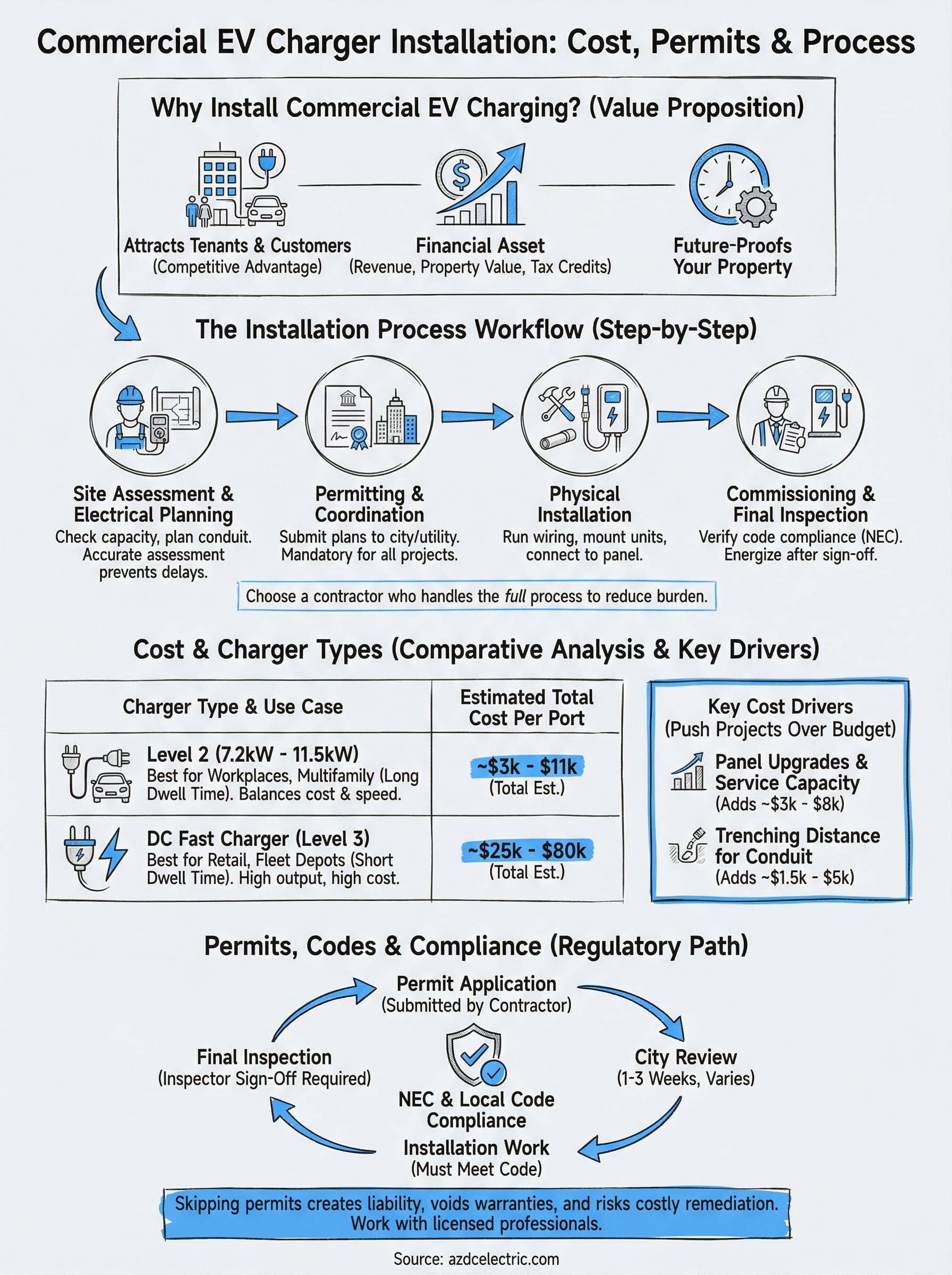
Commercial EV charger installation services follow a clear sequence from first contact to energized stations. Understanding each phase helps you set realistic timelines and avoid surprises. Most commercial projects move through three core stages: site assessment, permitting, and physical installation, with utility coordination woven throughout each one.
Site assessment and electrical planning
Before any hardware is ordered, a licensed electrician visits your property to evaluate your existing electrical infrastructure. This assessment covers your current panel capacity, available conduit pathways, and the distance between your service entrance and the proposed charging locations. Based on that data, the electrician determines whether your existing service can support the added load or whether a panel upgrade or new electrical service is required. Many commercial sites, especially older office buildings or retail strips, need a service upgrade before adding multiple Level 2 or DC fast chargers.
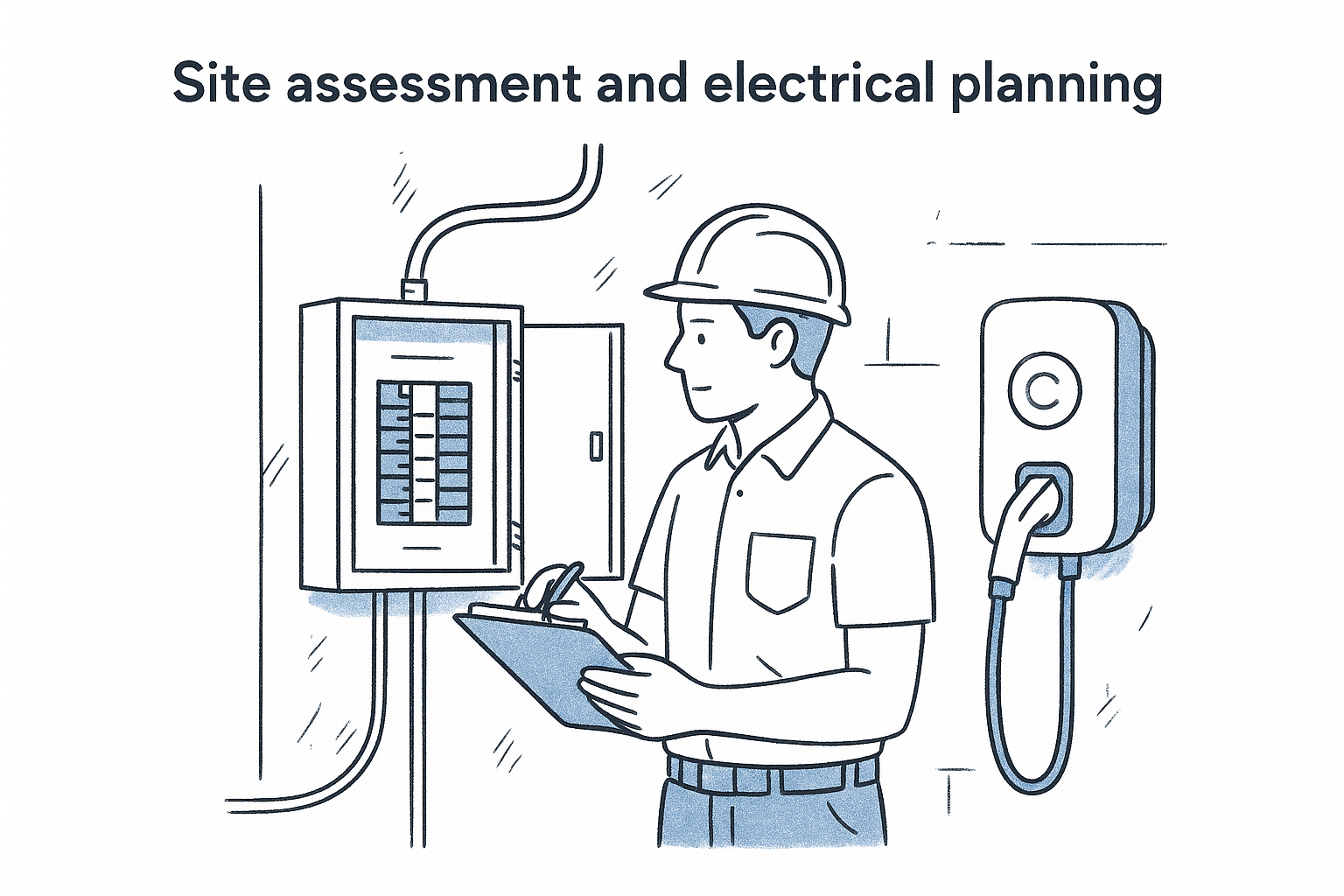
Getting an accurate site assessment upfront prevents costly mid-project discoveries that delay your timeline and inflate your budget.
Your electrician also helps you select charger hardware at this stage, matching the output level, connector type, and network management features to your specific use case, whether that is a workplace fleet, a retail amenity, or a multi-tenant complex.
Permitting, installation, and commissioning
Once the design is finalized, your contractor pulls the required electrical permits from the local jurisdiction, which in the Phoenix Metro Area means coordinating with city building departments and your utility provider. Permit timelines vary by municipality but generally run one to three weeks for commercial projects. After permit approval, the crew installs conduit, runs wiring, mounts the charger units, and connects everything to the panel. A city inspector then signs off on the completed work before any station goes live.
What commercial EV charger installation costs in 2026
Budgeting for commercial EV charger installation services requires separating hardware costs from installation costs, because both vary significantly based on your property’s electrical condition and the charger type you select. Most commercial property owners in the Phoenix Metro Area spend between $3,000 and $12,000 per charging port when you factor in equipment, labor, conduit runs, and any required electrical upgrades. DC fast chargers (Level 3) carry a much steeper price, typically ranging from $20,000 to $80,000 per unit installed.
Level 2 vs. DC fast charger cost breakdown
Level 2 chargers are the most common choice for workplaces, retail lots, and multi-unit housing because they balance cost with practical charging speeds. A single Level 2 unit adds 20 to 30 miles of range per hour, which covers a typical workday or overnight session without issue.
DC fast chargers make sense for high-turnover locations like retail centers or fleet depots, but the electrical infrastructure they require often doubles the total project cost.
Here is a simplified cost comparison to help you set expectations:
| Charger Type | Hardware Cost | Typical Installation | Total Per Port |
|---|---|---|---|
| Level 2 (7.2 kW) | $500 – $2,000 | $2,500 – $6,000 | $3,000 – $8,000 |
| Level 2 (11.5 kW) | $1,000 – $3,000 | $3,000 – $8,000 | $4,000 – $11,000 |
| DC Fast Charger | $10,000 – $40,000 | $15,000 – $40,000 | $25,000 – $80,000 |
What drives your total project cost
Panel capacity and trenching distance are the two factors that most frequently push a project over initial estimates. If your service entrance sits far from the parking area, conduit trenching alone can add $1,500 to $5,000 to your total. A panel upgrade, when required, typically adds another $3,000 to $8,000 on top of charger costs.
Permits, codes, and inspections in Phoenix Metro
Every commercial EV charger installation in the Phoenix Metro Area requires an electrical permit before any conduit is run or hardware is mounted. Your contractor submits the permit application to the city building department in the jurisdiction where your property sits, whether that is Scottsdale, Mesa, Chandler, Tempe, or another municipality. Each city processes permits independently, and review timelines range from one to three weeks for commercial projects, so factoring this into your schedule early avoids unnecessary delays.
Skipping the permit process is not a shortcut. Unpermitted electrical work creates liability exposure, voids equipment warranties, and can trigger costly remediation when you sell or refinance the property.
What your contractor must pull before work starts
Your licensed electrician handles permit applications and code documentation on your behalf as part of professional commercial ev charger installation services. The permit package typically includes a load calculation demonstrating that your electrical service can handle the added demand, a wiring diagram, and specifications for all hardware and conduit materials to be used. In Arizona, all electrical work must comply with the National Electrical Code (NEC) as adopted by the state, along with any local amendments your specific city has added on top.
Passing the final inspection
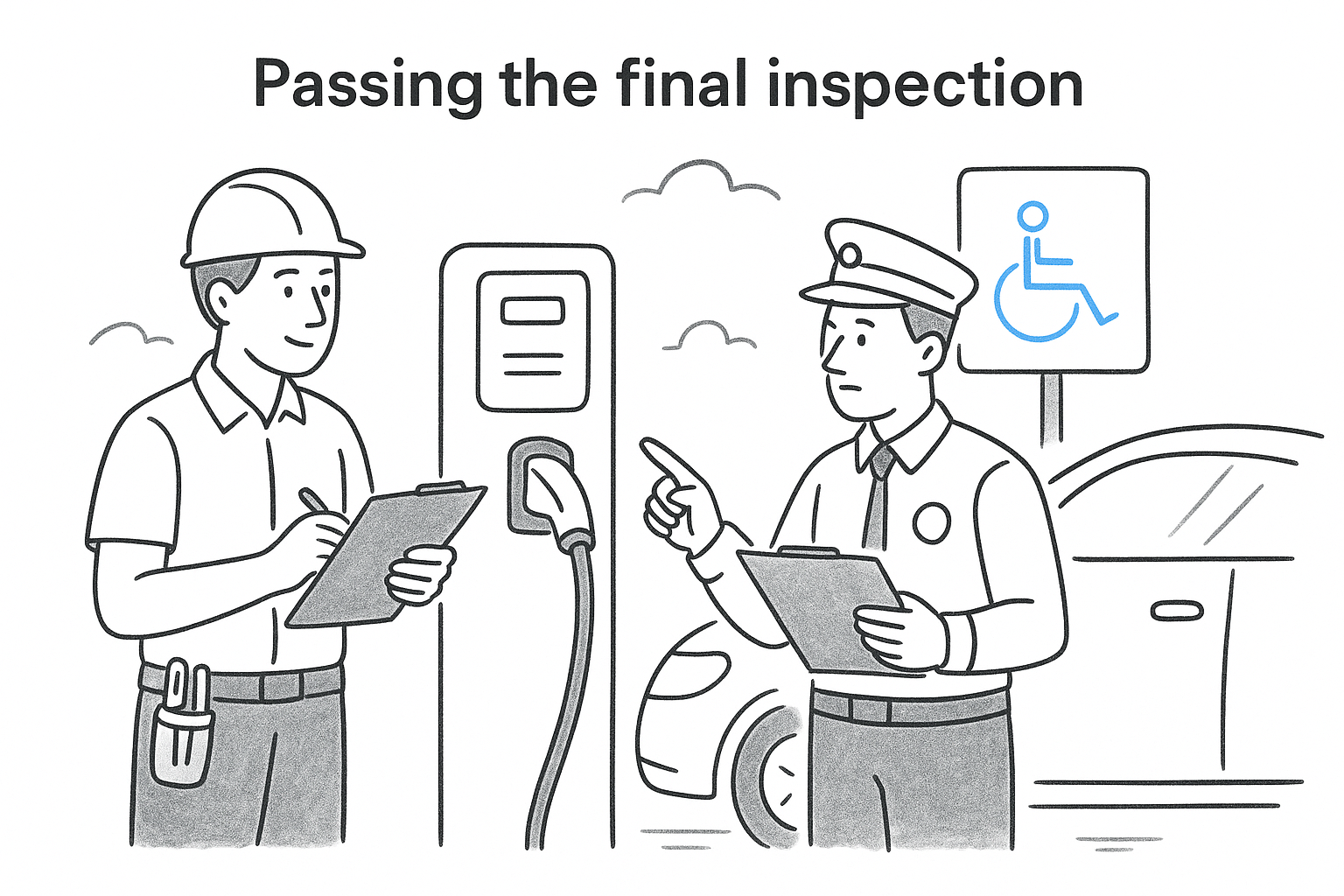
Once your crew completes the installation, a city inspector visits the site to verify that the work matches the approved permit drawings and meets code. The inspector checks conduit installation, grounding, weatherproofing, and breaker sizing. If your project includes ADA-compliant accessible charging spaces, the inspector will confirm those measurements and signage requirements as well. Only after the inspector signs off can your stations be energized and opened for use. Your contractor should handle scheduling that inspection and be present on site to answer any questions the inspector raises.
How to choose chargers and an installation partner
Selecting the right hardware and contractor determines how well your charging stations perform long after installation day. For most commercial properties, Level 2 chargers with networked management software offer the best combination of cost, reliability, and administrative control. Networked units let you track usage, set pricing, manage access, and generate reports remotely, which matters when you manage multiple spaces or need to bill tenants for energy consumption.
Matching charger type to your use case
Your property type should drive your charger selection more than any single technical specification. Workplace and multifamily properties typically benefit from Level 2 units because drivers park for several hours at a time, giving each charger enough time to deliver a full or near-full session. High-turnover retail or fleet depot locations, where drivers need maximum charge in minimum dwell time, are better suited for DC fast chargers despite the higher upfront equipment and infrastructure cost. Matching output level to actual parking behavior keeps your hardware investment efficient and avoids overspending on capacity you will rarely use.
Choose hardware that matches how long your customers or tenants actually park, not simply the most powerful option on the market.
What to look for in an installation contractor
Not every licensed electrician carries the specific experience that commercial EV charger installation services require. Look for a contractor with a current state electrical license, general liability and workers’ compensation insurance, and verifiable commercial project history in your area. Ask directly whether they handle permit applications, utility coordination, and final inspections as part of their standard scope, or whether those tasks fall on you separately. A contractor who manages the full process from initial site assessment through final inspector sign-off reduces your coordination burden and keeps your project on a predictable timeline from start to finish.
Next steps
Adding EV charging to your commercial property is a manageable project when you work with a contractor who handles every step, from site assessment through final inspection. The real risk is not the project itself but starting without a clear picture of your electrical capacity, permit requirements, and total budget. This guide gave you that picture: charger types, realistic cost ranges, permit timelines, and the specific factors that push projects over initial estimates so you can plan accurately from the start.
Your next move is to schedule a site assessment with a licensed electrician who handles commercial EV charger installation services in your specific municipality. That single conversation will tell you exactly what your property needs, what it will cost, and how long the full project will take from permit submission to energized stations. Contact AZ DC Electric to book your assessment and receive upfront pricing before any work begins.