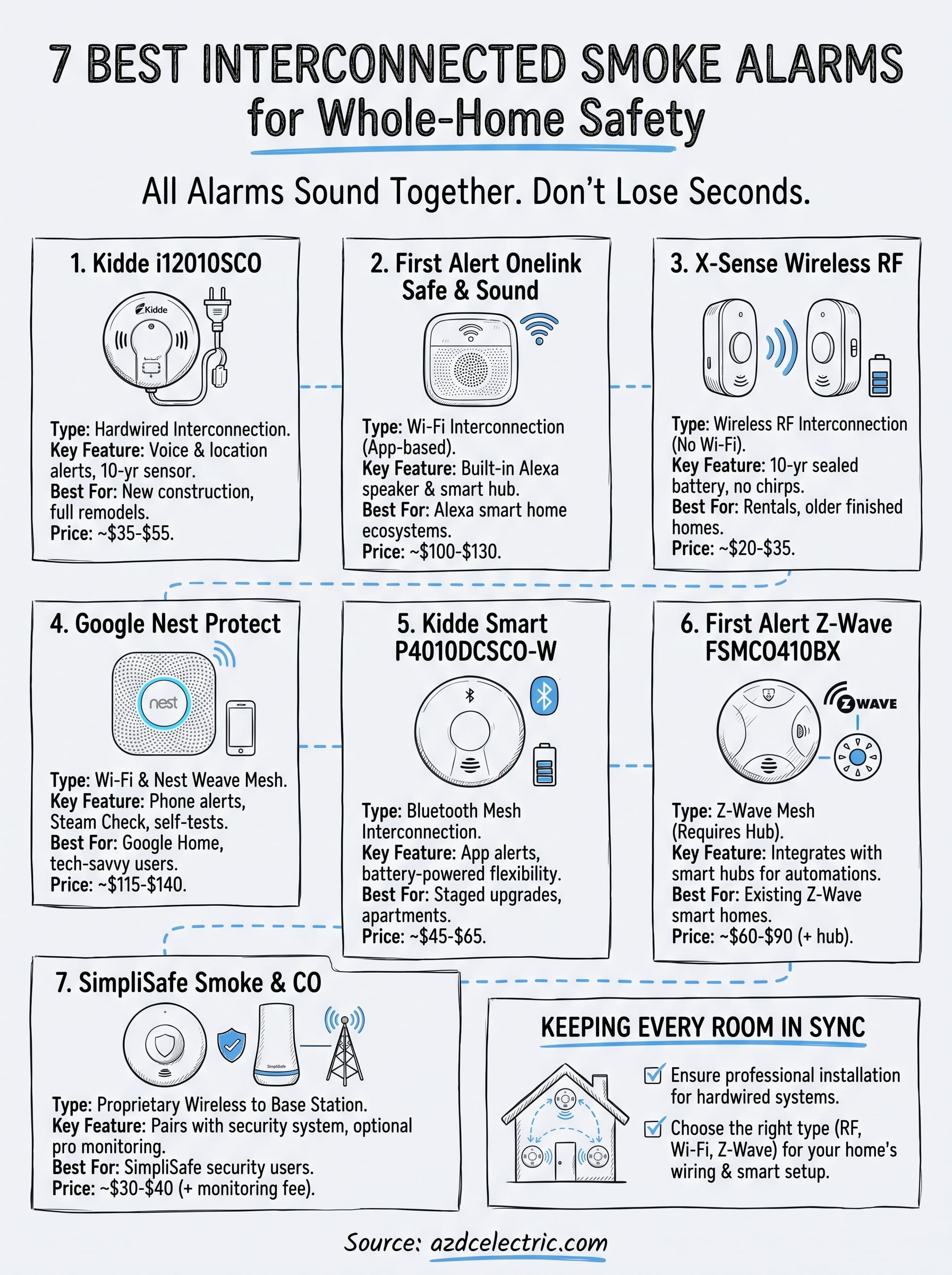
When one smoke alarm in your house goes off, every alarm should go off. That’s the whole point of the best interconnected smoke alarms, and it’s the single feature homeowners in Scottsdale, Mesa, and Chandler ask us about most after they’ve dealt with a false alarm that only woke up one room. If your current detectors work in isolation, you’re losing precious seconds during an actual fire, especially if it starts in a garage, basement, or far bedroom.
This guide gets straight to the recommendations. We’ve compared wired and wireless interconnected systems from brands we actually install and service across the Phoenix Metro Area, weighing battery life, false-alarm rates, smart-home compatibility, and how each performs during Arizona’s dust storms and triple-digit summers. You’ll see which units suit a new construction wiring project versus which ones retrofit easily into an older home without tearing open walls.
Below, we break down seven models worth your money, what separates hardwired systems from RF-connected ones, and when a simple swap makes sense versus calling in a licensed electrician for a full upgrade. By the end, you’ll know exactly which alarm system fits your home’s layout and your budget.
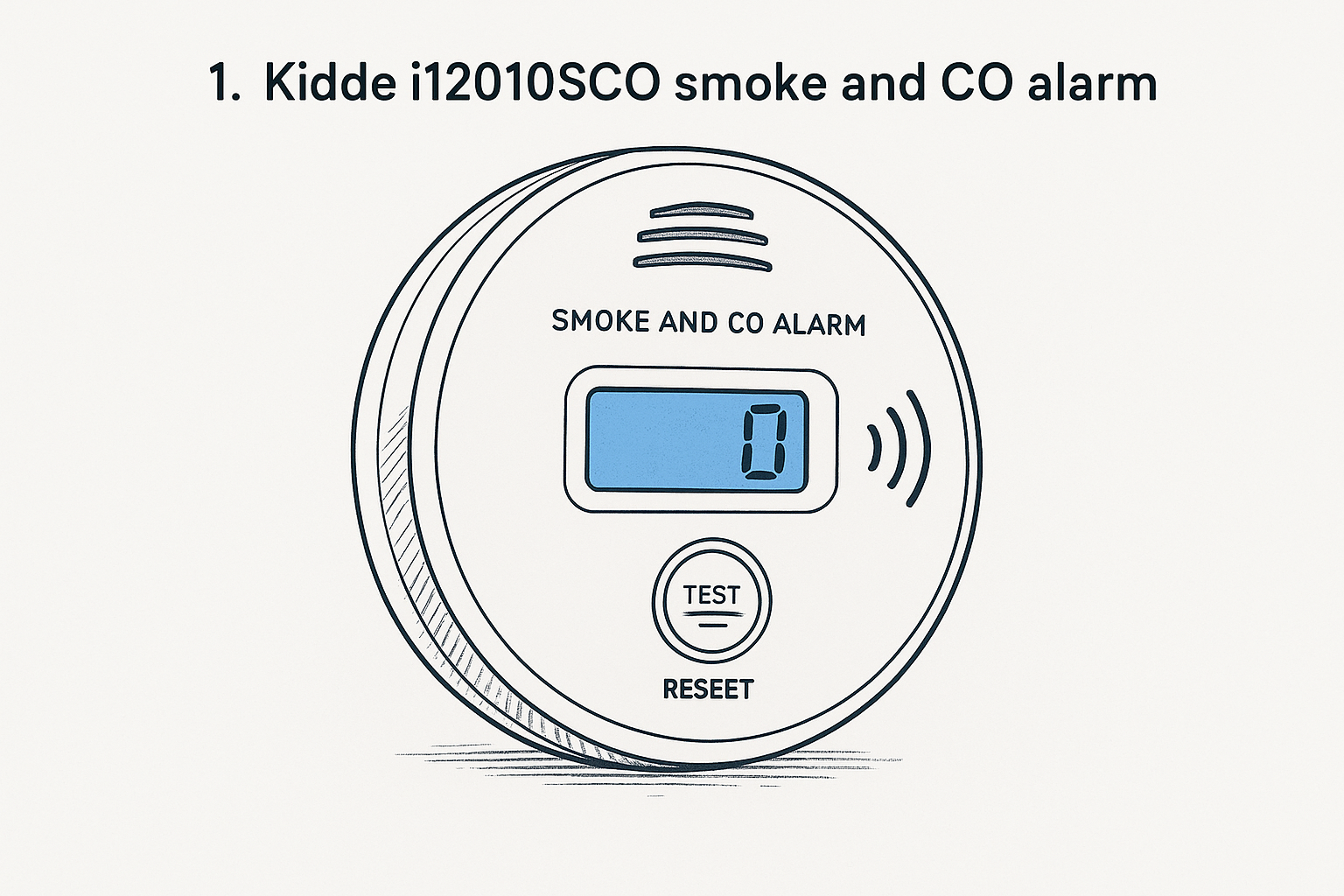
1. Kidde i12010SCO smoke and CO alarm
The Kidde i12010SCO is the alarm most electricians reach for when a Phoenix homeowner needs a hardwired smoke and carbon monoxide combo unit that just works. It’s a dual-sensor alarm, meaning it catches both smoke particles and CO buildup in one housing, which saves you from mounting two separate devices on every ceiling. We install this model constantly in new builds and full rewires because it plugs directly into your home’s 120-volt wiring and ties into every other alarm on the same circuit.
Key features
This unit uses an ionization sensor for fast response to flaming fires, backed by a 9-volt battery backup so it keeps working through a power outage. The digital display shows real-time CO levels, and a single button silences nuisance alarms without disconnecting the unit. Voice and location alerts announce which room triggered the alarm, which matters when smoke is coming from the garage and everyone else is asleep upstairs.
- Ionization smoke sensor plus electrochemical CO sensor
- 9V battery backup (up to 1 year)
- Digital CO concentration display
- Voice location alerts on interconnected units
- 10-year sensor life
Type of interconnection
This is a hardwired interconnection, meaning every alarm on the same circuit shares a dedicated interconnect wire alongside the standard power line. When one unit senses smoke or CO, a signal travels through that wire and triggers all connected alarms within seconds, no Wi-Fi or hub required.
A hardwired system doesn’t depend on your router, your app, or your phone battery to wake up the house.
That reliability is why building codes in most Arizona municipalities require hardwired interconnection in new residential construction.
Best for
The i12010SCO makes the most sense for new construction or full remodel projects where an electrician is already running wire through open walls. It’s also the right call if you’re replacing an aging hardwired system room by room and want every alarm to match. Renters and owners of finished homes without existing interconnect wiring should look further down this list at wireless options instead.
Price range
Expect to pay $35 to $55 per unit at retail, though installation cost depends heavily on whether wiring already exists. If you’re adding interconnect wiring to an older home, budget for an electrician’s time on top of the hardware, since running new circuits through finished walls takes longer than a straight swap.
2. First Alert Onelink Safe & Sound
The Onelink Safe & Sound is what happens when a smoke detector doubles as a speaker system. First Alert built this one for homeowners who already lean on Alexa or Google Assistant and want their smart home ecosystem to include fire safety instead of treating it as a separate gadget on the ceiling. It’s pricier than a basic alarm, but you’re also getting a room-filling speaker and voice assistant access built into the housing.
Key features
This unit packs a smoke sensor, CO sensor, and a 3-inch speaker capable of streaming music or answering voice commands. Amazon Alexa integration lets you ask it questions or play audio the same way you would a standalone smart speaker, and it still handles its primary job of detecting smoke and carbon monoxide.
- Photoelectric smoke sensor and electrochemical CO sensor
- Built-in Alexa voice assistant
- Bluetooth and Wi-Fi audio streaming
- App-based alerts and self-check diagnostics
- Battery or hardwired versions available
Type of interconnection
Onelink units interconnect over Wi-Fi through the First Alert app, so every alarm in the house talks to each other and to your phone without running dedicated interconnect wire. That makes it a strong fit for finished homes, though it does mean your alarms depend on a stable home network.
Wi-Fi interconnection saves you from opening walls, but it puts your fire alerts partly in your router’s hands.
Best for
Choose this model if you already use Alexa-based smart home devices and want your alarms folded into that same system. It suits remodeled homes where wiring wasn’t part of the renovation plan.
Price range
Expect $100 to $130 per unit, noticeably higher than basic hardwired alarms because of the added speaker and smart features.
3. X-Sense wireless interconnected smoke alarm
X-Sense built a reputation on affordable RF-based interconnection, and it’s the model we recommend to Chandler and Mesa homeowners who want whole-home coverage without touching a single wall wire. This alarm uses radio frequency signals instead of Wi-Fi or hardwiring, so units talk directly to each other over a dedicated wireless protocol rather than routing through your home network or an app server.
Key features
Each unit runs on a 10-year sealed lithium battery, which means no yearly battery swaps and no chirping at 2 a.m. The photoelectric sensor handles smoldering fires well, and a test button lets you silence and verify the whole network at once.
- Photoelectric smoke sensor with RF interconnection up to 40 units
- 10-year sealed battery, no replacements needed
- LED status indicators for smoke, low battery, and malfunction
- One-button silence syncs across every connected alarm
- No subscription or app required
Type of interconnection
This is a wireless RF interconnection, separate from Wi-Fi entirely. Each alarm broadcasts a short-range radio signal to every other paired unit, so when one detects smoke, all of them sound within seconds, even if your internet goes down.
RF interconnection gives you whole-home alerts without touching your home’s electrical wiring or your Wi-Fi network.
Best for
This system suits rental properties and older finished homes where running new interconnect wire isn’t practical or affordable. Property managers overseeing multiple units also like that there’s no monthly fee or app login required per tenant.
Price range
X-Sense alarms typically run $20 to $35 per unit, and a 10-pack often costs less per unit than buying individually, making it one of the most budget-friendly options on this list for covering an entire house.
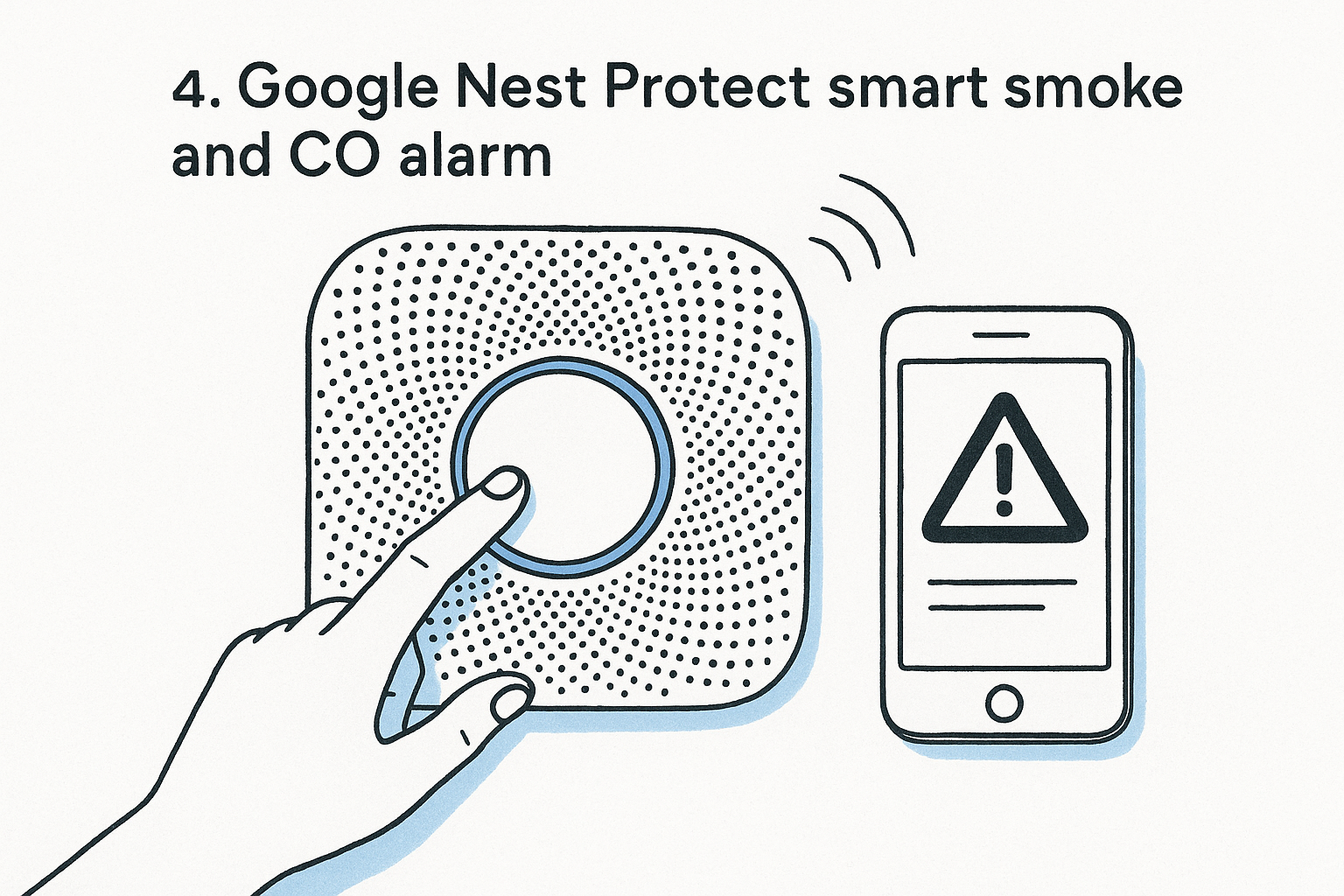
4. Google Nest Protect smart smoke and CO alarm
Nest Protect is the alarm we point tech-savvy homeowners toward when they want smart alerts without buying into a separate hub or subscription platform. Google built this unit around phone notifications and self-testing, so instead of a random 2 a.m. chirp, you get a push alert telling you exactly which sensor needs attention before the battery actually dies.
Key features
Nest Protect uses a split-spectrum sensor that reads both fast-flaming and slow-smoldering fires, which cuts down on the nuisance alarms that plague single-sensor units. A Steam Check feature recognizes shower steam and cooking smoke to skip false alarms, and the app sends a Sunday morning self-test notification instead of an unexpected midnight beep.
- Split-spectrum smoke sensor plus electrochemical CO sensor
- Steam Check reduces false alarms from showers and cooking
- Pathlight feature turns on a soft glow when you walk underneath at night
- App notifications identify the exact triggering unit and sensor type
- Battery and wired power options
Type of interconnection
Nest Protect units interconnect over Wi-Fi and a proprietary Nest Weave mesh, meaning alarms talk to each other directly even if your internet drops briefly, then sync with the app once connectivity returns.
Nest Protect pairs whole-home alerts with a phone notification, so you know which room triggered the alarm before you even leave bed.
Best for
This alarm fits Google Home households already running Nest thermostats or cameras, plus homeowners who travel often and want remote alerts when nobody’s home to hear a beeping unit.
Price range
Nest Protect runs $115 to $140 per unit, positioning it alongside First Alert’s smart lineup rather than budget RF alarms, but the diagnostics and app integration justify the price for connected households.
5. Kidde Smart P4010DCSCO-W battery combo alarm
Kidde’s Smart P4010DCSCO-W bridges the gap between the budget RF alarms above and pricier smart units, giving battery-powered flexibility without giving up whole-home interconnection. We recommend it to Scottsdale homeowners who want a step up from basic detectors but don’t want to commit to a full smart-home ecosystem or a hardwiring project. It’s one of the more practical picks among the best interconnected smoke alarms for anyone renovating one room at a time instead of the whole house at once.
Key features
Dual sensors handle both smoke and carbon monoxide in a single housing, and the alarm runs entirely on batteries, so it fits homes with no interconenct wiring already in the ceiling. A companion app sends push alerts and lets you silence alarms remotely.
- Photoelectric smoke sensor plus electrochemical CO sensor
- Fully battery-powered, no hardwiring required
- Bluetooth connection to the Kidde app for remote silence and alerts
- Voice location announcements identify the triggering room
- 10-year sealed lithium battery
Type of interconnection
This model links alarms through Bluetooth mesh networking rather than RF or hardwiring, so units within range pass the alert along phone to phone until every alarm sounds.
Bluetooth interconnection lets you add alarms one room at a time and still get whole-home alerts.
Best for
Apartment owners, condo dwellers, and anyone doing a staged home upgrade will get the most value here, since you can start with two or three units and expand later without rewiring.
Price range
Expect to pay $45 to $65 per unit, landing this model between the cheapest RF alarms and the premium smart options on this list.
6. First Alert Z-Wave FSMCO410BX
The FSMCO410BX is the alarm we suggest when a homeowner already has a Z-Wave smart home hub, like SmartThings or a security panel that supports the protocol, and wants smoke detection folded into that same system instead of running a separate app. First Alert built this unit specifically to talk over the Z-Wave mesh rather than Wi-Fi or Bluetooth, which means it plugs into whatever automation routines you’ve already set up for lights, locks, and thermostats.
Key features
This alarm pairs a photoelectric smoke sensor with an electrochemical CO sensor, and it reports status directly to your hub instead of a standalone app. You can trigger automations off of it, such as flashing smart bulbs red when smoke is detected or unlocking doors automatically during an alarm event.
- Photoelectric smoke sensor plus CO sensor
- Z-Wave Plus wireless protocol for hub integration
- Compatible with SmartThings, Vivint, and other Z-Wave controllers
- Battery backup included on hardwired versions
- Reports low battery and sensor end-of-life to the hub
Type of interconnection
This is a Z-Wave mesh interconnection, distinct from the RF systems earlier on this list because it routes through a central smart home hub rather than device-to-device broadcasting alone.
A Z-Wave alarm only performs as well as the hub and automation rules you build around it.
Best for
Choose this model if you’re already invested in a Z-Wave smart home setup and want smoke alerts tied into existing automations rather than managing a separate fire safety app.
Price range
Expect $60 to $90 per unit, plus the cost of a compatible hub if you don’t already own one.
7. SimpliSafe smoke and CO alarm
SimpliSafe rounds out this list for homeowners who want smoke detection folded into a whole-home security system instead of standing alone on the ceiling. It pairs with SimpliSafe’s base station and monitoring plans, which means a triggered alarm doesn’t just wake up the house, it can also alert a monitoring center that calls the fire department for you. We point commercial property managers toward this option when they already run SimpliSafe for burglary protection and want fire coverage under the same contract.
Key features
The alarm uses a photoelectric sensor tuned for smoldering fires, paired with a CO sensor housed in the same unit. Professional monitoring sets this model apart from the rest of this list, since a live agent can dispatch emergency services even if nobody’s home to call 911 themselves.
- Photoelectric smoke sensor plus electrochemical CO sensor
- Connects to SimpliSafe base station over proprietary wireless protocol
- Optional 24/7 professional monitoring with fire dispatch
- Battery-powered, no hardwiring required
- App alerts alongside monitoring center notifications
Type of interconnection
This system interconnects through SimpliSafe’s proprietary wireless network, routing every sensor and alarm through the base station rather than device-to-device or a general smart home hub.
Pairing fire detection with professional monitoring adds a safety net for homes that sit empty during the workday.
Best for
This alarm suits homeowners and small business owners already running SimpliSafe for security who want fire alerts and dispatch under one monitoring plan instead of juggling separate systems.
Price range
Hardware runs $30 to $40 per unit, but professional monitoring adds a monthly fee, typically $20 to $30, which pushes the long-term cost above the unmonitored alarms earlier on this list.
Keeping every room in sync
Picking one of the best interconnected smoke alarms on this list gets you halfway there. The other half is making sure every unit actually talks to the others, whether that’s through hardwired interconnect, RF, Bluetooth, Wi-Fi, or a Z-Wave hub. A single alarm that fails to sync with the rest of the house defeats the entire purpose of interconnection, and that’s the mistake we see most often when homeowners try a DIY swap on an aging system.
Code requirements around hardwired interconnection also trip up a lot of remodel projects, especially when old wiring doesn’t match what new units expect. Professional installation catches those mismatches before they become a failed inspection or, worse, a alarm that stays silent during an actual fire.
If you’re upgrading a Scottsdale, Mesa, or Chandler home and want it done right the first time, talk to AZ DC Electric about wiring your whole-home smoke alarm system correctly.